
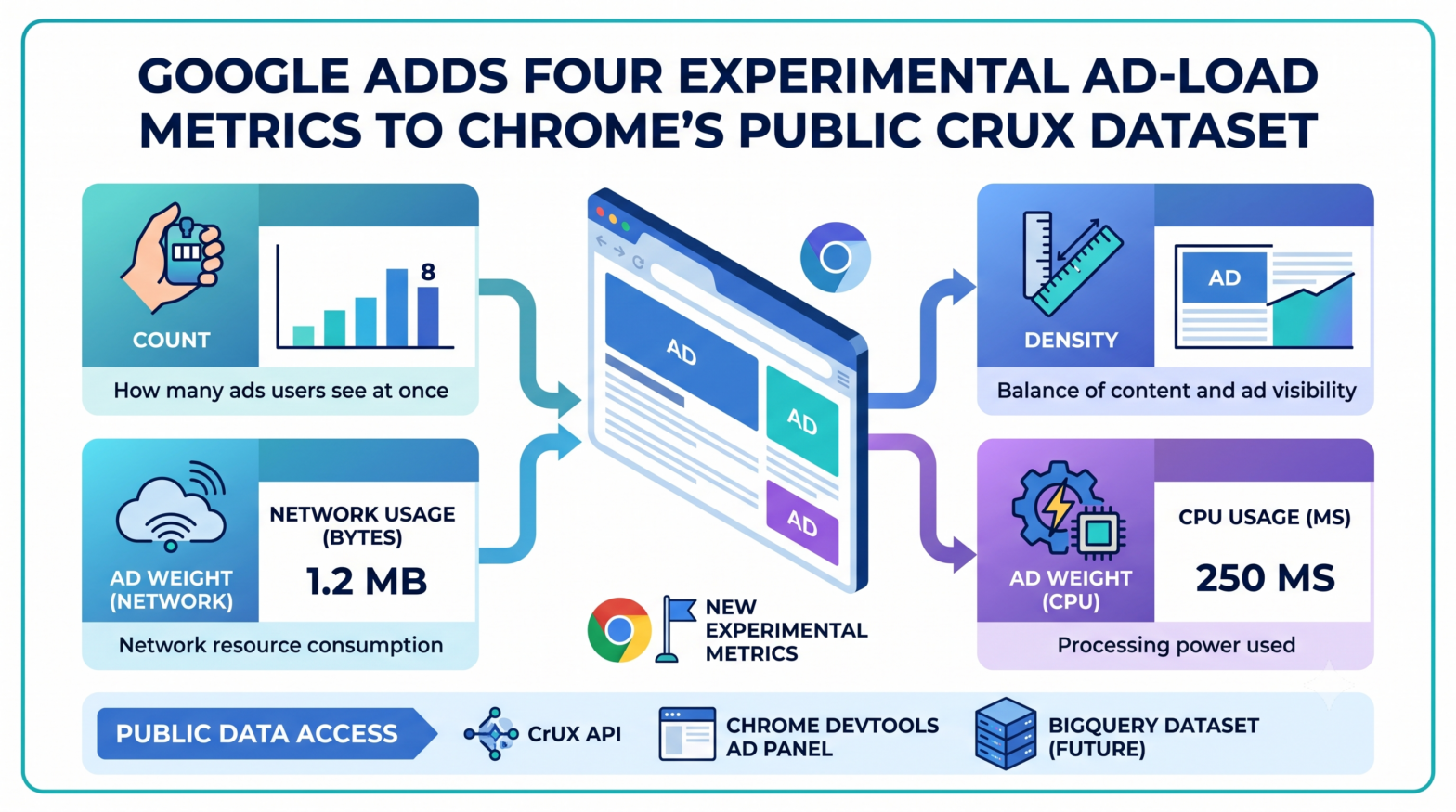
Advertisers and publishers can now access publicly reported data on how many ads users see on a given website, how much screen space those ads occupy, and how much processing power and bandwidth they consume. Google's Chrome team published four experimental advertising measurements to the Chrome User Experience Report (CrUX) on September 15, 2026, as confirmed in a blog post authored by Alex Cone, group product manager at Chrome.
Four New Measurements Now in the CrUX Dataset
Chrome added four new metrics to CrUX: Ad Count, Ad Density, Ad Weight by network usage, and Ad Weight by CPU usage. Each is drawn from real browsing sessions collected through Chrome.
Chrome publishes these experimental metrics about users' ad experiences through CrUX, reported for eligible sites at both the origin and page level. According to Chrome's official documentation, the metrics are defined as follows: Ad Count describes how many ads a typical user is seeing at once on a site. Ad Density describes a typical user's balance of content and advertising visibility. Ad Weight: CPU describes CPU consumption by ads, which can impact performance, while Ad Weight: Network describes network resource consumption by ads.
Chrome is making the data available through the CrUX API, CrUX History API, and Chrome DevTools' Ad panel. Google has also said it will add the metrics to the CrUX BigQuery dataset in the future, which would enable larger-scale analysis.
How Chrome Identifies and Measures Ads
Chrome identifies advertising using a combination of network-level filtering and script execution analysis. URLs matching Chrome's ad filter list are classified as advertising, and Chrome can also identify resources or frames created by scripts it has already classified as ad-related.
Together, the metrics cover how many ads users see on their screen, how much of the screen those ads occupy, and how much they tax a device's bandwidth, measured in bytes, and processing power, measured in milliseconds. For Ad Count and Ad Density, Chrome samples the visible viewport once per second. CPU and network usage accumulate over the user's session, with CrUX reporting results at the 75th percentile.
Aggregate CrUX reporting of these metrics is limited to sites carrying an ads.txt file that names at least one authorized seller, a condition that captures sites monetized through programmatic supply chains and excludes sites that sell directly, operate behind subscriptions, or carry no third-party advertising at all.
Scope and Eligibility Restrictions
One technical distinction affects how the data is interpreted. Chrome's local DevTools measurements can differ from aggregated CrUX results because the aggregate data is subject to site eligibility rules and reported at the 75th percentile, while DevTools captures session-level data directly.
Google is not collecting any new data to power the new metrics. CrUX, which has existed for years as Chrome's dataset for measuring real-world web performance, taps the same methodology that underpins Chrome's Core Web Vitals.
Industry Backing and Google Ads Involvement
The September 15 blog post includes statements of support from across the advertising industry. Chrome's blog post includes quotes from WPP, The Guardian, Mediavine, Index Exchange, and Adelaide.
Bill Reardon, GM of Enterprise Platform at Google Ads, is quoted in the announcement, stating that Display & Video 360 supports the initiative to bring transparency to page layout quality, and that Google looks forward to exploring with the industry how these signals can improve quality and support advertiser goals.
Alex Cone wrote in the announcement that Google "expects these metrics to be particularly useful for web advertisers and the services they use to place ads."
On the question of data access equity, Cone confirmed that DV360 and Google Ads will not have preferential access to the new CrUX data. This point carries particular weight given the ongoing proceedings in Google's ad tech antitrust case.
No Thresholds Set, No Core Web Vitals Status
The new ad metrics are not technically part of Core Web Vitals, and Chrome is not setting benchmarks; Cone stated there are "no plans" to do so. Core Web Vitals, by contrast, give publishers specific suggested targets and thresholds that categorize user experiences as "good," "needs improvement," or "poor."
Google did not disclose whether DV360 is currently testing the signals for inventory evaluation, bidding, or reporting. Each of the four metrics is labelled "experimental" in the CrUX dataset, signalling that Google remains open to community feedback and may evolve the measurements over time.
Practical Implications for Digital Marketers and Publishers
For media buyers, the availability of CrUX ad metrics introduces a new category of publicly accessible data that can be queried per site when evaluating programmatic inventory. Publishers with lower ad density and lighter resource loads now have a data point they can reference in direct sales conversations. Because the metrics are reported at the 75th percentile and are restricted to programmatic supply, sites with an authorized seller in ads.txt, they are most immediately relevant to teams operating within open-auction environments. Neither Google nor any third party has established what constitutes an acceptable or poor result for any of the four metrics, meaning interpretation currently requires context and judgment rather than a fixed benchmark.
Barry Pollard, who works on web performance at Google, described the release as: "These metrics are a set of ad-related measurements that provide transparency into sites' ad experiences."