
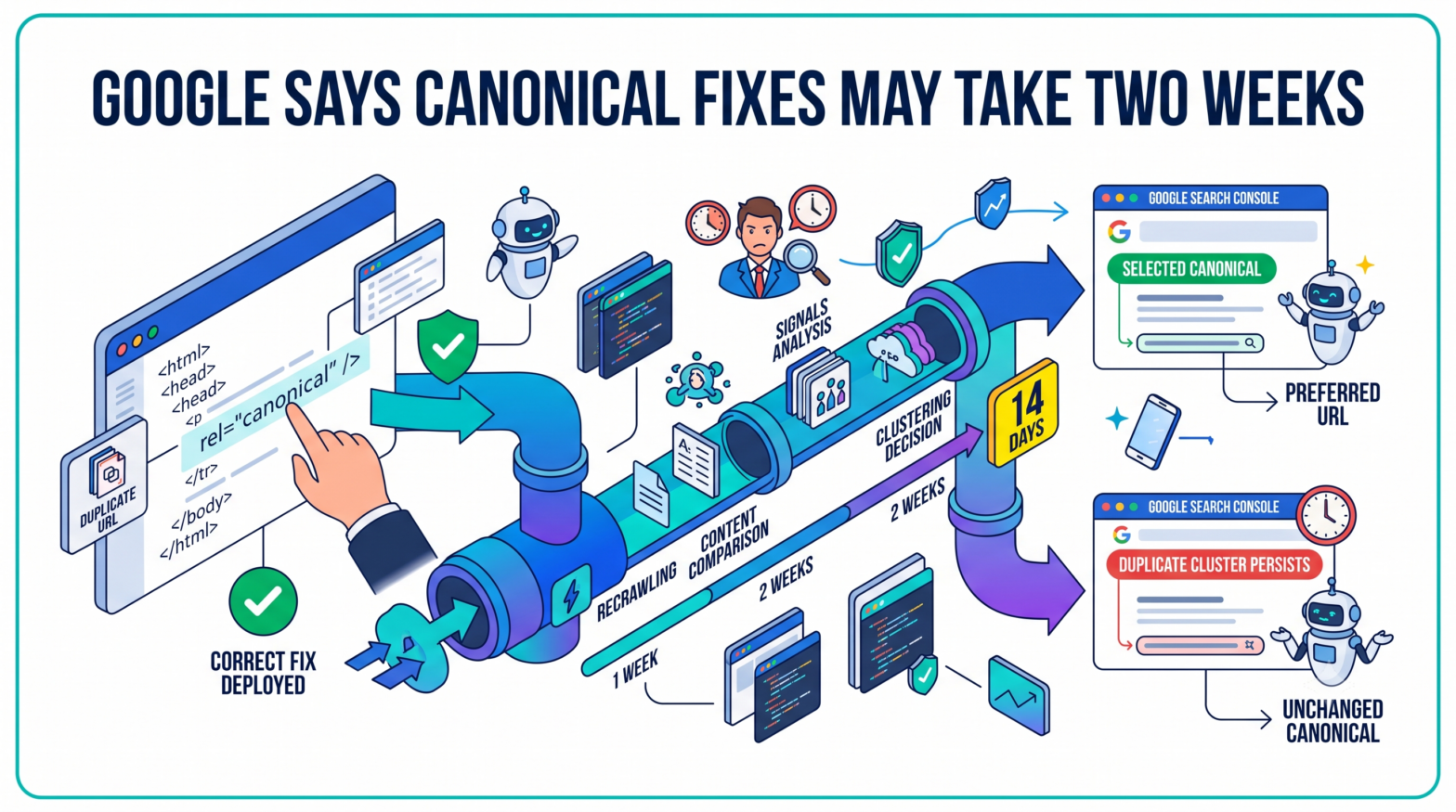
Fixing a canonical tag does not mean Google will recognize the correction tomorrow.
Google has updated its canonicalization troubleshooting guidance to warn that pages may remain grouped as duplicates for up to two weeks after site owners resolve the underlying problem. The clarification gives SEOs a firmer timeline for judging whether a repair failed or Google simply has not finished processing it.
A Correct Fix Can Still Look Broken in Search Console
Google added the timeline clarification to its Search Central documentation on July 10, 2026. The company said the change was intended to set better expectations about how long canonicalization updates take to appear.
The revised guidance explains that Google may continue holding pages in the same duplicate cluster for as long as two weeks, even after content or technical issues have been corrected. Pages are generally separated faster when Google can detect a clear and substantial difference between them.
That distinction matters during technical SEO audits.
A site owner may remove an incorrect canonical tag, rewrite a duplicated page or repair a redirect, then check the URL Inspection tool a few days later. If Google still shows another address as the selected canonical, the natural conclusion is that the repair did not work.
Google is now telling site owners that conclusion may be premature.
Canonicalization requires more than processing a line of HTML. Google must recrawl the affected URLs, compare their content and signals, reconsider how the pages are clustered, and decide which version should represent the group in Search.
Until that process is complete, Search Console can continue reflecting the earlier canonical selection.
Canonical Tags Remain Signals, Not Commands
The documentation update does not change how canonicalization works.
Site owners can identify a preferred URL using a rel="canonical" element, redirects, sitemap inclusion and consistent internal linking. Google considers those signals together, but it can still choose a different canonical URL when its systems believe another page is more suitable for searchers.
Google recommends using the URL Inspection tool in Google Search Console to compare the user-declared canonical with the URL selected by Google.
A mismatch does not automatically indicate an error.
Before changing anything, Google advises site owners to consider whether the selected page may genuinely be the stronger representative. Content quality, duplication patterns and conflicting technical signals can all influence the decision.
A product page might identify itself as canonical while its content is nearly identical to a broader category page. Local service pages may each point to themselves but contain only city-name substitutions. Parameter URLs may remain internally linked across hundreds of pages despite canonical tags directing Google elsewhere.
The tag says one thing. The wider site architecture says another.
Google’s systems are not required to accept the tag in isolation.
Small Content Edits May Not Break a Duplicate Cluster
The most consequential part of Google’s clarification concerns content similarity.
Google says resolving canonicalization issues technically depends on making pages grouped together as duplicates “sufficiently different.” Pages are more likely to leave a duplicate cluster quickly when the differences are clear and significant.
That creates a problem for sites built around near-identical templates.
Changing a page title, introductory paragraph or location name may not give Google enough evidence that two URLs serve separate purposes. The pages can remain clustered even when every canonical element is technically correct.
This is common across ecommerce filters, franchise sites, property listings, service-area pages and large publishing archives.
An ecommerce site may create separate URLs for products that differ only by colour. A national business may publish dozens of location pages using the same services, testimonials and FAQs. A publisher may distribute substantially similar versions of an article across several domains.
These are not always improper configurations. They do, however, give Google less reason to treat every URL as independently valuable.
Older approaches to duplicate content in SEO often focused heavily on placing canonical tags across repeated pages. Google’s current troubleshooting language places more emphasis on whether the pages themselves are meaningfully distinct.
A technically valid canonical setup cannot manufacture differentiation that the content does not contain.
Request Indexing Is Not a Site-Wide Reset Button
Google says site owners can request indexing after fixing a canonicalization problem, but it recommends reserving the feature for important URLs because requests are subject to quotas.
The tool asks Google to revisit a page. It does not force an immediate canonical decision.
For a small group of commercially important URLs, requesting indexing may help Google discover corrected content or signals sooner. Submitting every filtered page, regional variant or duplicate URL individually is unlikely to be a practical recovery strategy.
Large-scale problems still need large-scale fixes.
Incorrect templates should be corrected at the content management system level. Internal links should consistently point to preferred addresses. Redirect chains should be cleaned up. XML sitemaps should contain canonical URLs rather than every crawlable variation.
Sites dealing with index bloat may also need to determine whether certain URLs should remain indexable at all. A canonical element and a noindex directive solve different problems, and combining conflicting controls can make diagnosis harder. TechWyse’s guide to strategic indexation with noindex tags outlines how low-value URLs can be excluded when they do not warrant independent search visibility.
Once a broad fix is deployed, recrawling and reprocessing will still occur on Google’s schedule.
The Wrong Canonical May Point to a Deeper Failure
Google’s troubleshooting guide lists several reasons its selected URL may differ from the site owner’s preference.
Some content management systems and plugins insert incorrect canonical elements or direct them to unintended URLs. Server configuration problems can cause one domain to return another site’s content. Hacking can introduce malicious redirects or cross-domain canonical tags. Missing hreflang annotations may also prevent Google from understanding regional pages that contain substantially similar material.
Syndicated content presents a separate complication.
Google says canonical tags are not its recommended solution when publishers want to prevent syndication partners from competing with an original article. Because syndicated pages may differ considerably, Google recommends that partners block their copies from indexing instead.
Copycat sites can also become selected canonicals in rare cases. When content has been reproduced without permission, Google directs rights holders toward contacting the host or filing a copyright removal request rather than relying only on canonical markup.
These cases show why waiting two weeks should not become the default response to every canonical discrepancy.
A delay is reasonable after a verified repair. Waiting will not correct a hacked website, broken CMS template, server error or contradictory set of indexing signals.
SEO Teams Need a Longer Validation Window
For marketers and SEOs, the practical change is in how canonical fixes are monitored.
Teams should record when a repair was deployed, confirm that Googlebot can access the affected pages and inspect the rendered canonical element. The URLs can then be checked periodically over the following two weeks rather than repeatedly altered after every unfavourable Search Console inspection.
That waiting period should not prevent further investigation when technical signals remain inconsistent. It should prevent unnecessary reversals when the implementation is sound but Google has not completed re-evaluation.
The clarification also changes how agencies report progress.
A canonical issue marked “fixed” in a development ticket may remain unresolved from Google’s perspective for several days. Reporting should distinguish between an implemented correction and a confirmed change in Google’s selected canonical.
Google did not announce a new canonicalization system or ranking change. It documented the delay already built into its processing.
The new benchmark is now explicit: after a legitimate fix, duplicate clustering can persist for up to two weeks.