
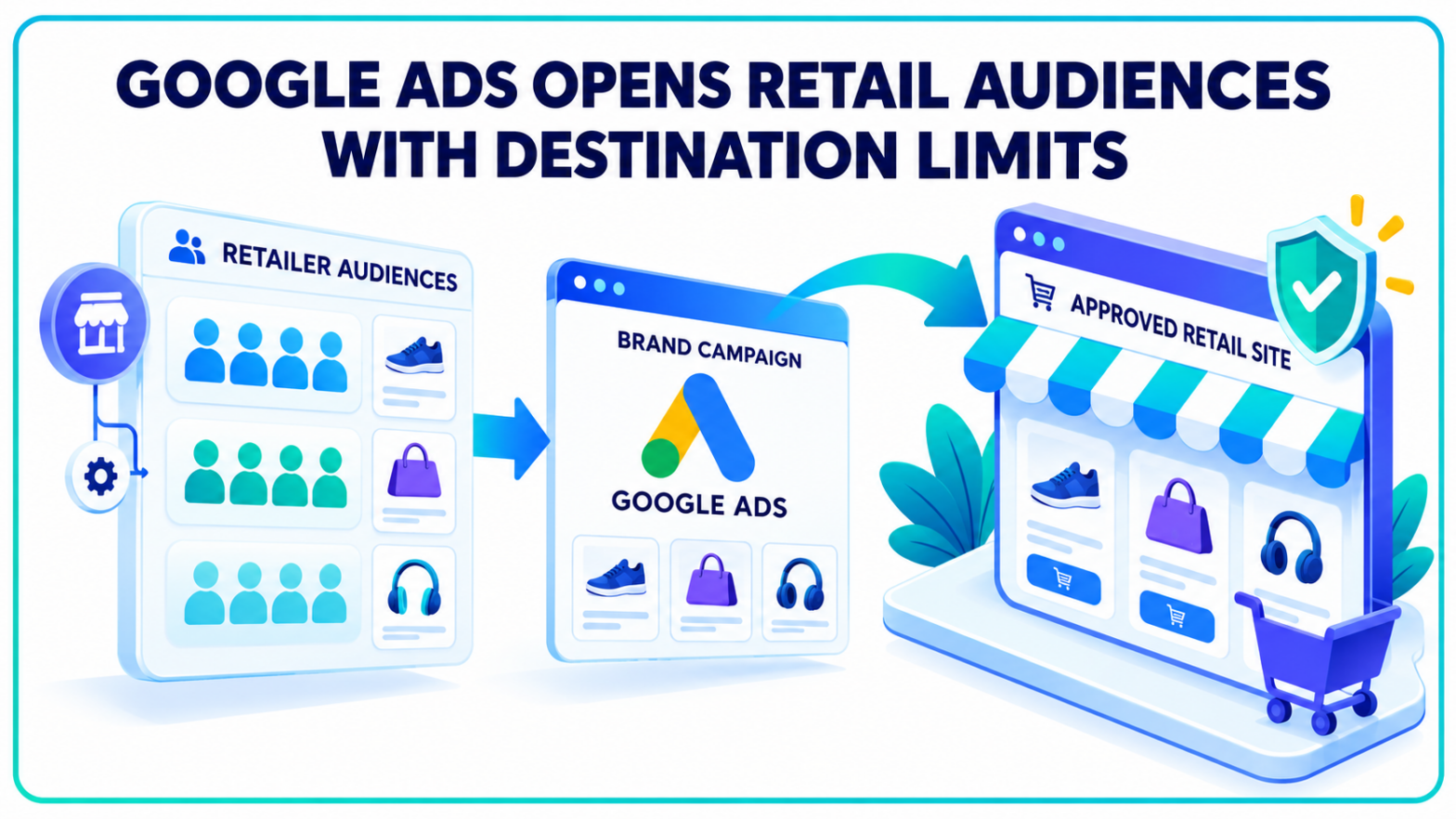
Brands can reach a retailer’s audience through Google Ads. The traffic must go back to the retailer.
Google’s commerce audience sharing feature allows retailers and marketplaces to make selected audience segments available to advertising partners. Access is limited to eligible commerce media campaigns, with the commerce partner controlling the approved destination.
The arrangement connects brand advertising with the business that holds the shopper relationship, product catalogue and checkout. For advertisers selling through retail partners, the central question is where those campaigns can operate—and which sales they can measure.
Retail Media Access Depends on the Merchant Relationship
Google places audience sharing within its broader commerce media offering, which connects brands and sellers with participating retailers and marketplaces. Those relationships allow commerce partners to selectively share product feeds, conversion information and audience data for advertising activity.
That infrastructure matters because the advertiser and the seller handling the transaction may be different businesses. A manufacturer can fund a campaign for its products while the purchase takes place on a retailer’s website.
Google’s commerce media documentation describes product-level performance reporting for advertising partners and visibility into individual partner campaign performance and spending for commerce partners. It also supports both self-service advertising and campaigns managed through the commerce relationship.
The audience capability extends a retail media framework that already connects retailer data with Google advertising inventory.
Availability remains restricted. Google says its commerce media suite is accessible only through participating merchants, with advertisers directed to their commerce partner or Google account team to confirm access. The documentation does not establish universal availability for every retailer or advertiser account.
Search and Performance Max Fit Inside the Commerce Setup
The restriction to commerce media campaigns needs a precise reading.
Google’s campaign setup guide lists Performance Max, Search, Standard Shopping, Demand Gen and Video as supported campaign types. These familiar formats can operate within commerce media when the required partner setup is in place.
During campaign creation, advertisers select the partner’s website as the destination and confirm the relevant Merchant Center and data-sharing accounts. They then choose the purchase and add-to-cart conversion goals configured by the commerce partner.
The distinction is between campaign format and campaign eligibility. A Search or Performance Max campaign can qualify through the commerce workflow; an existing campaign does not gain access simply because it uses a supported format.
Google also instructs advertisers to disable text customization and Final URL expansion where those settings apply, and to use their storefront on the commerce partner’s website as the asset’s final URL. App promotion and local store visits and promotions objectives are excluded from the setup.
The destination requirement is therefore part of campaign construction, alongside the product source and conversion goals.
Retailers Choose Which First-Party Data Segments Travel
Audience sharing begins with segments already held in the commerce partner’s data-sharing account. Through Audience Manager, the partner selects segments and chooses which actively linked advertising partners receive access. Sharing can also be stopped through the same interface.
Brands can combine those shared audiences with their own customer segments, subject to the approved destination. Both participants must meet the applicable requirements for the audience type, including Customer Match eligibility when that feature is used.
The source and classification of first-party data remain relevant to how an audience is interpreted. Access to a retailer segment does not establish that its members are new customers of the brand.
Google’s separate Customer Match policy requires good policy compliance and payment history. It also requires appropriate privacy disclosures and consent where applicable law or Google policy demands it. Customer information uploaded through Customer Match must have been collected in a first-party context.
Those existing Customer Match rules remain part of the audience-sharing arrangement. A commercial partnership does not replace the underlying data-use requirements.
Two Account Links Connect Products With Purchases
Audience access depends on account connections as well as retailer permission.
Google’s account-linking instructions require the advertising partner’s Google Ads account to connect with the commerce partner’s Google Ads data-sharing account and Merchant Center account. Advertisers should receive two linking requests, with administrator access required to submit and accept them. Google Ads manager accounts cannot be linked to a marketplace.
The connections serve different purposes. Merchant Center supplies the relevant product information; the data-sharing relationship supports the conversion information used by the commerce campaign.
Accepting the data-sharing link creates conversion actions, such as purchases reported by the partner. Google explicitly states that accepting these requests does not give the commerce partner direct access to the advertiser’s Google Ads account. Existing links can be reviewed or removed in Data Manager.
For marketers, the practical implication is that retailer-directed advertising needs its own measurement context. Campaign spending, available products, landing destinations and partner-reported purchases must be read together. A sale completed through a retailer represents a different transaction path from a purchase on the brand’s own website.
Reporting Visibility Runs in Both Directions
The partnership also determines who can see campaign results.
Google’s commerce data-sharing documentation says advertising partners can access retailer product and conversion performance information, alongside specified commerce account details. Commerce partners receive advertiser account details and performance and spending metrics for campaigns sending traffic to their websites, including impressions, clicks and conversions.
That reporting gives both businesses visibility into advertising tied to the retail destination. Access to performance information is distinct from direct account access.
Google’s audience-sharing documentation also specifies that advertisers can see shared segment details, including names, customer types, list sizes and membership status. The commerce partner decides which audiences are made available.
The published guidance defines account connections, campaign setup and data visibility. It does not provide an audience-sharing-specific performance benchmark or a dated rollout schedule. The broader commerce media offering remains limited to participating merchants.