
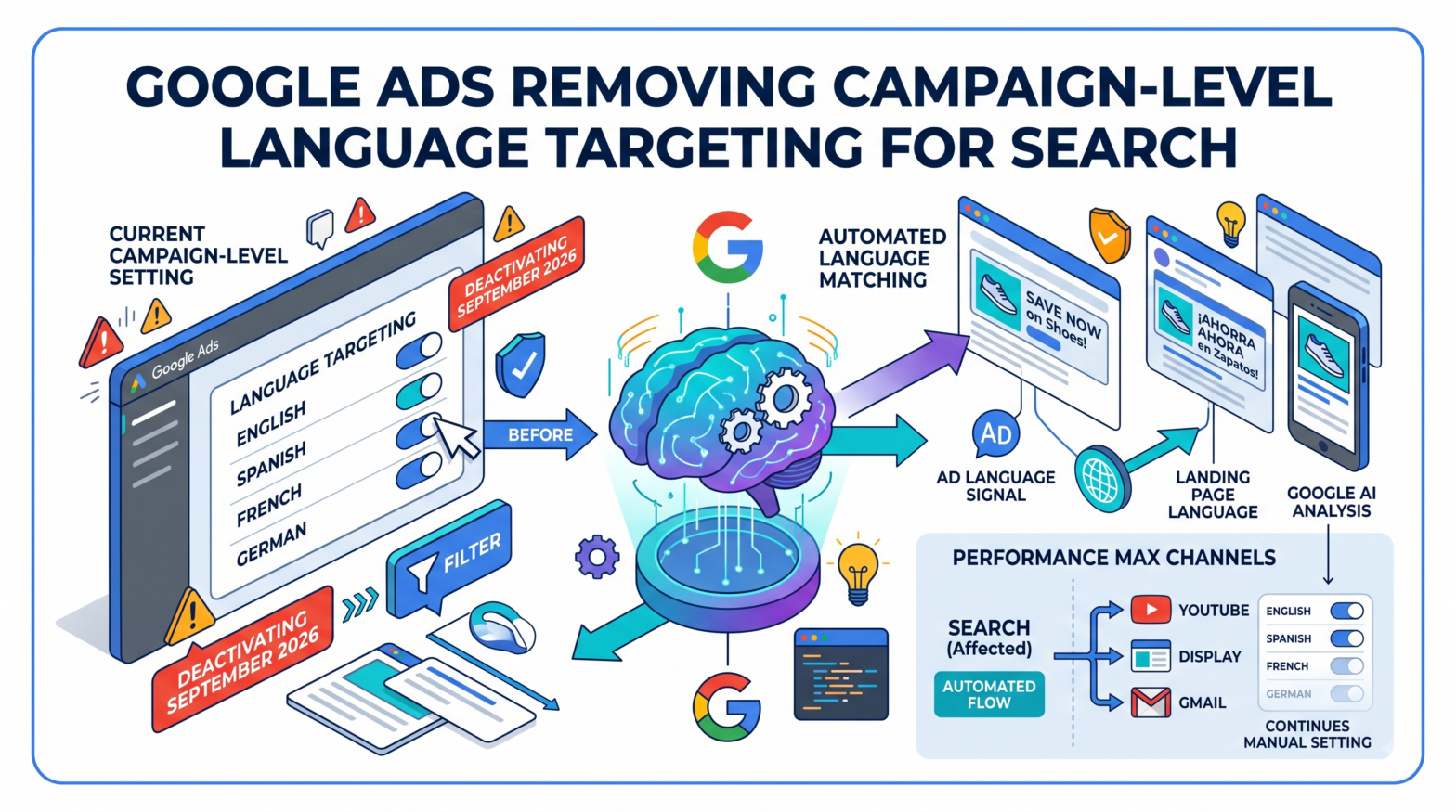
Google Ads advertisers will lose the ability to manually set language targeting at the campaign level for Search campaigns beginning in late September 2026. The announcement came from Ginny Marvin, Ads Product Liaison at Google, in a post published on LinkedIn on August 14, 2026. Google's official "About language targeting" help document, updated to reflect the September 2026 timeline, confirms the campaign-level language targeting setting will be removed and that Search ads will automatically match based on the language of the ads themselves.
What Google Is Removing
Currently, Google uses both campaign settings and its own language signals to determine whether a Search ad is eligible to serve. Advertisers select one or more target languages at the campaign level, and Google cross-references that selection with its own signals about what languages a user understands, including query language, browser settings, and search history.
Starting in late September, the campaign-level language setting will be removed for Search and AI Max for Search campaigns, and Google will instead rely on the language of the creative and landing page, along with its existing understanding of the languages a user knows. This closes out a removal the company first scheduled for the end of 2025, representing a delay of roughly nine months from the original target date.
How Performance Max Is Affected
The change applies differently across Performance Max channels. For Performance Max campaigns, the campaign-level language setting will no longer apply to ads shown on the Google Search Network; those will function like standard Search campaigns, but language settings will continue to apply to other channels within Performance Max, including YouTube, Display, Discover, and Gmail. Shopping ads within Performance Max are not affected by language settings.
How Google Will Determine Language Matching
The update also changes how Google handles accounts where more than one language is eligible. If Google determines that a user understands both English and Spanish, for example, ads in either language could qualify. Google's AI-based ad group prioritization will then determine which language is the stronger match for a given search.
When a search query has a clear language signal, Google will prioritize an ad and landing page in that language when an eligible option exists. For branded queries, where a brand name may be identical across languages, Google will use ad language and its own signals about what users understand, which could create less predictable delivery for multilingual campaigns.
Advertisers using the Google Ads API are also affected. Google recommends that developers stop sending language criteria when creating or updating Search campaigns. Existing language criteria can remain in place but will no longer influence Search targeting.
Compliance and Reporting Gaps
The removal introduces an unresolved question for advertisers in regulated industries. Advertisers in sectors such as insurance have raised the issue of how they can document equitable ad delivery across language groups when Google, rather than a campaign setting, determines language eligibility for each user. Google has stated that providing ads in both English and Spanish signals advertiser intent to reach both audiences, but has not announced additional language-level reporting that would show which language was served or how performance differed by language.
That reporting gap is particularly relevant for advertisers who rely on language settings not just for audience matching, but for internal or regulatory compliance documentation.
AI Max and Multilingual Creative
Language targeting is not disappearing entirely from Performance Max, since language settings can still influence its non-Search channels. However, a separate question applies to AI Max campaigns with auto-generated creative. If AI Max generates French-language creative based on campaign inputs, such as for a campaign targeting Quebec, that ad could serve when a user searches in English, provided Google determines the user understands French. Creative generation occurs first; language comprehension checks are applied afterward. The language of the query does not need to match the language of the ad.
What This Means for Canadian and Multilingual Advertisers
For advertisers managing campaigns that span English and French audiences in Canada, or English and Spanish audiences in the United States, the practical implications centre on creative hygiene and post-launch monitoring rather than campaign restructuring. Google states that no action is required by advertisers for this change. Accounts that currently separate campaigns by language do not need to be merged or restructured; Google will use the language of the ads and landing pages as its primary matching signals.
The accounts that warrant closer review are those using language targeting beyond its standard function. Advertisers who have historically relied on the campaign-level language setting to control audience eligibility, support compliance documentation, or limit exposure to certain language segments should assess what automated matching will replace, and what it will not, before the change takes effect in late September.
Advertisers should review campaign structures, creatives, and landing pages and closely monitor performance once the change rolls out. Traffic pattern changes after rollout, including shifts in search terms, geographic distribution, and the language composition of incoming users, will be the clearest indicator of whether Google's automated matching behaves consistently with the prior manual setting.
Marvin wrote:
"Starting in September, Google Ads will be removing the language targeting setting for Google search ads in Search and PMax campaigns."