

Google Ads retailers can now tell automated bidding which products matter most to their business, not just which ones sell. Google confirmed Product Value Optimization as part of its Google Marketing Live 2026 announcements on May 20, with the beta appearing in advertiser accounts as of mid-September 2026.
What the Beta Does
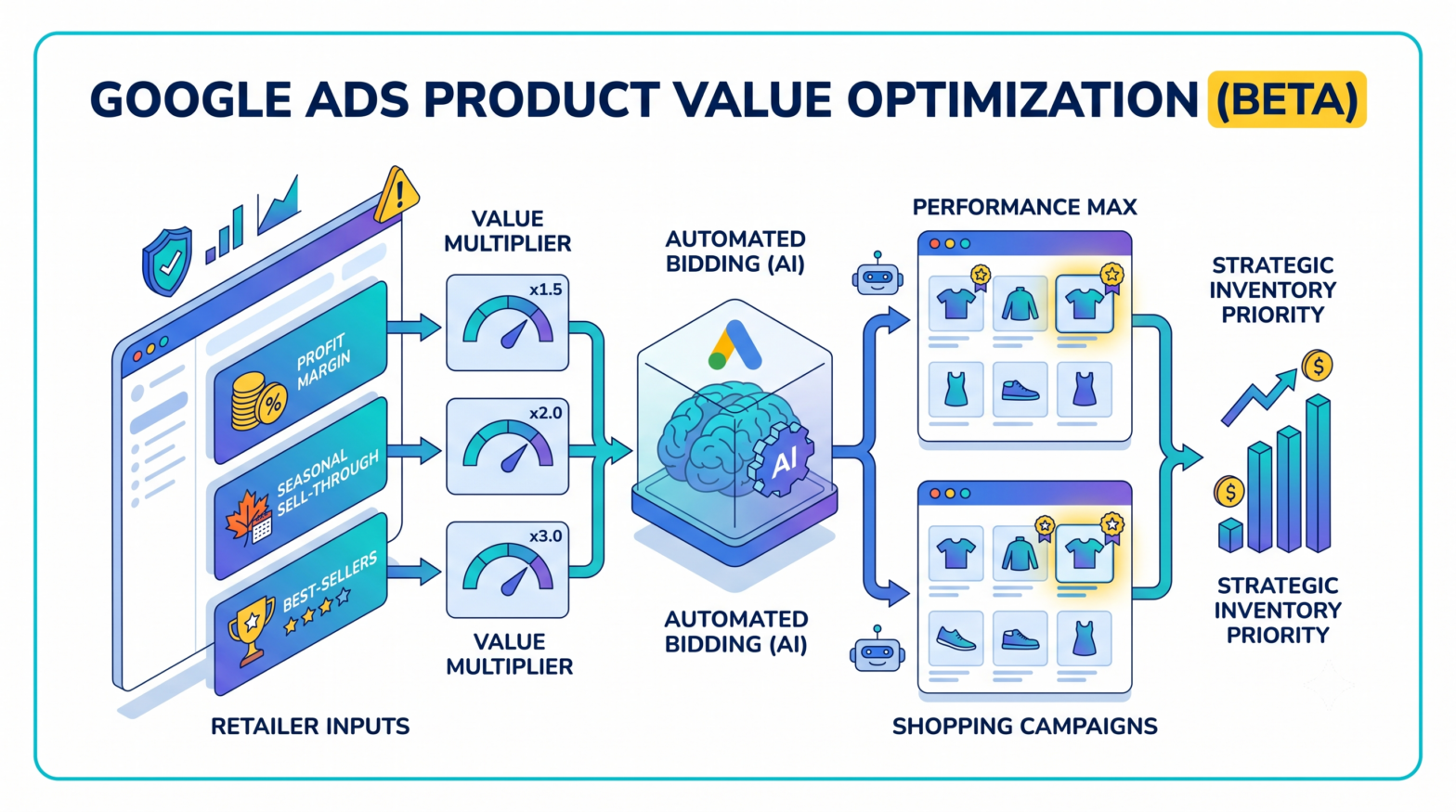
The feature allows advertisers to configure value adjustments to guide automated bidding to optimize for the products that matter for their business goals. As described on Google's Accelerate with Google announcement page, it works by letting advertisers align ad spend with true business value by strategically adjusting conversion values for specific products based on product priorities.
Rather than applying a uniform conversion value across a product catalogue, advertisers can assign multipliers to individual products or product attributes to signal relative importance to Google's bidding systems.
How Adjustments Are Applied
Advertisers can create adjustments to optimize toward goals such as profit, seasonal sell-through, or best-sellers, and apply them across products and attributes like brands and categories without altering campaign structure. The bidding adjustments operate in real time within Performance Max and Shopping campaigns.
The setup allows advertisers to create product-level value adjustments, use product attributes to define which products matter more, multiply conversion value for selected products, and apply adjustments at the campaign level rather than the account level.
Campaigns in Scope
The beta targets two of Google's primary retail campaign types. Advertisers can apply adjustments based on products and attributes such as brands or categories without having to restructure their campaigns, and Google's automated bidding can then use those adjusted values when optimizing Performance Max and Shopping campaigns.
Stated Use Cases
Google's announcement identifies three primary scenarios where the feature adds value. A retailer could place greater value on products with higher profit margins, prioritize seasonal inventory it needs to sell through, or put more emphasis on best-selling products.
The feature also presents an alternative path for retailers wary of sharing sensitive financial data. Google recently announced profit optimization bidding, which requires advertisers to upload actual gross margin data directly into Google Merchant Center. Many businesses are either hesitant or unable to share backend financial data. Product value adjustments offer a flexible alternative, letting advertisers guide the AI toward high-margin items using proxy multipliers without exposing exact financial data.
Where the Feature Stands
The beta was first publicly noted by Google Ads marketer Adriaan Dekker, who posted about it on LinkedIn in week 37, writing that "Google Ads is testing something pretty interesting, Product value optimization (BETA)." The feature's listing on Google's Accelerate with Google portal places it among the full list of product announcements from Google Marketing Live 2026. No broad availability date has been confirmed by Google.
What This Means for Retail Advertisers
Standard Smart Bidding treats reported conversion values as equally weighted signals. Product Value Optimization introduces a layer of business context above that baseline, allowing retailers to push bidding toward inventory that aligns with commercial priorities beyond raw revenue, such as margin contribution, sell-through rate, or strategic product positioning. The practical effect depends directly on the quality and accuracy of the rules advertisers configure; adjustments based on a product being a bestseller do not necessarily reflect incremental profitability, and miscalibrated multipliers could steer spend away from genuinely high-value outcomes. Advertisers with access to the beta should validate adjustments against actual business performance data before scaling.
Google's announcement states that automated bidding will optimize for outcomes based on the rules advertisers set, applying them across products and attributes like brands and categories without requiring campaign restructuring.