

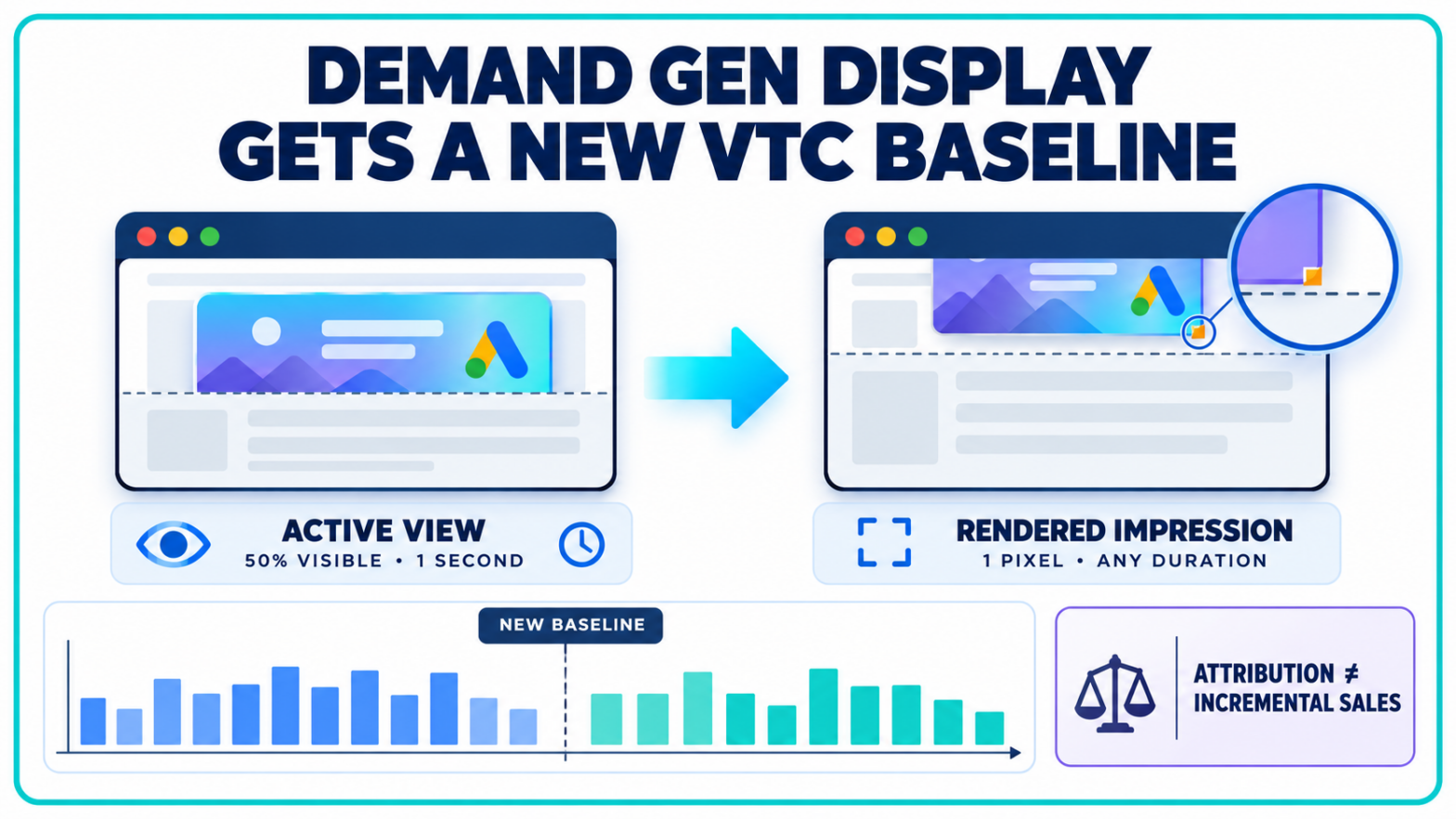
A stronger conversion report does not always mean more customers. Google is lowering the threshold for an ad view to receive conversion credit on Display inventory within Demand Gen, creating a break in how those results can be compared over time.
Display ads in the campaign type are moving from Active View criteria to a rendered ad impression definition for view-through conversion attribution. Google says eligible campaigns will transition automatically over the coming weeks, without advertisers changing their campaign settings.
Demand Gen Results Cross a Measurement Boundary
For advertisers, the immediate issue is continuity. A campaign reporting more conversions after the transition will be using a different test for which ad impressions can receive credit.
Under the rendered impression definition, at least one pixel of the ad must appear on-screen, for any amount of time. Google's current Demand Gen view-through conversion documentation describes that threshold.
The change broadens the exposure that can qualify for attribution. It does not establish that people spent longer looking at the creative, visited the website more often or made additional purchases.
That distinction matters in recurring agency and in-house reports, where a monthly conversion total often becomes the starting point for a budget discussion. An upward movement across the transition cannot, by itself, establish that campaign performance improved. The definition of the qualifying exposure has changed alongside the reported result.
One Pixel Replaces the Active View Test
Active View applies visibility and duration requirements. According to Google's viewability standards, a standard display ad qualifies as viewable when at least half its area is visible for one second. Large display ads covering at least 242,500 pixels use a 30% visibility threshold for the same duration. Video ads require at least half their area to be visible during two seconds of playback.
The rendered impression definition does not require those percentages or durations.
A small portion of an ad appearing briefly on-screen can therefore qualify under the new attribution rule even when it would not meet the standard Active View test. That is a difference in measurement eligibility, rather than evidence about how much attention the ad received.
Even Active View does not prove that someone looked at an ad. Google explicitly distinguishes the opportunity to see an impression from a guarantee that the user was looking at the screen.
The reporting change brings Demand Gen Display VTC attribution onto a lower exposure threshold. It should not be read as a new definition of a viewable impression across all Google advertising products.
View-Through Conversions Still Require a Customer Action
A qualifying impression is only one part of a view-through conversion. The customer must subsequently complete a tracked conversion within the applicable window, without the ad interaction that would give another event priority.
Google's view-through conversion explanation distinguishes these outcomes from conversions following an interaction with an ad. The later action might be a purchase or another event the advertiser has configured to measure.
The new threshold changes which earlier exposure can receive credit for that action. A brief appearance on-screen is not itself a purchase, enquiry or completed registration.
Conversion windows remain another measurement variable. Longer windows generally allow more later actions to be attributed to an impression. Comparing two periods with different windows introduces a separate difference from the rendered impression change.
Demand Gen's use of view-through conversions also extends beyond observation into eligible bidding settings. Reporting an attributed action and using that action to optimize delivery are related functions, but they have different requirements.
Google Ads Columns Do Not Tell the Same Story
The dedicated VTC column and the main Conversions column have different scopes. Google's bidding documentation says the VTC column includes view-through outcomes from both biddable and non-biddable conversion actions. The main column includes eligible primary VTCs when VTC optimization is enabled.
Google provides an ad event type segment to distinguish conversions associated with impressions, engaged views and clicks. Its Demand Gen reporting guide also documents network segmentation, allowing advertisers to examine Google Display Network results separately from YouTube, Discover, Gmail and Maps.
Those distinctions help locate a reporting change within a campaign that serves across several surfaces. An aggregate total can combine different channels and different kinds of credited exposure.
For marketers, routine performance comparisons depend on consistent conversion actions, attribution windows and reporting columns. Separating Display results and retaining the measurement change alongside the reporting period gives teams context for evaluating VTC trends against tracked purchases, qualified leads and other business outcomes.
Billing is another separate question. Earlier changes to Google Ads billing for VTC-optimized Discover campaigns concerned how spend was charged. The Display update concerns the exposure eligible for conversion attribution; the two changes address different parts of campaign measurement and delivery.
Display Migration Expands the Reporting Context
The adjustment arrives while Google is moving Display campaign management into Demand Gen. Google's migration documentation places the start of its phased migration tool rollout in June 2026 and confirms that advertisers can continue buying Display-only campaigns within the combined environment.
That creates two distinct changes for reporting teams to track: where a campaign is managed and how an impression qualifies for conversion credit. Neither should be treated as evidence of additional customer demand on its own.
Google makes a further distinction between attributed conversions and incremental conversions. Its Conversion Lift measurement documentation explains that standard reporting assigns credit according to configured tracking and attribution rules. Lift measurement instead compares outcomes between groups exposed to advertising and groups held back from seeing it.
Conversion Lift is not available to every Google Ads account. Where it is available, its controlled comparison measures additional outcomes caused by advertising, a different question from whether a rendered impression qualifies to receive credit.