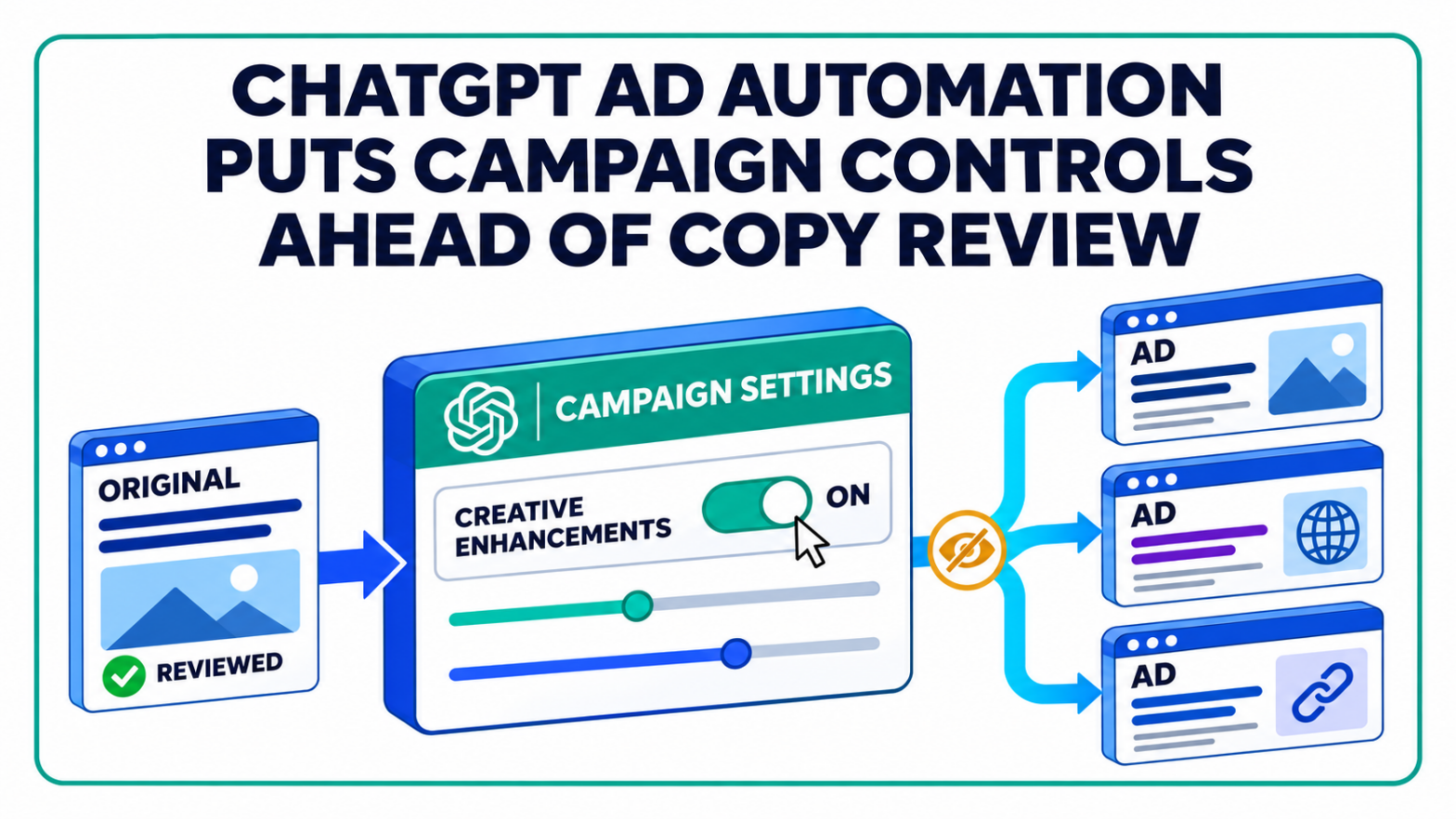
A ChatGPT campaign can now serve wording its advertiser never reviewed. OpenAI’s creative enhancements became the default for new and existing campaigns on October 30, 2026, while preserving previously saved opt-outs.
The distinction is between approving the campaign’s original material and approving every message delivered from it. OpenAI still offers tools for reviewing drafts, but that review does not cover every variation its advertising system can produce.
Campaign Settings Determine Where Automation Applies
Advertisers can change the setting through Manage settings in Ads Manager. Campaign-specific choices override the account default.
An account’s default therefore does not establish whether every campaign uses enhancements. A campaign-level exception can remain in effect even when the wider account takes a different approach.
That makes the configuration part of the approval process. Permission to adapt an ad can exist separately from the decision to approve its original headline, description and destination.
The change concerns campaigns already running as well as newly created campaigns. It is not limited to advertisers choosing an AI tool during their next campaign build.
Ads Manager Drafts and Live Variations Follow Different Rules
OpenAI’s September 16 advertising announcement described several ways AI could assist advertisers. Those tools do not all operate at the same stage.
For campaign creation, OpenAI introduced suggested copy and imagery based on an advertiser’s landing page and campaign objective. Advertisers could review and edit those suggestions before deciding whether to add them to a campaign.
The announcement also introduced optional AI-powered text customization, adapting existing headlines and descriptions to a conversation and translating copy into a user’s preferred language. That followed a broader expansion of Ads Manager into AI-assisted campaign creation and management.
The current creative-enhancements documentation describes a different approval boundary.
Enhancements can rewrite headlines and descriptions, translate text, resize images and select a relevant destination on the advertiser’s website. They draw on existing ads, landing-page content and conversational context or user interests. Variations can be prepared ahead of time or generated live, without approval of each version. Advertisers cannot preview every variation.
Reviewing a suggested draft and permitting automatic adaptation are therefore separate decisions, even when both begin with the same landing page.
The Landing Page Influences More Than the Click
OpenAI’s ad-creation guidance already treats the connection between an advertisement and its destination as part of the advertising experience. It recommends relevant product, collection or content pages rather than sending every visitor to a generic homepage.
The guidance also requires consistency across creative, imagery and landing pages. Misleading or inconsistent material can lead to rejection.
With the destination now eligible for automated adjustment, the uploaded URL is not the only element involved in shaping a user’s route through the advertiser’s website.
For marketing teams, the practical implication is a wider approval scope. Checking the original creative alone does not establish that every possible message and destination combination suits the offer. Website accuracy, campaign permissions and tracking configuration become part of the same operational review, particularly when several teams maintain the ads and landing pages.
OpenAI separately advises advertisers to add UTM tracking parameters directly to destination URLs. Its guidance for checking links in ChatGPT’s iOS browser says the displayed hostname does not reveal the complete URL; copying the full link exposes the tracking parameters.
Conversion Measurement Cannot Establish Creative Lift Alone
The reporting question is separate from the approval question.
OpenAI’s creative-enhancements guidance cautions that changes in overall results do not establish the effect of the feature. Better campaign results after activation are not, by themselves, evidence that an automatically rewritten headline caused the improvement.
The platform’s measurement documentation explains another distinction: ad clicks and analytics sessions measure different events. Page loading, redirects, consent settings, browser blocking, UTM handling, attribution windows and time zones can all affect comparisons.
Its reporting tools allow advertisers to export cumulative or daily results. Supported dynamic URL parameters can identify the campaign, ad group, ad and account, helping connect traffic with the relevant buying structure.
Those identifiers establish where traffic came from, not whether a particular creative variation generated additional business.
TechWyse has previously covered the expansion of conversion measurement beyond immediate clicks. That broader measurement capability remains distinct from evidence isolating the incremental effect of creative enhancements.
A Rewritten Ad Is Not a Rewritten ChatGPT Answer
The automatic changes also need to be distinguished from another AI-generated element already surrounding advertisements.
In an October 21 engineering account of its advertising system, OpenAI described a short, model-generated introduction explaining how an ad relates to the conversation. That introduction is separate from the advertiser’s title, description, destination link and call to action.
Creative enhancements can alter the advertiser’s material. The introduction explains the placement’s relevance. They are not the same component.
OpenAI says ad selection runs in a separate service from ChatGPT’s answer generation to prevent advertising from influencing answers. Its system evaluates conversational relevance, applies eligibility checks and runs an auction before a placement can appear.
For ChatGPT Ads, campaign permissions govern creative adaptation, while separate delivery systems determine whether an eligible placement reaches the user.
Even an ad selected by the auction may not appear. OpenAI says that if the advertising material arrives after ChatGPT’s response has finished generating, the placement is not shown for that turn.