
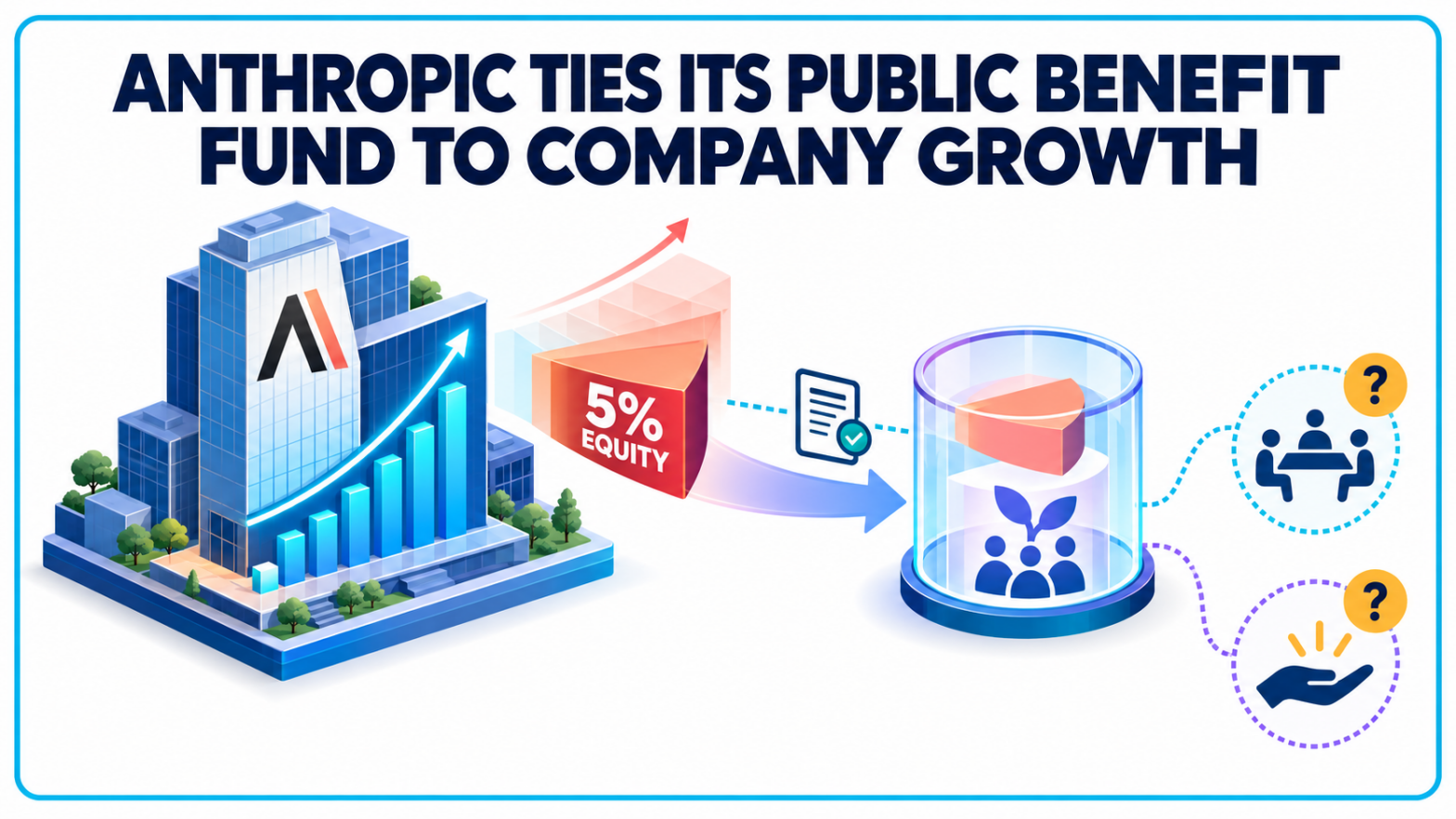
Anthropic is tying public-benefit spending to the value of the company behind Claude. The commitment could become substantial if Anthropic grows, but today it is an equity allocation with essential governance and distribution details still unpublished.
Five Per Cent Is an Equity Promise, Not a Cash Grant
Anthropic announced the Anthropic Public Benefit Fund on October 18, 2026, committing 5% of the company’s shares to a new entity, subject to stockholder approval.
The company did not assign a monetary value to those shares or announce an immediate grant total. It also did not identify any initial recipients.
That distinction matters. A percentage of company equity is not the same as placing an equivalent amount of cash into a charitable account. The eventual resources available to the fund will depend on Anthropic’s value, the terms attached to the shares and how the fund converts or otherwise uses its holdings.
Anthropic says the new entity could support large donations to established nonprofits or distribute money directly to specific groups. Those are examples of what the structure may permit, not confirmed programs.
There is no public application process, funding calendar or eligibility framework yet.
The new fund also sits outside Anthropic’s existing commercial and research programs. The company already conducts AI safety work, biomedical research and discounted Claude programs internally because those activities can advance its public mission while also supporting its business.
The fund is designed for initiatives that may not fit as easily inside the company.
Anthropic’s Valuation Could Increase the Fund’s Stake
The initial 5% allocation is only the starting point.
Anthropic says its board may add another 2% of the company’s shares for every 50% increase in Anthropic’s value above a set baseline. The additional allocations are discretionary rather than automatic.
Neither the baseline nor the method for calculating those valuation milestones has been disclosed. Anthropic says it will provide more information about the triggers in the coming months.
The structure connects potential public spending to commercial growth. If Anthropic becomes more valuable, the fund could receive both a larger percentage of the company and shares worth more individually. If the board decides against an additional allocation at a milestone, the announcement does not describe an appeal, review or external approval mechanism.
Anthropic compared the arrangement with equity awards that technology companies commonly provide to executives as their value rises. In this case, the company says the escalating equity would be directed toward public benefit.
The announcement also places the fund within a wider set of commitments by Anthropic’s workforce and founders. Its co-founders pledged at the company’s creation to donate 80% of their personal equity holdings. Anthropic separately operates an employee equity donation program in which the company matches participating workers’ pledges.
Approximately half of its employees participate, according to Anthropic.
Combined with the new fund, the company estimates that roughly 20% of Anthropic shares will be dedicated to the public good. That figure aggregates several different arrangements; it does not mean the new LLC will immediately control 20% of Anthropic.
The LLC Offers Flexibility While Governance Remains Open
The fund will be established as a wholly owned limited liability company rather than a tax-exempt charitable organization such as a 501(c)(3).
Anthropic says the LLC format will allow it to move between different forms of giving. A conventional charity can face restrictions on its permitted activities and recipients, while an LLC may offer greater flexibility for grants, direct payments and other interventions.
That flexibility also makes the pending governance details more consequential.
Anthropic has not named the fund’s directors, managers, advisers or decision-making bodies. It has not explained how beneficiaries will be selected, how conflicts of interest will be handled or whether external representatives will participate in allocation decisions.
The company did establish one boundary: none of the Anthropic equity held by the fund will be used for lobbying or political contributions in the United States or other countries.
The fund should not be confused with Anthropic’s existing Long-Term Benefit Trust. The Long-Term Benefit Trust is an independent governance body with authority over the selection and removal of a growing portion of Anthropic’s board. The new public benefit fund is a wholly owned LLC intended to hold and deploy equity for public purposes.
Both structures relate to Anthropic’s status as a Delaware public benefit corporation, but they perform different functions. The trust affects corporate oversight. The fund is intended to finance public-benefit activity.
That separation will be important when assessing Anthropic governance. Independence, decision-making authority and financial control cannot be inferred from the word “fund” alone.
AI Labour Market Disruption Is the First Named Test
Worker disruption is the clearest potential use Anthropic has identified.
The company says artificial intelligence could create significant economic value while also destabilizing employment for many workers. The fund could support responses that go beyond research, potentially including direct distributions to affected groups.
No such payment program has been announced.
Anthropic has already committed $200 million to its separate Economic Futures Research Fund, which finances external research into how governments, employers and other institutions could prepare for AI’s economic effects.
That research agenda covers workplace-level changes, worker transitions, income support, broader ownership of AI-driven growth and public investment. The public benefit fund could eventually act on evidence produced through that research, although Anthropic has not established a formal link between the two entities.
The company has also committed $200 million in funding, Claude credits and technical support through a four-year partnership with the Gates Foundation. Those programs cover global health, life sciences, education and economic mobility.
Other initiatives combine commercial access with social programs. TechWyse previously reported on Anthropic’s small-business AI package, which includes training and partnerships with nonprofit lenders and entrepreneur-support organizations.
The new fund potentially expands that work beyond access to Anthropic’s products. Direct financial assistance would represent a different type of intervention from research grants, discounted software or technical support.
Public-Benefit Claims Now Depend on the Missing Details
For marketers and communications teams, the current distinction is narrow but important: Anthropic has announced a proposed 5% equity commitment subject to stockholder approval, not a cash donation of a stated value or an active grant program.
Nonprofits, research institutions and community organizations do not yet have a published route for seeking support. Describing the fund as open for applications would go beyond Anthropic’s announcement.
The structure may also become relevant to enterprise customers evaluating the wider social commitments of AI suppliers. TechWyse has tracked Claude’s growing role in enterprise AI adoption, where procurement decisions increasingly include questions about governance, workforce effects and responsible deployment alongside model performance.
Anthropic says it will disclose the fund’s structure, governance and valuation milestones in the coming months. It also plans to publish a broader report measuring its progress against its public-benefit mission.
Until those disclosures arrive, the fund has a percentage, a legal form and several possible uses. It does not yet have a published cash value, independent leadership structure or distribution process.