Google has issued post-event guidance clarifying three of its most-questioned announcements from Google Marketing Live 2026. Google Ads Liaison Ginny Marvin addressed advertiser questions on AI Search eligibility, the Qualified Future Conversions (QFC) metric, and YouTube Creator Partnership rights in the latest edition of the Ads Decoded newsletter and an accompanying video, published July 10, 2026.
None of Marvin's responses introduced new product announcements. They added context to features Google announced at GML and reinforced how Google expects advertisers to use them.
Ad Eligibility for AI Search Remains Unchanged
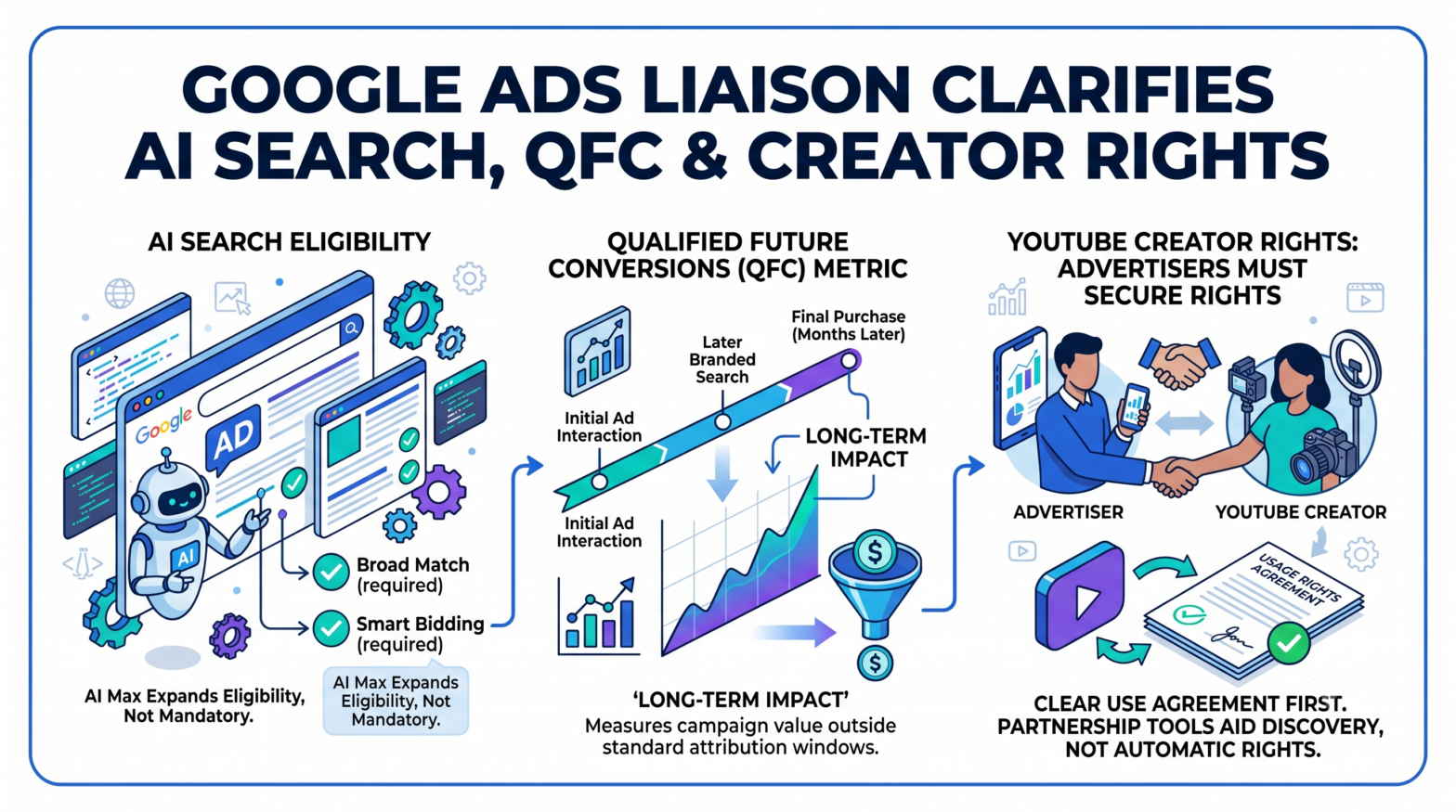
One of the central clarifications from Marvin was that advertisers do not necessarily need AI Max enabled to appear in AI-powered search experiences. According to Marvin, campaigns using broad match keywords remain eligible to show ads in AI Overviews and AI Mode. AI Max expands eligibility by applying broad match behaviour to phrase and exact match keywords while also enabling keywordless matching.
Marvin stated that advertisers need to be using AI-powered targeting solutions, meaning broad match on Search, or the keywordless targeting technology available through AI Max for Search campaigns, Performance Max campaigns, Shopping campaigns, or Dynamic Search Ads. Smart Bidding is also required. Dynamic Search Ads are scheduled to migrate to AI Max for Search in February 2027, according to Marvin's statement.
Marvin noted that the relevance bar is higher in AI Search, and ads are matched to Google's understanding of user intent based on both the user query and the content in the response.
Google's May 20, 2026 Google Marketing Live blog post confirmed that when AI Mode provides a list of recommendations, highly relevant, high-quality ads are eligible to appear as a Highlighted Answer, and that building a strong foundation with AI Max for Search, AI Max for Shopping campaigns, and Performance Max is recommended to take full advantage of these new AI-powered formats.
Marvin also highlighted two features within AI Max that support relevance in AI Search environments. Text customization tailors ad copy to better match the surrounding conversational context, while Final URL Expansion directs users to the landing page Google determines is most relevant to their intent. Marvin also confirmed that the AI Brief will allow advertisers to set messaging, matching, and audience guidelines, and that both negative and positive guidance can be included. The AI Brief is expected to roll out in English in the coming months.
Additional controls available in AI Max include brand controls, location-of-interest settings at the ad group level, and URL inclusions and exclusions.
What Qualified Future Conversions Measures and Who It Targets
Google introduced Qualified Future Conversions at Google Marketing Live 2026 as a new measurement metric designed to help advertisers better understand the long-term impact of their digital marketing campaigns.
With QFC, marketers can see the complete picture of how demand creation campaigns generate conversions in the long run, even outside the standard attribution window. QFC is an always-on metric in Google Ads that helps marketers measure how demand generation campaigns and digital advertising efforts influence future conversions, even when those conversions occur outside traditional attribution windows.
Marvin explained the problem the metric is designed to solve. Standard attribution windows fail to capture the full impact of awareness and demand generation campaigns. According to data Google provided in Marvin's newsletter, roughly 70 percent of conversions from standard Google Ads campaigns are captured within a 30-day click and three-day engaged-view window. That figure drops to approximately 50 percent for Performance Max campaigns and approximately 40 percent for Demand Gen campaigns.
QFC connects early signals of intent, such as branded searches, to future financial outcomes. By using AI to model the probability of a future purchase based on today's user actions, QFC allows advertisers to optimize for long-term profitability while campaigns are still live.
QFC is not intended to replace Google's other conversion metrics like Attributed Branded Searches, but to supplement them. QFC aggregates follow-up actions, such as additional branded searches and site visits, occurring up to six months later, allowing campaigns to be evaluated based on their potential long-term value rather than immediate results.
QFC was announced during Google Marketing Live in May 2026, but not much had been said about it publicly until Marvin explained it during the Community Q&A published July 10. The metric is currently being tested with a select number of advertisers, with wider availability expected later this year.
Advertisers Must Secure Rights Before Boosting Creator Content
Marvin addressed whether advertisers need to establish usage rights with YouTube creators before boosting creator videos in their campaigns. The answer is yes.
Advertisers are responsible for securing the rights to use a creator's video as an ad. The partnership tools in Google Ads are aimed, in part, at helping make connecting with creators and getting agreements to use their content easier.
As detailed in an earlier Ads Decoded podcast recorded live at the YouTube NewFronts, Marvin and Melissa Hsieh Nikolic, Director of Product Management for YouTube Ads, discussed how Google is building tools to make creator partnerships accessible and effective. With YouTube Creator Partnerships available in Google Ads and Display & Video 360, it is now possible to discover creators and activate and manage creator-driven ads in performance campaigns.
Marvin also addressed a common misconception about who the Creator Partnerships feature is designed for. While large-brand examples are often spotlighted at events like GML, there are a lot of creators with smaller audiences who might be a great fit for many types of businesses. Marvin recommended spending time exploring the Creator search tab, which allows filtering by subscriber count, average views, location, and more, for eligible accounts.
YouTube Creator Partnerships unified BrandConnect and the Creator Partnerships Hub into a single platform across seven markets, the US, India, Indonesia, the UK, Brazil, Australia, and Canada, on March 24, 2026.
Practical Implications for Advertisers
For advertisers managing paid search campaigns, Marvin's guidance indicates that AI Search placement does not require a full account restructure, but does require specific campaign types and settings to be active. Campaigns relying exclusively on exact or phrase match keywords without AI Max enabled will not be eligible for AI Overviews or AI Mode placements. On measurement, QFC is a supplemental reporting layer and is not designed to replace existing conversion tracking or attribution models. Advertisers evaluating the metric should treat it as an additive signal alongside established reporting, not a substitute for it. On creator partnerships, rights clearance is entirely the advertiser's responsibility before any creator content can be promoted as a paid ad; Google's tools facilitate discovery and outreach, but do not confer usage rights.
Marvin confirmed in the July 10 Ads Decoded Q&A that QFC "doesn't replace standard conversion metrics" and that the feature "is currently in testing with a select number of advertisers, with wider availability expected later this year."