

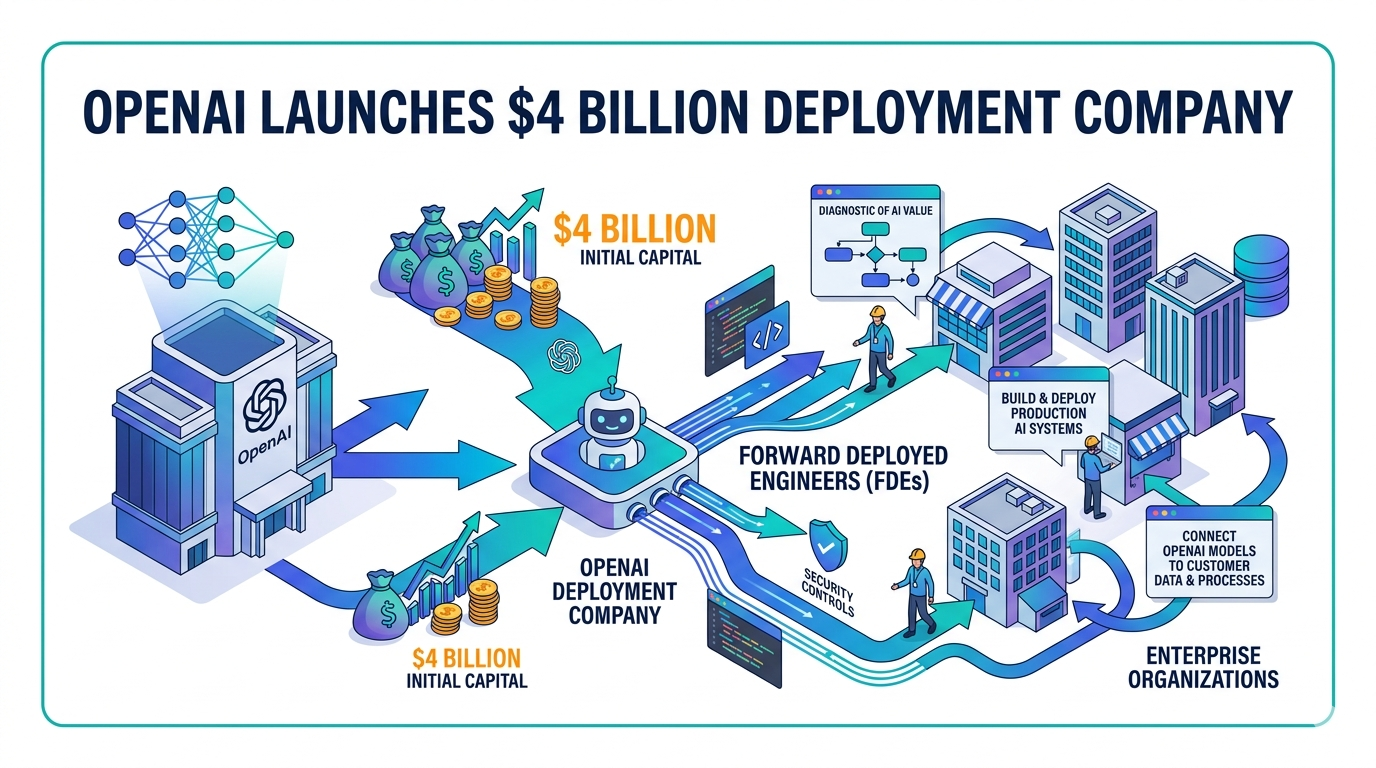
Large enterprises now have a direct path to embed OpenAI engineers inside their own operations. OpenAI announced on May 12, 2026, the launch of the OpenAI Deployment Company, a majority-owned subsidiary backed by more than $4 billion in initial capital, designed to place specialized AI engineers directly inside client organizations to build and operate production AI systems.
Structure and Ownership
The OpenAI Deployment Company is majority-owned and controlled by OpenAI, giving customers a unified experience whether they work with OpenAI, the OpenAI Deployment Company, or both. OpenAI launched the Deployment Company as a standalone business unit so it can develop the operating model, pace, and customer focus that this work requires.
The venture is structured as a committed partnership between OpenAI and 19 leading global investment firms, consultancies, and system integrators, led by TPG, with Advent, Bain Capital, and Brookfield as co-lead founding partners, and B Capital, BBVA, Emergence Capital, Goanna, Goldman Sachs, SoftBank Corp., Warburg Pincus, and WCAS as founding partners. Investors also include leading consulting and systems integration firms, including Bain & Company, Capgemini, and McKinsey & Company.
The Deployment Company will launch with more than $4 billion of initial investment, which it will use to scale operations and acquire firms that can accelerate OpenAI's mission of ensuring that artificial general intelligence benefits all of humanity.
Tomoro Acquisition
Concurrent with the Deployment Company's launch, OpenAI has agreed to acquire Tomoro, an applied AI consulting and engineering firm that helps enterprises turn AI into operational advantage, a deal that will bring approximately 150 experienced Forward Deployed Engineers and Deployment Specialists to the new unit from day one.
Founded in 2023 in alliance with OpenAI, Tomoro is a specialized AI consulting and engineering firm headquartered in London with offices in Edinburgh and Manchester, and has expanded to an APAC headquarters in Singapore with additional offices in Sydney and Melbourne. Its client list spans Fidelity International, Virgin Atlantic, Tesco, the NBA, Red Bull, and Supercell, where it launched an in-game support agent serving 110 million users in just 12 weeks.
The acquisition is subject to customary closing conditions, including applicable regulatory approvals, and is expected to close in the coming months.
How the Deployment Model Works
The Deployment Company's core service offering centres on a class of specialists called Forward Deployed Engineers, or FDEs. The Deployment Company will embed these specialized engineers directly into organizations working on complex problems in demanding environments. A typical engagement will begin with a diagnostic of where AI can create the most value, followed by a focused set of priority workflows selected with the customer's leadership and operating teams. FDEs will then design, build, test, and deploy production systems that connect OpenAI models to the customer's data, tools, controls, and business processes.
At the same time, the Deployment Company will operate as an extension of OpenAI, keeping customers closely connected to the research, product, and in-house deployment teams shaping frontier AI. This means FDEs will be positioned to build for where OpenAI's frontier capabilities are headed, giving customers systems designed to improve as new models, tools, and deployment patterns come online.
OpenAI Chief Revenue Officer Denise Dresser described the core problem the venture is designed to solve.
"AI is becoming capable of doing increasingly meaningful work. The challenge now is helping companies integrate these systems into the infrastructure and workflows that power their businesses. DeployCo is designed to help organizations bridge that gap."
Partner Network and Reach
The Deployment Company's investment and consulting partners collectively sponsor more than 2,000 businesses worldwide, with its integrator partners working with many thousands more across industries, company sizes, and workflow types.
Competitive Context
OpenAI's enterprise position has been under pressure, with its share of the enterprise API market reportedly falling from around 50% in 2023 to roughly 25% by mid-2025, as Anthropic and Google made significant inroads. Anthropic has also announced a $1.5 billion joint venture aimed at helping businesses integrate AI more deeply into their operations. The move confirms recent reports that the AI industry is entering a "services phase," with Reuters reporting last week that both OpenAI and Anthropic were independently negotiating with private equity firms to acquire service providers capable of helping non-tech businesses navigate the complexities of AI adoption.
OpenAI noted in its announcement that more than one million businesses have adopted its products and APIs over the past several years, and that the next stage of enterprise AI will be defined by how effectively businesses can deploy this technology into real-world use cases, a challenge it launched the Deployment Company as a standalone unit to address.
Implications for Enterprise Buyers
For enterprise technology and marketing teams evaluating AI adoption, the Deployment Company's model represents a shift in how frontier AI vendors are going to market. Rather than licensing software and leaving integration to the client, OpenAI's approach places its own engineers inside client organizations for full-cycle implementation, from workflow diagnosis through to production deployment. Businesses assessing AI partners will need to weigh the speed-to-deployment advantages of this integrated model against the potential for vendor dependency that analysts have flagged as a structural consideration with any single-vendor deployment arrangement.
Ron Westfall, analyst at HyperFRAME Research, said:
"I see OpenAI transitioning to a high-touch, human-in-the-loop services model that embeds frontier engineers directly within corporate teams to bridge the experimentation-to-execution gap."