

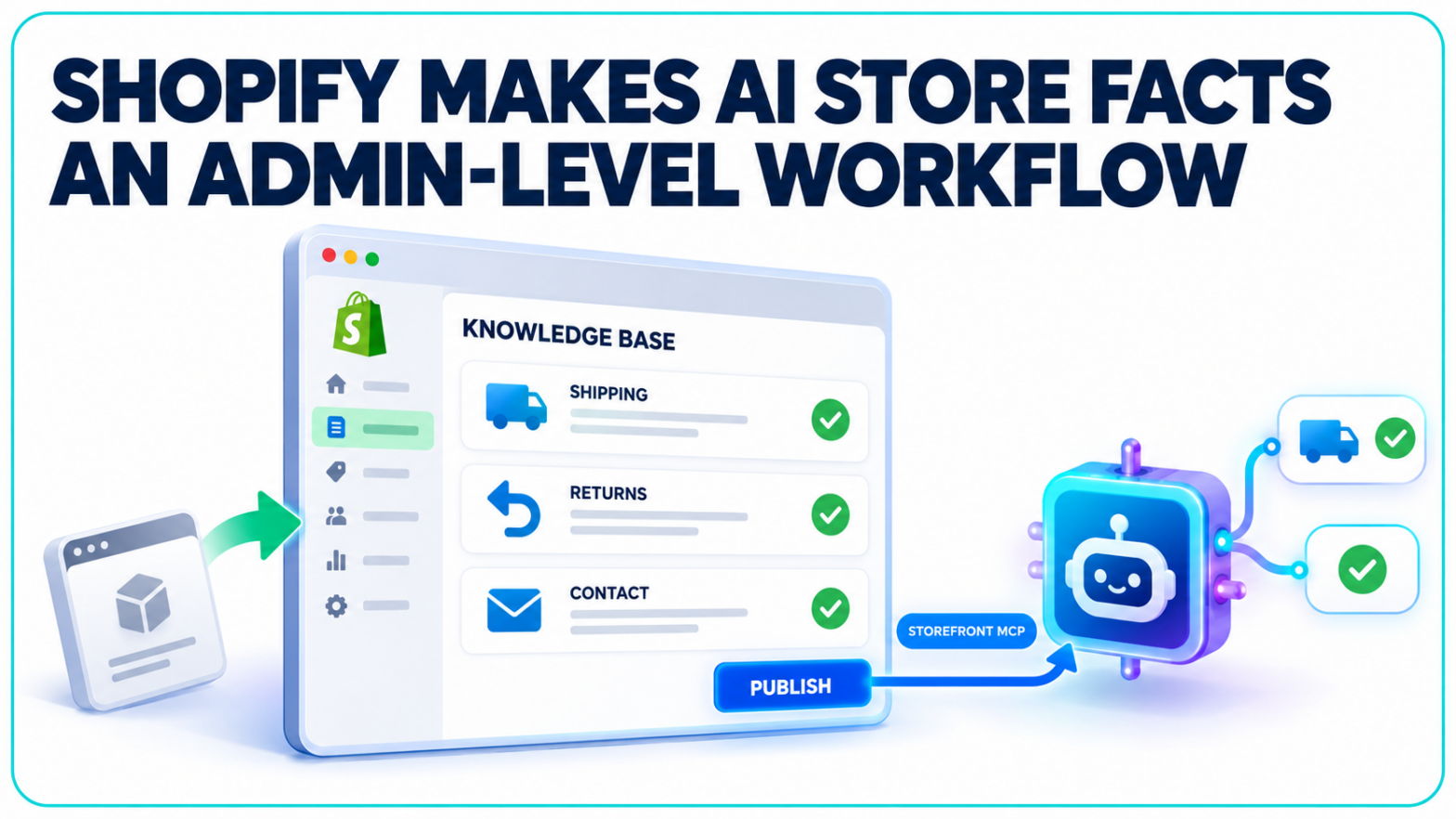
Shopify is turning store policies, contact details and fulfilment information into infrastructure for AI shopping. Its Knowledge Base now sits inside the Shopify admin, while merchants with large existing datasets face a January deadline before the standalone app disappears.
The Shopify Knowledge Base Becomes an Admin Control
The Shopify Knowledge Base is now available under Sales channels > Agentic > Knowledge base. According to Shopify’s October 26 changelog, the new admin page replaces the standalone Knowledge Base app, which will no longer be available after January 15, 2027.
The app has already been removed from the Shopify App Store for new installations.
This is more than a change of location. Knowledge Base now functions as a central page where merchants can review, edit and publish non-product information that AI agents may use when answering questions about a business.
That includes return processes, shipping timelines, payment options, gift services, warranty information, contact details and brand values. Product titles, prices, availability and other catalogue attributes remain part of Shopify’s separate product-data infrastructure.
Shopify organizes the information into 10 categories: About the Store, Brand and Identity, Company policies, Contact, Gift services, Payment, Returns and warranty, Second hand, Fulfillment and Additional facts.
Each field identifies where its information came from. The source can be a public storefront page, a setting inside Shopify admin or information entered manually by the merchant. Fields can also include reference links that an agent may use to trace the basis of an answer.
AI Shopping Agents Get a Separate Layer of Store Information
Product feeds can tell an agent what a merchant sells. They are less useful when the shopper asks whether an item can be gift-wrapped, how long international delivery takes or whether a return will incur a fee.
The Knowledge Base is intended to fill that gap.
When customers ask questions in an AI chat, an agent can query the published facts through Shopify’s Storefront MCP. Shopify describes the published knowledge base as publicly available through that connection, allowing the information to be used by Shop and third-party AI platforms.
That creates a distinct information layer for AI shopping agents. Shopify Catalog supplies structured product information, while the Knowledge Base supplies non-product details about the merchant and its services.
The distinction matters because an AI-assisted purchase can depend on both. A product may match a shopper’s requested size, price and colour, yet still be rejected if an agent cannot confirm delivery timing, return conditions or accepted payment methods.
Shopify’s broader agentic storefront documentation says eligible stores can make products available through AI channels such as ChatGPT, Google AI Mode and Gemini, Microsoft Copilot and Meta. The Knowledge Base gives those emerging shopping experiences a structured place to retrieve store-level answers, although Shopify does not state that every channel will use every published fact.
Published Facts Require Different Levels of Approval
Not every fact follows the same publishing process.
Information drafted from a storefront scan remains unpublished until the merchant approves it. Shopify says every scanned fact links back to its source page, giving merchants a way to compare the proposed information with the content customers can see.
Facts connected directly to Shopify admin, including store policies and contact details, are published when Shopify creates them. Merchants can subsequently unpublish individual fields, entire categories or the complete set of facts.
That difference makes the first admin review consequential. A merchant opening the page for the first time may find a mixture of unpublished storefront-derived suggestions and published information drawn from existing settings.
Shopify regularly rescans storefronts and can present detected changes as suggestions. Those suggestions still require approval, and Shopify says it will not replace knowledge base content automatically.
Scans are not guaranteed to detect every storefront change. Merchants can edit a field directly or request another scan, which Shopify says may take up to 48 hours.
For marketing and SEO teams, the practical implication is straightforward: public policy pages, Shopify settings and published knowledge base facts now need to remain consistent. Conflicting shipping, return or contact information could give an AI agent multiple versions of the same answer, while an unpublished field may leave it without an approved answer at all.
The 1,000-Fact Limit Creates a Migration Deadline
Most previous Knowledge Base app users will not need to rebuild their information manually.
Shopify’s Knowledge Base migration documentation says stores with 1,000 or fewer facts had their manually added facts and overridden store facts transferred to the admin version. Shopify published the transferred information so AI agents could continue using it, although merchants can unpublish any field.
Stores with more than 1,000 facts received different treatment. Their existing facts were not transferred, and Shopify says those merchants must manually add the facts and overrides they want to retain before January 15, 2027. The company says affected stores were contacted by email.
The new admin knowledge base can hold 1,000 facts in total, including information generated by Shopify and additional facts supplied by the merchant.
Stores that never used the standalone app do not need to complete a migration. Shopify may already have drafted facts from their storefronts, but those scanned facts remain unpublished until reviewed.
The migration also exposes a broader change in agentic commerce. Information that once lived in a separate marketing application is becoming part of Shopify’s core sales-channel administration, alongside the controls that determine where products can be discovered and purchased.
Storefront Content Now Feeds a Customer-Facing Answer Layer
The Knowledge Base does not remove the need for clear storefront content. Shopify uses published pages as source material, while references attached to each fact can give agents supporting URLs for their answers.
Merchants can change a scanned or admin-sourced field to a manually maintained source. Doing so removes references supplied by the previous source, although references that the merchant added remain attached. Shopify recommends keeping manually entered information aligned with publicly available customer-facing pages.
Additional facts can be entered as paragraphs, yes-or-no answers or groups of tags. Those formats let merchants provide information that does not fit Shopify’s standard categories, such as loyalty-program details, product-material policies or business certifications.
Published facts can be controlled at the individual-field, category or full-knowledge-base level. Access is limited to the store owner or staff with the required app-development or Agentic sales-channel permissions.
Shopify will continue scanning eligible storefronts for potential updates, but it says those changes are not applied without merchant approval. The standalone Knowledge Base app will remain available only until January 15, 2027, after which the admin page becomes the remaining location for managing these AI-facing store facts.