

AI images are getting harder to spot with the naked eye.
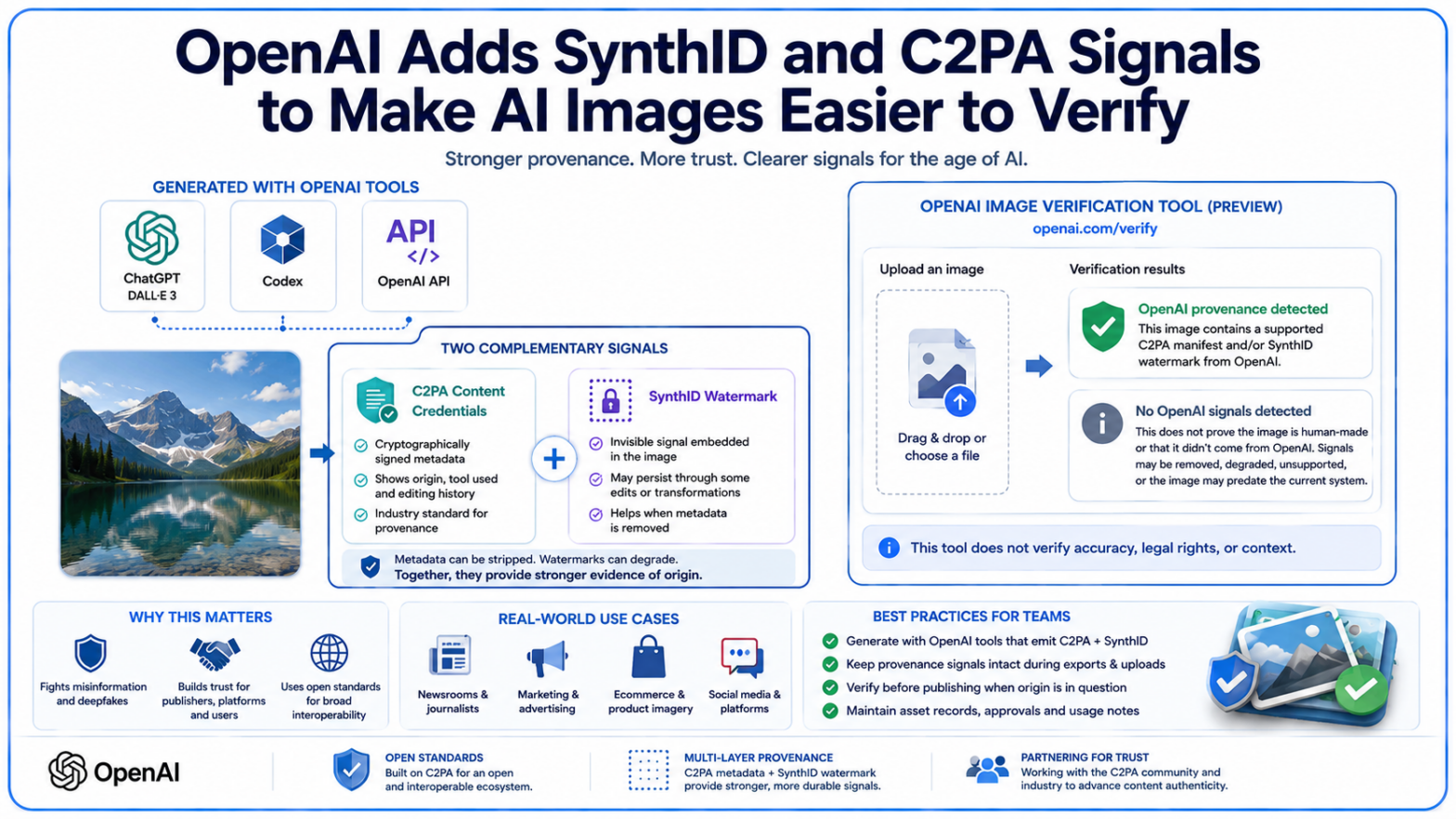
OpenAI is trying to make that less of a guessing game. The company is adding Google’s SynthID watermarking to images created with ChatGPT, Codex and the OpenAI API, while also using C2PA Content Credentials and previewing a public verification tool that can check whether an uploaded image carries OpenAI-linked provenance signals.
The New Signal Is Built Into the Image, Not Just Attached to It
OpenAI’s updated documentation says images generated with ChatGPT, Codex and its API include both C2PA metadata and SynthID watermarks.
That pairing matters because the two systems solve different problems. C2PA works through signed metadata that can describe where an image came from and how it was created or edited. SynthID works differently. It embeds an invisible signal directly into generated media, which OpenAI says may persist through some edits or transformations.
Metadata can be stripped. Watermarks can degrade. Neither system is a perfect answer on its own.
Together, they give platforms, publishers and users more than one signal to inspect when an image’s origin is in question.
C2PA Gives Platforms a Standard Language for Provenance
OpenAI has been working with the Coalition for Content Provenance and Authenticity since 2024, when it said it joined the group’s steering committee and began adding C2PA metadata to images generated and edited with DALL·E 3.
C2PA is an open technical standard used to attach cryptographically signed provenance information to digital media. That information can show which tool created or modified a file and can help platforms, journalists and users evaluate whether the media came from a trusted source.
OpenAI says its current implementation allows images from ChatGPT, Codex and the API to carry C2PA metadata. The company has also described C2PA as useful beyond AI-generated content, since camera manufacturers, publishers and other organizations can use the same standard to certify source and history.
The larger goal is interoperability. A provenance signal has limited value if it only works inside one company’s product.
SynthID Adds a More Durable Layer
The SynthID addition brings OpenAI closer to Google’s approach to AI media transparency.
Google DeepMind’s SynthID is designed to embed an imperceptible watermark into AI-generated content. OpenAI says this watermarking layer complements C2PA because it can remain detectable in some cases where metadata does not survive.
Screenshots, resizing, format changes and repeated uploads can weaken or remove provenance data. That is a common problem for marketers, newsrooms and social teams because creative assets often move through multiple platforms before reaching the public.
A watermark does not provide the same detailed history as metadata. But it can provide a persistent signal that the image originated from a supported AI system.
OpenAI’s Verification Tool Has a Narrow Job
OpenAI is also previewing a public verification tool at openai.com/verify. The tool checks uploaded images for supported provenance signals associated with OpenAI-generated content, including a trusted C2PA manifest or a SynthID watermark originating from OpenAI.
The company is careful about what the tool can and cannot prove.
If the tool detects a supported signal, it can indicate that the image was generated using OpenAI tools. If it finds no signal, that does not prove the image is human-made or that it did not come from OpenAI. The metadata may have been removed, the watermark may have been degraded, the source may be unsupported, or the image may predate the current signals.
OpenAI also says the tool does not verify whether an image is accurate, unedited, legally owned or presented in the correct context.
That distinction is important. Provenance can answer where a file appears to have come from. It cannot settle every question about truth, rights or intent.
Brand Teams Now Have a Provenance Workflow Problem
For marketers, publishers and creative teams, the practical implication is straightforward: AI-generated media needs a traceable workflow. Teams using ChatGPT, Codex or the OpenAI API for image generation should know which assets carry Content Credentials and SynthID signals, how those signals survive exports or platform uploads, and where verification fits before publication. Provenance checks may become part of brand-safety review, especially for campaigns using synthetic product scenes, executive imagery, editorial visuals or social content tied to current events.
The work will not stop at detection.
Teams will also need asset naming rules, approval records and usage notes that explain when AI was used and what was changed. A watermark can help verify origin, but it cannot replace internal governance.
The Labelling Fight Is Moving From Policy to Infrastructure
The AI transparency debate has often focused on whether platforms should label synthetic media. OpenAI’s update shows the next stage is more technical: making those labels easier to preserve, detect and trust across systems.
C2PA gives the file a signed record. SynthID gives the pixels a hidden signal. The verification tool gives the public a way to inspect both, at least for OpenAI-generated images.
The limitation is still clear. The system works best when creators, platforms and toolmakers keep provenance signals intact. Without that chain, verification becomes harder and uncertainty returns.