

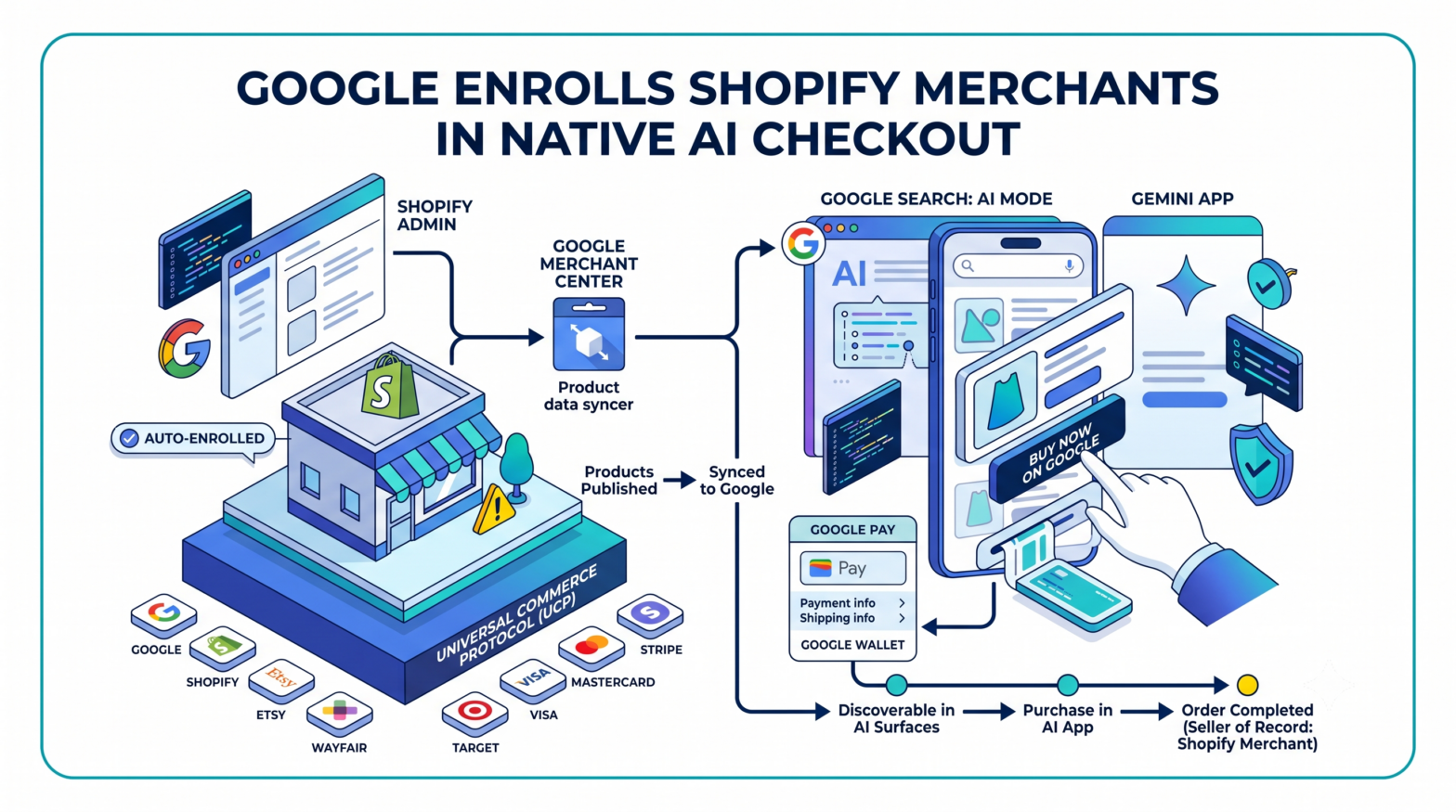
Eligible U.S. Shopify merchants can now accept purchases directly within Google's AI surfaces, with no action required on their part. Google is notifying qualifying merchants via Merchant Center that their Shopify stores have been matched to their Merchant Center accounts, enabling native checkout inside AI Mode in Google Search and the Gemini app, a capability powered by the Universal Commerce Protocol (UCP).
Automatic Enrollment and the UCP Foundation
Google is sending email notifications to Google Merchant Center users whose e-commerce platforms support UCP, informing them that "your products are now eligible for native checkout." The notification states that products must be published on the merchant's Shopify storefront and available in Merchant Center, and that eligible products are automatically included, with "nothing for you to set up."
UCP is an open-source standard designed to power agentic commerce by establishing a common language between consumer surfaces, businesses, and payment providers. Google announced UCP on January 11, 2026, at the National Retail Federation conference, co-developed with Shopify, Etsy, Wayfair, Target, and Walmart, and endorsed by more than 20 partners including Visa, Mastercard, Stripe, American Express, Best Buy, and The Home Depot.
Unlike Google's earlier checkout button, where shoppers clicked through and completed the transaction on the merchant's website, UCP-powered transactions happen directly on Google's surface. Shoppers use Google Pay, drawing on payment methods and shipping information stored in Google Wallet.
How the Shopify Integration Works
Shopify built UCP support directly into Shopify Admin through Agentic Storefronts. Shopify merchants do not need to build a custom REST API or MCP integration; they apply through Shopify Admin, and Shopify handles the UCP handshake with Google.
Shopify's agentic storefront for Google AI Mode and Gemini is in early access and not yet available for all Shopify stores. Merchants receive an email and an admin notification when agentic storefronts become available to them. UCP-powered checkout initially launched in February, with Google expanding access to more retailers in the most recent rollout.
To be eligible, merchants must be based in the U.S. and sell to U.S. customers. Products must be published on the merchant's Shopify storefront and available in Merchant Center. Products can be synced through Shopify's Google & YouTube channel or supplied through another Merchant Center feed method.
Merchants Are Opted In by Default
When a store is eligible, checkout on agentic storefronts is active by default. Merchants do not need to take any action for their products to be discovered by AI channels, but must remain opted in for products to be purchased directly within those channels.
Merchants who do not want customers to purchase directly on Google and prefer they complete transactions on the merchant's own website must actively disable the feature. Native checkout can be turned off in the Shopify admin under Sales channels > Agentic. If a merchant opts out, customers using AI channels can still discover the merchant's products but are redirected to the online store to complete their purchase.
What the Native Checkout Experience Does Not Support
The direct checkout experience within AI surfaces does not replicate the full functionality of a merchant's own storefront. Google Analytics and custom pixels will not fire in all agentic storefront checkouts. These checkouts fire only server-to-server pixels for session-started and completed events, meaning none of the standard or custom client-side pixels fire.
To help ensure customers can complete purchases, Shopify loads only checkout blocks essential to completing the transaction. Certain customization blocks, such as those for custom fields, upsells, or specific validations, may not display in agentic storefront direct checkouts. Local delivery, in-store pickup, and pickup points are not supported as delivery methods in agentic storefront checkouts.
Merchants retain full ownership of their customer relationships, data, and sales. The merchant remains the seller of record, owns the customer relationship, and handles fulfillment and post-purchase support.
Implications for Ecommerce Marketers
Merchants enrolled in native checkout should audit their Shopify Admin under Sales channels > Agentic to confirm whether the feature aligns with their operational and measurement requirements. Because client-side pixels do not fire during agentic checkout flows, brands relying on Google Analytics or custom pixel data for attribution and retargeting will have reduced visibility into conversions that occur on Google's surfaces. Merchants with checkout customizations, including upsells, loyalty touchpoints, or specific delivery configurations, should evaluate whether the native checkout experience adequately reflects their intended purchase flow before remaining opted in.
Google's Merchant Center documentation confirms that shoppers can experience select checkout features across retailers including Nike, Sephora, Target, Ulta Beauty, Walmart, Wayfair, and Shopify merchants such as Fenty and Steve Madden. Google has also stated it plans to expand UCP-powered checkout to Canada, Australia, and the U.K. in the coming months, and to YouTube in the U.S., with additional verticals including hotel booking and local food delivery to follow.