Google’s regular search results are looking less like a fixed hierarchy of publishers and platforms.
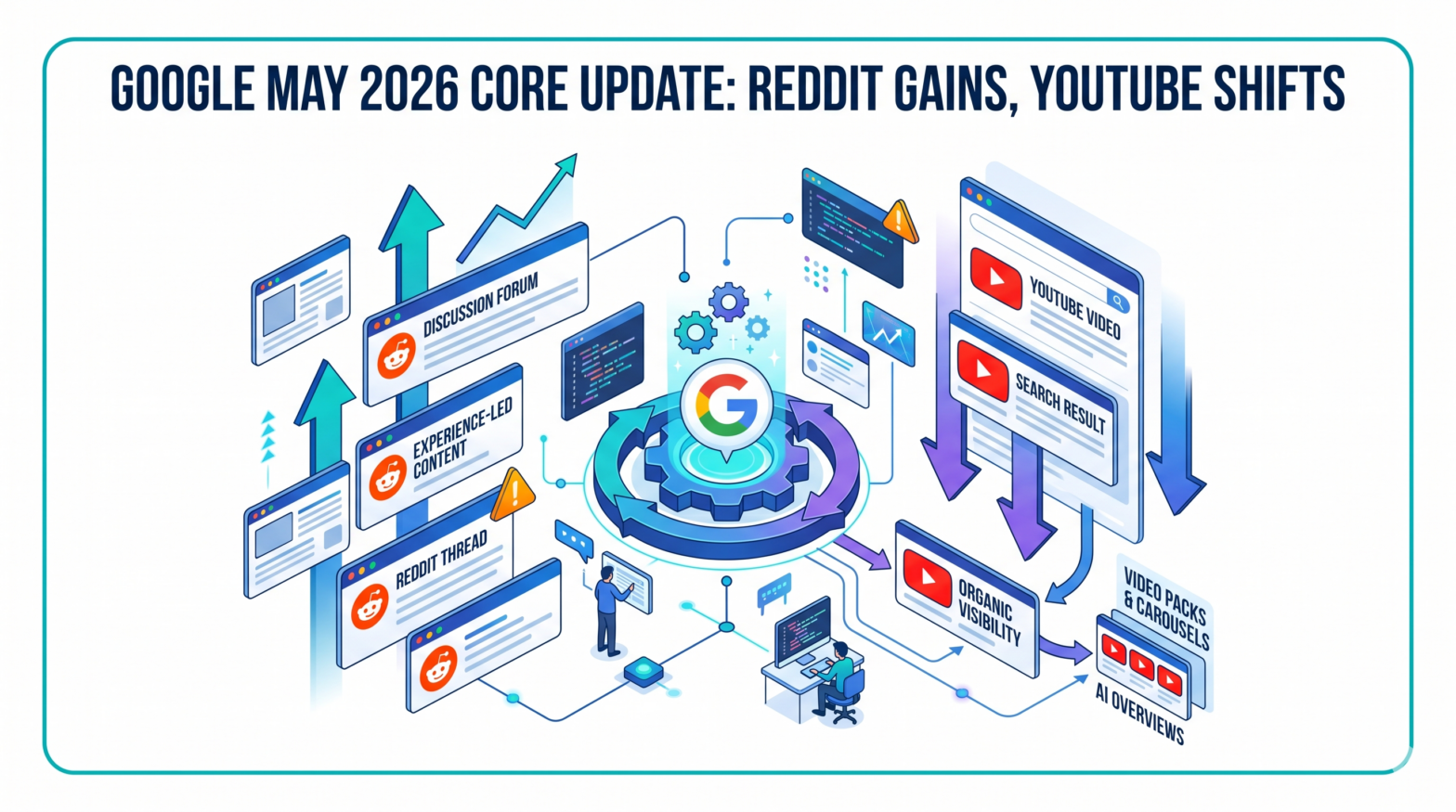
After the May 2026 core update, early visibility data points to a sharper split inside organic rankings: Reddit gained more high-ranking positions across every tracked niche, while YouTube lost ground in standard blue-link results. The shift does not mean Google demoted video outright. It does suggest that Google’s core ranking systems are giving community-led, discussion-heavy pages more room in conventional organic listings.
Google confirmed the May 2026 core update began on May 21 at 8:40 a.m. Pacific time and finished on June 2 at 5:40 a.m. Pacific time. The rollout lasted 11 days and 21 hours, making it Google’s second broad core update of 2026 after the March update.
Reddit’s Gains Were Not Limited To One Niche
The clearest movement after the May rollout was Reddit’s wider presence near the top of Google Search.
Visibility data reviewed after the update found Reddit’s share of top-three organic positions rose to 10.24%, up from 8.56% after the March 2026 updates and 9.19% after the December 2025 core update. The increase appeared across all 20 tracked niches, rather than clustering around one category.
That matters because broad gains across unrelated verticals are harder to explain as a single topic trend.
Reddit’s growth was strongest in categories where searchers often look for lived experience, product feedback, informal comparisons, and peer advice. Pets, education, sports and exercise, ecommerce, entertainment, technology, food and beverage, and business all saw noticeable gains.
The pattern was softer in more sensitive categories. Healthcare, real estate, and news showed much smaller increases. That split is important for SEOs tracking the May 2026 core update because it points to a more selective use of forum-style content, not a blanket elevation of user-generated content across every query type.
Google has not said the update was designed to reward Reddit or discussion forums. Its public guidance on core updates is broader: core updates are significant changes to ranking systems intended to keep results helpful and reliable as the web changes.
Still, the result is visible. For many informational and commercial queries, Google appears more willing to place firsthand discussion beside, or above, traditional editorial and brand-owned pages.
YouTube Lost Space In Standard Organic Listings
YouTube moved in the other direction.
The same post-update data showed YouTube’s share of top-three regular organic positions fell to 2.14% after the May update, down from 2.50% after March and 2.40% after December. That is not a collapse. It is a repositioning.
Video has not disappeared from Google Search. It often appears through video packs, carousels, shorts-style surfaces, or other SERP features that sit apart from standard organic links. The change is more specific: YouTube appears to have lost some visibility inside the ordinary web-result stack.
That distinction matters for search visibility analysis.
A site can lose regular organic positions without losing all search exposure. A video result may move from a blue-link ranking into a video module. A creator may still appear prominently, but not in the same reporting bucket used by rank trackers focused on classic organic positions.
For marketers reviewing Google rankings after the May core update, that creates a measurement problem. A lost YouTube ranking may not always mean lost visibility. It may mean Google is reorganizing the format of the result page around the type of content it wants to surface.
This is part of a broader search pattern TechWyse has been tracking, including Google’s continued expansion of AI Overviews, AI Mode links, and Search Console reporting changes for AI-generated search surfaces. Traditional ranking reports still matter, but they no longer describe the whole page.
The Update Reordered Results More Than It Rebuilt Them
The May update produced heavy movement, but not chaos.
The data showed 76.03% of top-three URLs changed position and 88.39% of top-10 URLs moved during the comparison period. In the top 100, nearly every tracked URL shifted at least somewhere.
That sounds dramatic. In core update terms, it is more nuanced.
May appeared more volatile than the December 2025 core update but slightly calmer than the combined March 2026 core and spam update period. Google’s ranking history supports the timing: the March 2026 core update began on March 27 and lasted 12 days and 4 hours, while the March spam update began on March 24 and lasted less than a day.
Because the March spam update and March core update happened close together, some datasets cannot cleanly separate which system caused which ranking change. May is cleaner. It was a core update without an overlapping spam update in the same rollout window.
The result was a broad reshuffling of the page rather than a full reset.
Roughly one in five URLs that ranked in the top 10 before the May update dropped out of the top 100 afterward. At the same time, the number of unique domains in the top three increased, and complete top-three monopolies — where one domain held all three top results for a keyword — declined.
That points to more diversity in some high-value result sets. It also raises the bar for sites that relied on occupying multiple positions with similar pages, especially where Google found fresher, more experience-led, or more varied alternatives.
Core Update Recovery Still Starts With Search Console
Google’s public advice after core updates is deliberately cautious.
The company recommends confirming that a core update has finished rolling out, then waiting at least one full week before analyzing Search Console data. For the May 2026 core update, that means meaningful post-rollout comparisons should begin no earlier than the week after June 2.
Google also advises comparing the week after that waiting period with the week before the rollout began. For this update, the clean comparison window would use pre-rollout performance before May 21 against post-rollout data after the early June settling period.
Small ranking drops are not treated the same way as large losses. Google’s core update documentation says a drop from position two to four does not call for drastic action, while a drop from position four to 29 requires deeper review.
The practical implication for marketers and SEOs is measurement discipline. Core update analysis should separate Web Search, Images, Video, News, Discover, and AI-related visibility where data is available. Teams should also avoid rewriting pages simply because rankings moved during the rollout. The first useful question is whether the affected page lost visibility to a better-matched format, a more authoritative source, a forum discussion, a fresher page, or a different intent interpretation.
That is especially relevant for brands watching Reddit gains in the same SERPs where their content slipped. The answer is not to imitate forums. It is to understand why Google may have preferred a page with more direct experience, broader discussion, or clearer alignment with the query.
TechWyse previously covered Google’s May 2026 rollout window in Google May 2026 Core Update Now Rolling Out, the post-rollout review process in Google May 2026 Core Update Done: What To Do Next, and the March visibility shifts in Google March 2026 Core Update: Aggregators Lose Visibility.
Search Results Are Splitting By Source Type
The May 2026 core update lands during a period when Google Search is becoming harder to read through one metric.
Organic links, Reddit threads, YouTube videos, AI Overviews, AI Mode, Discover, and specialized SERP features now compete for different parts of the same query journey. A ranking report that only shows ten blue links may correctly capture one part of the page while missing the surfaces where attention is shifting.
That is the larger signal from May.
Reddit’s rise in regular organic results suggests Google is still finding value in open-web discussion, especially when the query calls for lived experience. YouTube’s decline in standard top-three positions suggests video may be increasingly handled through formats outside the classic organic stack.
Neither movement changes Google’s stated core update guidance. Core updates remain broad ranking-system adjustments, not penalties against individual sites or pages. Google says sites affected by a large drop should assess whether their content is helpful, reliable, and people-first, and avoid quick fixes made only because a ranking system changed.
For now, the May update leaves SEOs with a more fragmented search page to measure. The rollout is complete. The interpretation is just beginning.