

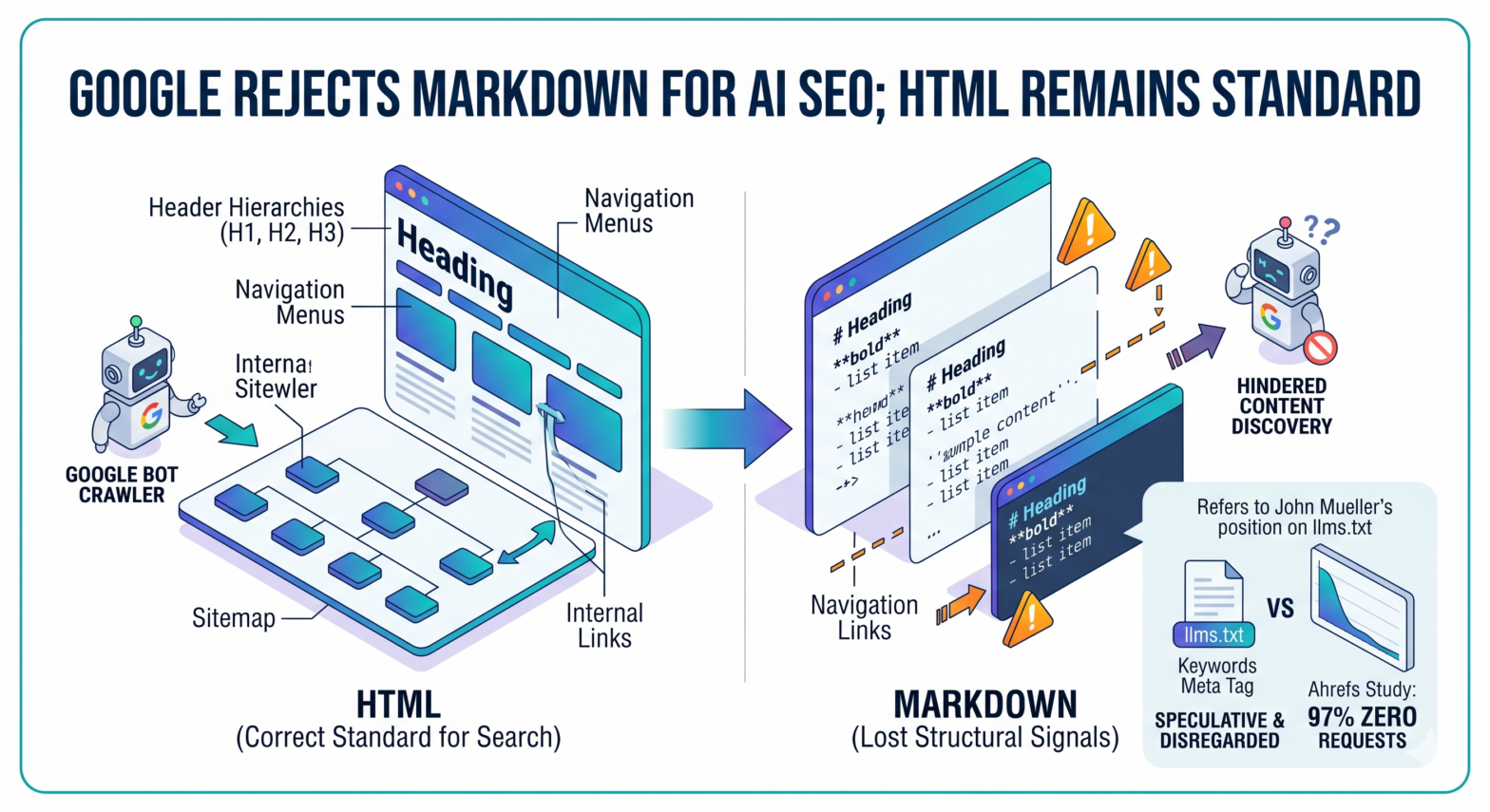
Websites converted to Markdown for AI optimization are losing the structural signals Google uses for crawling and content discovery, according to Google's own search team. In a recent episode of the Search Off the Record podcast titled "Markdown vs HTML," Google's John Mueller and Martin Splitt addressed the use cases for both formats and concluded that HTML is the standard required for SEO and search.
The Claim Google Is Pushing Back Against
A growing practice among AI-focused SEOs holds that converting web content to Markdown, a lightweight plain-text formatting syntax, makes it easier for large language models and AI agents to parse website content. The episode directly addresses whether publishers should convert their websites to Markdown to help LLMs understand their content better, and whether files like `llms.txt` are worth the effort for SEO. Mueller and Splitt rejected both premises.
Why HTML Conversion Is Already a Solved Problem
Central to the Google team's position is that the technical argument underpinning the Markdown-for-AI approach does not hold up. Web crawlers and search engines have decades of practice processing standard HTML, and extracting plain text from HTML is already a trivial task for automated systems and web libraries. Mueller and Splitt agreed that HTML remains the foundation for crawling and discovery. The premise that Markdown reduces processing complexity for crawlers is, by Google's account, a solution to a problem that no longer exists.
Navigation and Link Structure Are Lost in Markdown
The more consequential issue raised by Splitt is what Markdown actively removes. According to Splitt, Markdown is designed to serve a single piece of content in isolation, which means the HTML elements that situate a page within its broader site architecture, navigation menus, internal links, and header hierarchies are stripped away. Those elements are not decorative; both hosts said that when it comes to SEO and search, HTML is the standard and what is needed, and that Markdown files do not provide any benefit for SEO purposes. Without those structural signals, Google cannot efficiently determine how a given page connects to the rest of a site, a process the search team refers to as content discovery.
Mueller's Position on llms.txt
John Mueller, Google's Senior Search Analyst, stated on Search Off the Record that `llms.txt` files cannot be used by large language model systems to differentiate which website to surface. Mueller added one narrow use case: `llms.txt` may be helpful once an agent is already on a site and navigating or completing a task. For discovery, the process by which a crawler first finds and indexes a site's pages, Mueller said the mechanism does not function as its proponents claim.
Mueller has called building Markdown pages for bots "a stupid idea" and has also compared `llms.txt` to the keywords meta tag. That comparison carries specific weight: the keywords meta tag was once used by site owners to insert unrelated ranking terms regardless of actual content, ultimately causing search engines to disregard it entirely. Nothing stops site owners from adding self-serving content to `llms.txt` files.
Independent Data Reinforces Google's Position
The lack of measurable benefit from these practices is not limited to Google's internal assessment. Independent telemetry from Ahrefs, which analyzed 137,000 domains, found that 97% of `llms.txt` files received zero requests in May 2026, and only 28% of domains had published such a file at all. A separate analysis by SE Ranking of 300,000 domains found no link between `llms.txt` adoption and citation frequency in LLM answers.
Practical Implications for SEOs and Web Publishers
For SEOs and digital marketers evaluating AI optimization tactics, Google's position suggests that efforts to build or maintain parallel Markdown or `llms.txt` versions of site content are unlikely to produce measurable ranking or discovery benefits. Standard HTML pages with well-structured internal linking, clear navigation, and crawlable anchor text remain the baseline for how Google indexes and contextualizes web content. Resources spent converting or duplicating content in alternative formats may be better directed toward content quality, site architecture, and established technical SEO fundamentals.
Mueller summarized the team's position at the close of the episode: "for all of the SEO-related things and discovery of content, a normal HTML website is like...", what you need.