
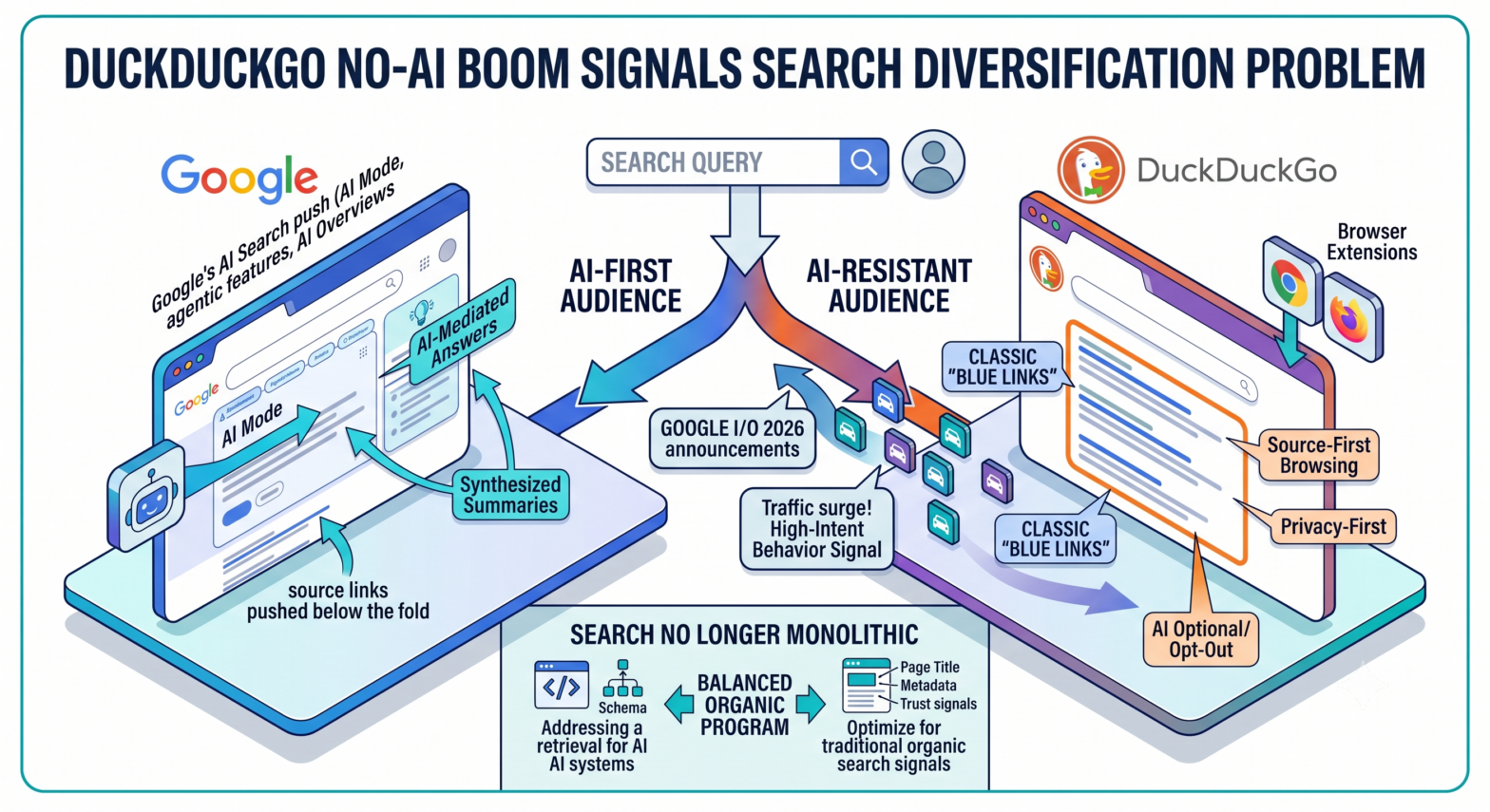
Not every search user wants an answer synthesized for them.
That is becoming a real market signal, not just a preference buried in settings menus. DuckDuckGo is making its no-AI search experience easier to use as traffic to that version of its search engine climbs, giving marketers another sign that search behaviour is splitting across AI-first and AI-resistant audiences.
DuckDuckGo’s no-AI experience works like its standard search product but turns off its AI features. The company says the page blocks Search Assist, removes Duck.ai entry points, and filters out AI-generated images as much as possible by default.
The company has now added browser extensions for Chrome and Firefox that let users set the no-AI version as their default search engine. For users already on the DuckDuckGo browser, AI preferences are preserved even when browser history is cleared.
Search Users Are Starting to Split Into Different Camps
At Google I/O in May 2026, Google described its Search changes as “a new era for AI Search” and said it was introducing the biggest upgrade to the Search box in more than 25 years. The company is adding a more intelligent AI-powered Search box, broader AI Mode access, follow-up questions from AI Overviews, and agentic features that can complete more complicated tasks inside Search.
DuckDuckGo is taking the opposite positioning: AI can be available, but it should not be unavoidable. Its public help pages describe AI features as private, useful, and optional. The no-AI page exists for users who want to search without AI answers, AI chat prompts, or a heavier presence of AI-generated images.
For marketers, the important shift is not whether one model is better. It is that different users are now choosing different search environments based on trust, control, privacy, speed, and tolerance for AI-generated results.
A user who rejects AI-generated answers may behave differently from a user who accepts AI Overviews as the default starting point. They may compare more links. They may scan snippets more carefully. They may respond better to clear source signals, plain-language page titles, and recognizable brand authority.
DuckDuckGo Is Turning AI Opt-Out Into a Product Feature
DuckDuckGo has offered AI controls before, but the new extensions lower the friction. The point is that users should not have to reset their preferences every time they search. Once the extension is enabled, searches route to the AI-free version of DuckDuckGo by default. That gives users a more consistent experience across sessions, rather than asking them to remember a separate search URL or adjust settings repeatedly.
DuckDuckGo also says its no-AI page will remain an AI-free search route even if the company expands its broader AI products. DuckDuckGo is not walking away from AI. It still offers Duck.ai, its own AI chat product, and subscription plans that include access to AI models alongside privacy services such as VPN tools, identity theft restoration, and personal information removal.
That difference matters for brands trying to understand user intent. A growing group of searchers may be comfortable with AI tools in specific contexts but still prefer traditional search results when researching products, services, medical information, financial topics, local providers, or news.
Google’s AI Search Push Is Creating a Counter-Market
Google is not hiding its direction. Google’s May 2026 Search announcements place AI Mode, AI Overviews, and agentic capabilities closer to the centre of the search journey. Google says users can ask follow-up questions directly from AI Overviews and move into conversational AI Mode while keeping context. It is also developing AI-generated layouts, tables, visual tools, simulations, and agentic features for tasks such as monitoring information, shopping, booking, and calling businesses.
For some users, that will be useful. For others, it changes the bargain that made search feel neutral: type a query, evaluate sources, click where you want to go. AI-first search compresses that journey. It can reduce the number of visible organic results above the fold. It can also change how users judge authority, because the synthesized answer may arrive before the source list receives attention.
DuckDuckGo’s traffic spike around no-AI search suggests some users are actively looking for a cleaner version of that older model. According to company figures shared publicly, visits to its no-AI page rose sharply after Google’s Search announcements, with a threefold increase reported on May 28, 2026, and visits averaging well above the previous baseline.
Those figures should be read carefully. DuckDuckGo remains far smaller than Google. A surge in relative traffic does not mean mass migration from Google Search. But relative growth can still reveal directional demand.
Marketing directors should pay attention to the type of user making that switch. People who intentionally choose a no-AI search engine are expressing a stronger-than-average preference. They are not passively accepting the default interface. They are taking action to change it.
Organic Visibility Can No Longer Assume One Search Interface
For years, many organic programs treated Google as the centre of the search universe. That was rational. In most markets, it still is.
But the search interface is fragmenting. A brand may now need visibility across Google AI Overviews, AI Mode-style experiences, traditional blue-link search results, privacy-first search engines, answer engines, vertical marketplaces, social search, and browser-level discovery surfaces.
That changes the role of an SEO strategy. Ranking in Google still matters, but ranking is no longer the only visibility problem. A page may need to be useful enough for a human researcher, structured enough for machine retrieval, authoritative enough for citation, and clear enough to earn clicks in a more skeptical search environment.
The DuckDuckGo case also gives marketers a reminder not to overcorrect into AI-only planning. Optimizing for AI search is becoming necessary, especially as Google expands AI-generated answers. But brands that shift all organic investment toward AI citations risk ignoring users who are deliberately avoiding AI-mediated results.
That audience may still value traditional signals: page titles that match intent, useful meta descriptions, comparison pages, original research, well-organized category pages, expert bylines, fast loading, and content that answers the query without burying the lead.
In practical terms, marketers should treat the no-AI search trend as another reason to maintain a balanced organic program. Content should be built for retrieval by AI systems, but still strong enough to perform in standard organic search environments where users choose links manually. Reporting should also separate visibility by channel where possible, rather than treating search traffic as one undifferentiated bucket.
The brands that depend entirely on Google’s AI surface may gain exposure in one environment while losing resilience everywhere else.
Privacy, Control, and Trust Are Becoming Search Features
DuckDuckGo’s no-AI push sits inside a larger behavioural pattern: users are paying more attention to how platforms shape what they see.
Privacy has already changed digital advertising. Consent banners, tracking restrictions, browser protections, and data regulation have forced marketers to rethink attribution and audience targeting. AI search adds a different layer. The concern is not only what data is collected, but who controls the answer.
That makes privacy-first marketing more than a compliance issue. It is becoming part of how users select tools and evaluate brands. A searcher who chooses DuckDuckGo’s no-AI route may be motivated by privacy, mistrust of AI-generated summaries, fatigue with automated content, or a desire to see source pages without an interpretive layer on top. Those motivations overlap, but they are not identical.
For publishers and businesses, the response should not be to chase every alternative engine with separate content. The better move is to make pages more defensible across environments. Clear sourcing. Strong topical relevance. Original information, where possible. Technical hygiene. Schema where appropriate. Fast pages. Human-readable expertise.
The same fundamentals that help a page survive Google’s AI-heavy results can also make it more attractive to users searching through no-AI interfaces.
Search is not returning to 10 blue links. Google has made that clear.
But DuckDuckGo’s growth shows that not every user wants the future of search delivered in the same format. Some will move toward AI agents and conversational answers. Others will choose the shortest path back to source-first browsing.