
Claude is not sending the web a flood of traffic.
Not yet.
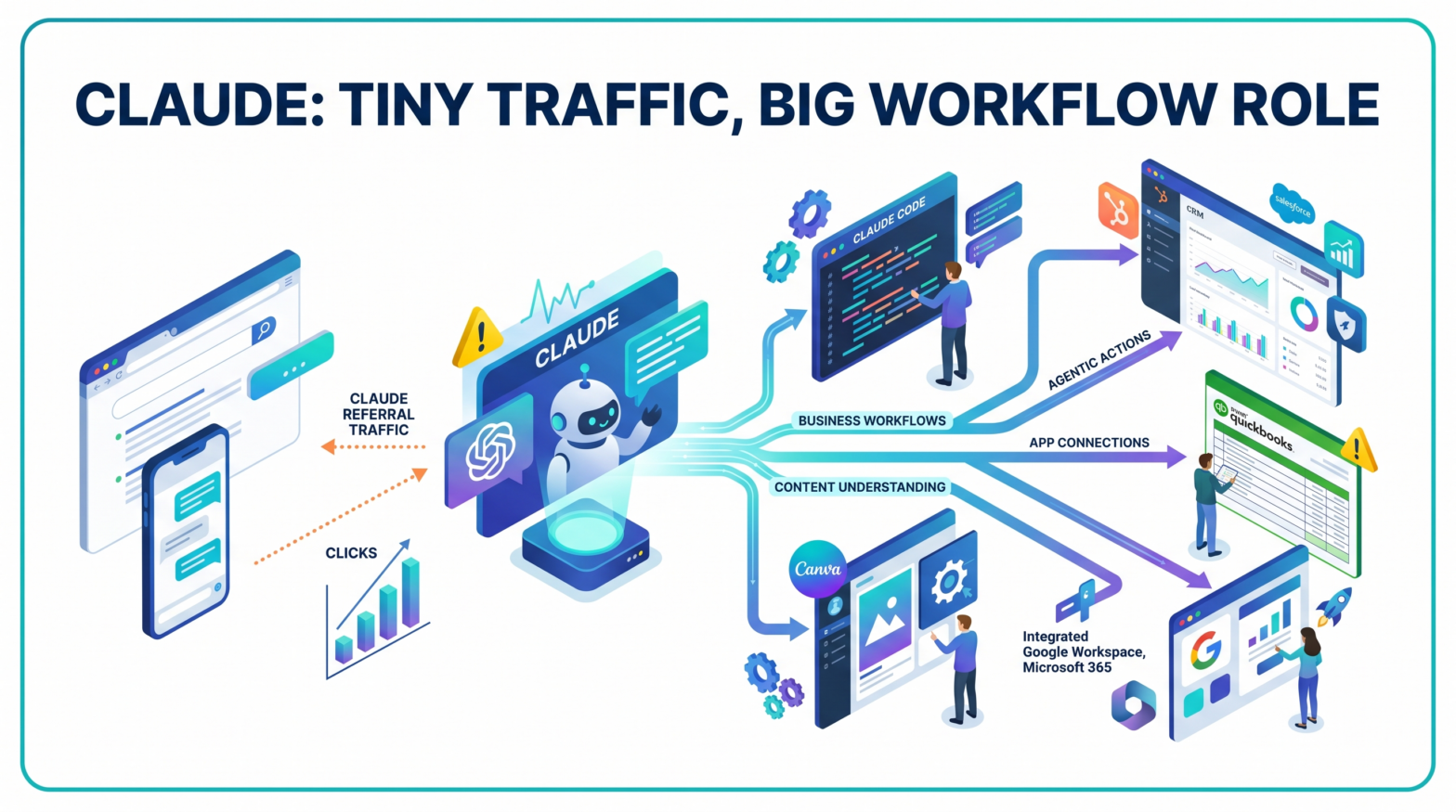
But new web traffic research shows something harder for marketers to ignore: Claude is growing faster as a referral source just as Anthropic is pushing the product deeper into everyday business workflows, from coding and finance to sales, marketing, operations, and small business automation.
That makes Claude a different kind of AI visibility problem. The near-term question is not only whether a brand earns a click from Claude. It is whether that brand’s content, data, tools, or products can show up inside the work Claude is helping users complete.
Claude’s Referral Share Jumped From Almost Invisible To Measurable
Across a dataset of 101,574 websites in 250 countries, AI platforms accounted for 0.33% of global web traffic in April 2026, up from 0.1976% in April 2025.
That is still a narrow slice of the web.
Inside that narrow slice, ChatGPT remains the dominant AI referral source by a wide margin. It accounted for 78.23% of AI-referred traffic across the full analysis period from January 2025 to April 2026. Perplexity followed at 9.33%, Gemini at 6.85%, Microsoft Copilot at 3.57%, and Claude at 1.40%.
Claude’s absolute share is small. Its growth curve is not.
Between January and April 2026, Claude’s referral traffic share rose from 0.0029% to 0.0141% of total global website traffic, a 386% increase. ChatGPT, by comparison, grew 1.53% over the same period.
The biggest movement came in March. Claude’s share climbed from 0.0049% in February to 0.0127% in March, a roughly 2.6x month-over-month increase. By April, it had reached 0.0141%.
For most websites, that level may still be too low to drive major reporting changes on its own. For marketers watching AI search, though, the pattern matters because early AI referral traffic often appears unevenly before it becomes a measurable acquisition channel.
The channel is not mature. It is forming.
The U.S. Is Seeing Claude Traffic Earlier
The regional picture shows the same broad pattern with different timing.
The United States led the analyzed markets, with Claude averaging 0.0049% of website traffic across the full 16-month period. The European Union averaged 0.0022%. Among individual European markets, France averaged 0.0028%, Germany 0.0025%, Spain 0.0020%, and the United Kingdom 0.0014%.
April 2026 produced the highest Claude traffic levels in the dataset across the U.S., EU, and U.K. Claude represented 0.0186% of website traffic in the U.S., 0.0100% in the EU, and 0.0054% in the U.K.
That gap is important because AI platform adoption rarely spreads evenly. A global average can flatten out what is happening market by market. U.S. businesses may see Claude-related referral movement earlier, while European markets may lag before following a similar curve.
For international SEO teams, this complicates measurement. A brand may see little Claude traffic globally while one market begins showing early signs of change. Channel-level reporting can miss that if AI referrals are grouped too broadly or buried inside referral traffic.
Google has already started adjusting analytics infrastructure around this shift. In May, Google Analytics added a default AI Assistant channel that can classify traffic from platforms including ChatGPT, Gemini, and Claude without custom setup. That kind of reporting change reflects the broader measurement problem: AI discovery is no longer limited to traditional search results or standard referral flows. GA4’s AI Assistant channel gives marketers a cleaner place to start, but it does not capture every AI-influenced visit.
A user may ask Claude for research, compare several options, then search Google later by brand name. The click shows up somewhere else.
Claude still shaped the path.
Anthropic Is Building For Work, Not Just Answers
The referral data would be less notable if Claude were only another chatbot competing for general search-style queries. Anthropic’s product direction points elsewhere.
In May 2026, Anthropic said Claude Code’s run-rate revenue had grown to more than $2.5 billion, more than doubling since the start of the year. The company also said weekly active Claude Code users had doubled since January 1, while business subscriptions to Claude Code had quadrupled since the beginning of 2026.
That is not search behaviour. That is workflow adoption.
Claude Code was made generally available in May 2025 and is designed to help developers work inside codebases, plan changes, write code, and run commands. Anthropic has also expanded Claude into broader business contexts through Claude Cowork, plugins, connectors, Microsoft 365 integrations, and industry-specific agent templates.
In financial services, Anthropic introduced ten ready-to-run agent templates for work such as building pitchbooks, screening KYC files, reviewing earnings, preparing client meetings, closing the books at month-end, and auditing financial statements. The company said Claude also works across Excel, PowerPoint, Word, and Outlook through Microsoft 365 add-ins, with context carrying between applications.
That matters for marketers because work tools influence decisions differently than search tools.
Search sends users to pages. Workflow tools help users produce outputs: briefs, reports, comparisons, campaigns, models, dashboards, lists, and recommendations. Visibility inside that environment can happen before a visit, without a click, and sometimes without a visible citation.
The old SEO question was: can we rank?
The newer AI visibility question is sharper: can an AI system understand, retrieve, trust, and use what we publish?
SMB Workflows Put Claude Closer To Marketing Decisions
Anthropic’s small business rollout makes the marketing angle more direct.
On May 13, Anthropic launched Claude for Small Business, a package of connectors and ready-to-run workflows built for tools small businesses already use, including Intuit QuickBooks, PayPal, HubSpot, Canva, DocuSign, Google Workspace, and Microsoft 365.
The product includes 15 agentic workflows across finance, operations, sales, marketing, HR, and customer service. Anthropic described examples such as planning payroll, closing the month, surfacing business insights, and running a campaign by analyzing HubSpot performance and generating assets in Canva.
For digital marketers, that last example is the hinge.
If Claude is operating inside CRM, creative, analytics, and productivity tools, it is closer to the point where campaign decisions are made. It can help draft audience segments, interpret performance, assemble briefs, compare vendors, summarize customer data, or prepare campaign assets. The brand or tool that integrates cleanly into that workflow may gain influence even without winning a traditional search click.
This is also where AI search and AI workflow automation begin to overlap. Search-style visibility rewards being discoverable and credible in answer environments. Workflow visibility rewards being structured, accessible, permissioned, and useful when an AI assistant is completing a task.
The overlap will be messy.
A marketer may ask Claude to compare SEO tools, pull data from a connected platform, summarize campaign options, and create a client-ready recommendation. Some inputs may come from web content. Others may come from integrated software, private files, CRM records, or structured data exposed through connectors.
That is a very different competitive surface from a Google results page.
Clicks Are Only One Signal In AI Discovery
The practical implication for marketers and SEOs is straightforward: Claude referral traffic should be monitored, but not overread in isolation. The current click volume is small for most sites, while the stronger near-term signal may be how AI tools use a brand’s content and data inside task-based workflows. Teams should make sure analytics can identify AI assistant referrals, keep high-value content crawlable and clearly structured, strengthen brand and product information that can support comparisons, and treat AI visibility as both a measurement and content accessibility issue.
There is no evidence that Claude is replacing Google, ChatGPT, or traditional search as a major website traffic source today.
The numbers do not support that.
What they do show is an early-stage channel growing quickly from a very small base, while the product behind it becomes more embedded in business software and decision-making environments. That combination makes Claude worth tracking before it becomes large enough to dominate dashboards.
For publishers, SaaS companies, ecommerce brands, marketplaces, agencies, and data-heavy businesses, the risk is not just losing a click. It is being absent from the workflow where the user asks the AI to compare, select, summarize, plan, or build.
Traffic reports will catch part of that shift. They will not catch all of it.
Claude’s visible referral share may still look minor in June 2026, but Anthropic’s current product direction places the assistant inside the systems where professional work is already happening. That is where the next layer of AI search competition is likely to surface first.