

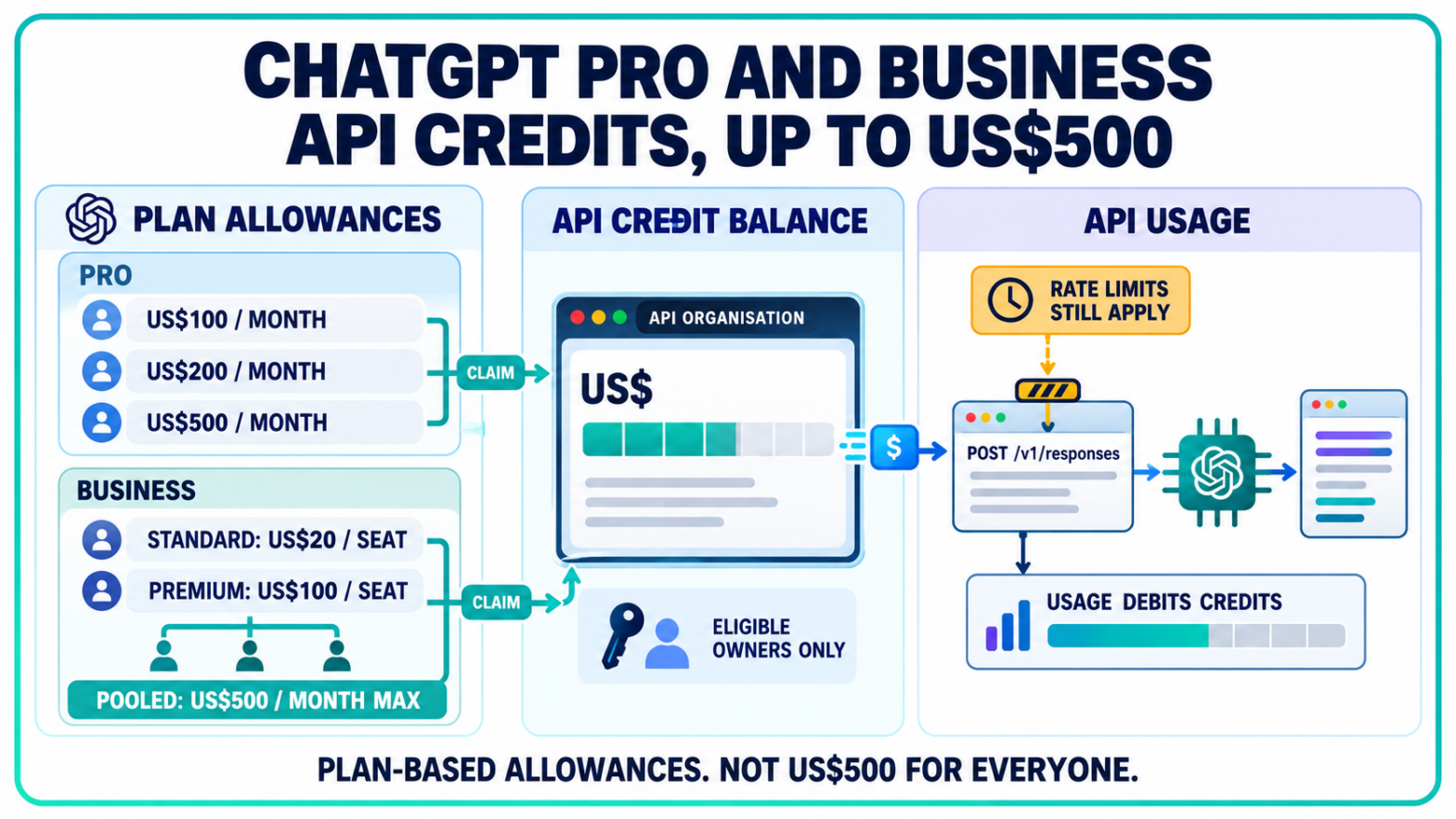
A paid ChatGPT subscription can now help fund software built outside the chat interface. OpenAI’s October 28 API update adds up to US$500 per month in API credits for eligible Pro and Business subscribers.
The benefit connects subscription spending with the separate costs of running API-powered applications. For agencies and marketing teams, that creates an allowance for development or recurring workloads, rather than requiring every API charge to come from purchased credits.
The headline amount is a ceiling. It is not a US$500 entitlement for every subscriber.
ChatGPT API Credits Depend on Plans and Paid Seats
The official OpenAI documentation lists these monthly allowances:
- Pro, US$100 tier - US$100
- Pro, US$200 tier - US$200
- Pro, US$500 tier - US$500
- Business Standard - US$20 per paid Standard seat
- Business Premium - US$100 per paid Premium seat
Business credits are pooled, with a US$500 monthly workspace cap. Annual prepaid workspaces receive a yearly grant that expires with their annual billing cycle.
The distinction matters when comparing individual and team subscriptions. A per-seat calculation determines a Business workspace’s allowance, but the workspace cap limits the total. Adding seats does not create an unrestricted API budget.
For a business assessing the benefit, the relevant figure is its eligible allowance, not simply the maximum advertised amount.
Subscription Ownership Determines Who Can Claim
Claimants need a paid subscription at least seven days old, ownership of both the subscription or workspace and the receiving API organization, and matching account emails. Activation is available through ChatGPT or API Platform billing.
Having access to a company’s ChatGPT workspace is therefore different from having authority to connect its subscription benefit to an API organization.
That distinction is particularly relevant where marketing staff use ChatGPT while developers or an external agency manage integrations. The people using an application, administering the workspace and controlling its API account may not be the same.
The change concerns funding. It does not remove the need to establish which organization operates the software and controls its credentials.
OpenAI API Pricing Still Determines How Far Credits Go
Credits cover text, agents, decisions, voice, images and built-in API tools. Codex API-key usage is excluded; ChatGPT and signed-in Codex limits do not increase.
The allowance is a monetary balance, not a fixed number of completed tasks.
OpenAI’s API pricing documentation separates model input, output and caching charges. Tools can introduce additional costs: web search, for example, carries a call charge alongside applicable search-content token charges. File search can involve both storage and tool-call fees.
A short classification request and an agent performing several searches will therefore consume different amounts, even if both serve the same business process. The number of model calls, the material supplied, and the work returned all affect consumption.
That makes OpenAI API pricing relevant beyond the advertised allowance. Reusing stable context through caching can change the cost calculation, while a workflow that repeatedly generates lengthy outputs has a different spending pattern.
The subscription benefit offsets eligible usage. It does not establish a universal cost per campaign, customer enquiry or completed document.
API Rate Limits Remain Separate From Credit Balances
A funded account can still encounter throughput restrictions.
OpenAI’s rate-limit guidance describes limits on requests, tokens and other usage measures within specified periods. These apply at organization and project levels and vary by model.
The documentation also distinguishes usage tiers from configurable spending controls. Paid tiers advance according to credit-purchase thresholds, while spend alerts notify administrators and hard spending limits can stop affected requests.
An available balance answers whether usage can be funded. It does not, by itself, establish how much work an application can send simultaneously.
For marketing teams evaluating AI workflow automation, the practical task is to measure a representative workload before treating the allowance as an operating budget. Cost per completed task, retries, tool charges and human review provide a more useful comparison than the number of requests alone.
Unused grants expire with the billing cycle; the first is prorated. Free credits are spent first, and purchased credits keep requests running afterwards. Without either balance, requests fail with a credit-balance-exhausted error.