

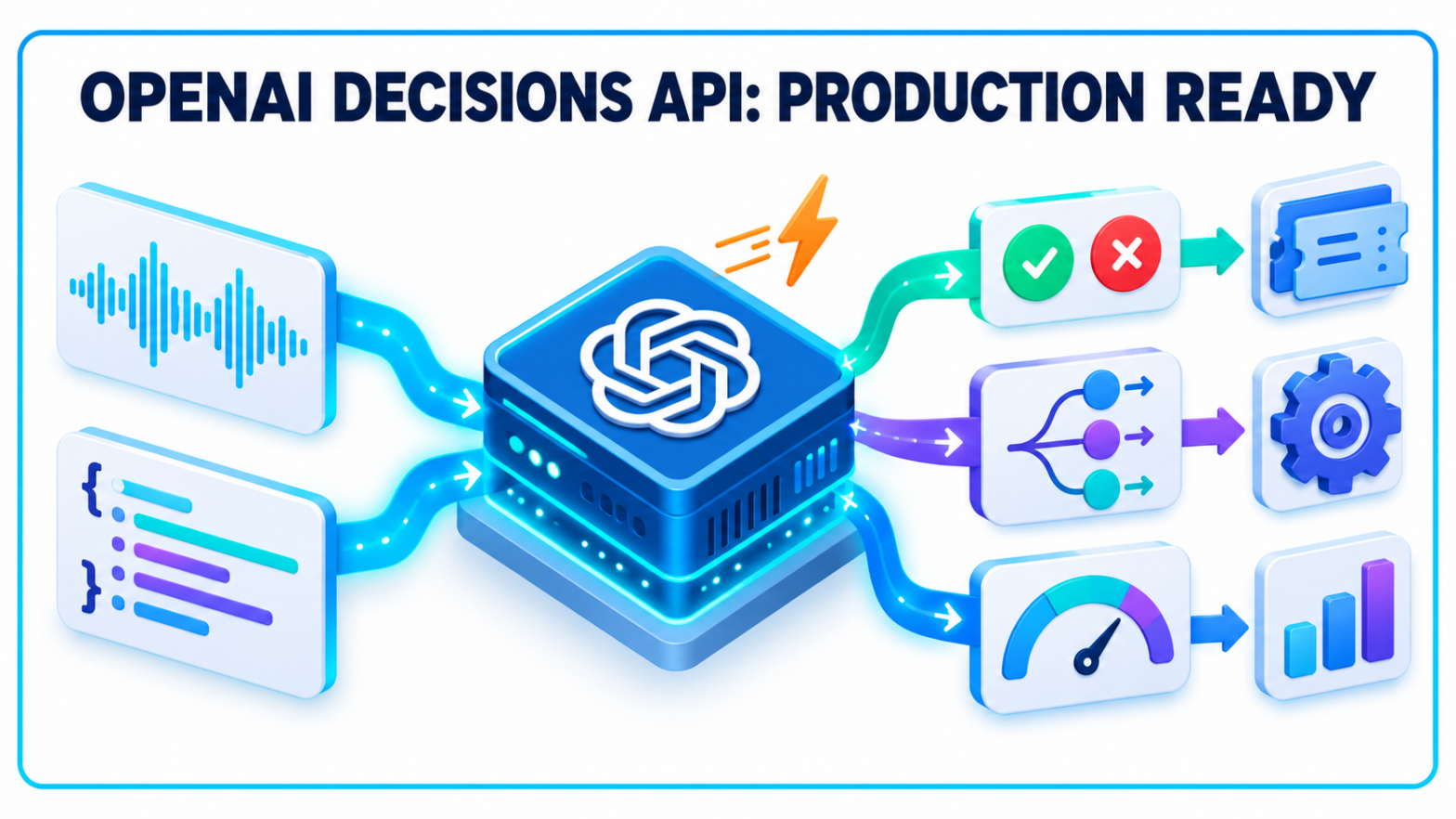
The small decisions inside an AI workflow now have their own production-ready endpoint. OpenAI has moved its Decisions API out of beta, adding controls for systems that need to classify, route and act without waiting for a full model response.
OpenAI’s Decision Layer Leaves Beta After 16 Days
OpenAI made the Decisions API generally available on October 22, 16 days after opening the dedicated endpoint to all developers in public beta.
The OpenAI Decisions API runs on GPT-6 Luna and remains accessible through POST /v1/decisions. Luna is still the only supported model.
Unlike a general-purpose model request, the endpoint is designed for questions with bounded answers. An application can ask whether a condition is true, select from predefined choices or assign a score against an ordered rubric. The response can then be passed directly into software that routes a support request, categorizes content or decides whether an automated process should continue.
According to OpenAI’s October 22 announcement, the endpoint can return these decisions up to 10 times faster than running GPT-6 Luna through the Responses API. That is OpenAI’s comparison rather than an independent benchmark.
The company also published results supplied by early customers. Box reported roughly five-times-faster route selection across an evaluation involving 30 insurance documents, while Sierra reported latency below 280 milliseconds at the 95th percentile for parts of its customer-service orchestration. Those figures reflect specific customer tests and should not be treated as universal performance guarantees.
Bounded Answers Replace Free-Form Generation
Most generative AI products are built to produce something for a person to read: an answer, explanation, image or block of code. Decisions address a narrower job.
Developers provide evidence as text, images or structured JSON, then define one or more questions. A predicate returns an estimated probability from zero to one. A choice selects one value from a fixed set and includes probability and confidence data. A score evaluates an input against ordered levels and returns a probability-weighted result.
That structure makes the output easier for software to consume. A marketing operations system could classify incoming leads by intent, score a campaign asset against a review rubric or determine whether customer feedback requires escalation. The endpoint does not execute the next step itself; the surrounding application remains responsible for acting on the answer.
The distinction matters for AI workflow automation. Using a full generative response to make every routing choice can introduce unnecessary latency, output tokens and parsing work. A bounded decision endpoint limits the possible answers before the request is sent.
It is not a replacement for the Responses API. OpenAI’s developer guide directs teams to Structured Outputs when they need a custom JSON object, function calling when a model must request a tool and the Decisions API when the required result is a probability, fixed choice or rubric score.
JSON Inputs and 400 Questions Expand Batch Workflows
General availability brings a larger set of production features than the public beta offered.
Applications can now send structured evidence directly through an input_json content part rather than converting records into text first. A support system, for example, can submit a customer complaint alongside an order record and ask whether the reported problem is supported by the transaction data.
Each request can contain as many as 400 independent questions, twice the beta limit. Questions that rely on a previous answer still require separate requests, but teams can evaluate multiple independent criteria against the same shared input in one call.
Images can also appear inside individual question instructions. That allows each question to compare a different candidate image against evidence shared by the request. For marketing teams, a comparable workflow could assess multiple pieces of creative against a reference asset or apply separate review criteria to a common campaign brief.
Hosted image inputs are now supported through publicly accessible HTTP or HTTPS URLs. During the beta, image handling was more restrictive and relied on inline base64 data.
The API can also evaluate conversation history containing messages, function calls, custom tool calls and their outputs. OpenAI has added organization-level usage reporting, allowing administrators to track request counts and token consumption by model, project or API key.
Prompt Caching Changes the Cost Calculation
The endpoint continues to charge US0.10permillionuncachedinputtokens,withnooutput-tokenfee.CachedinputispricedatUS0.01 per million tokens, while cache writes are charged according to GPT-6 Luna’s standard caching rates.
New prompt caching support lets applications reuse a matching prefix of shared evidence across requests. That could be useful when the same brand policies, product catalogue, campaign rubric or reference document must inform a stream of separate decisions.
OpenAI places an implicit cache breakpoint at the end of the shared input by default. The reusable prefix must contain at least 1,024 tokens, remain identical across requests and exclude the question content itself. Developers can also define explicit breakpoints when they need more control over which material is eligible for reuse.
The practical calculation depends on repetition. A large reference document used across many classifications may produce meaningful savings. A short or frequently changing input may never meet the threshold or achieve enough cache hits to offset the write charge.
Regional processing premiums and long-context pricing multipliers may also apply. OpenAI says the endpoint supports Zero Data Retention and HIPAA use for eligible customers. Data residency is available across supported API regions, while regional processing is currently limited to the United States and Europe, including the European Economic Area and Switzerland.
GPT-Live Can Make Decisions During a Conversation
The new GPT-Live integration moves the endpoint into live voice experiences.
Developers can configure GPT-Live to call Decisions when input or output transcript events arrive. A voice application could classify a customer’s request, decide whether clarification is needed or determine when an issue should be escalated while the conversation is still underway.
OpenAI’s demonstration uses transcript updates to choose an avatar’s facial expression. The Decisions API selects from predefined reactions, and the application uses the selected value to animate the character. The same event structure could support less visible operational choices, such as routing a caller or selecting an approved next action.
For marketers and customer-experience teams, the immediate opportunity lies in narrow, repeatable decisions rather than open-ended campaign strategy. Teams still need labelled examples, clear answer categories and thresholds tested against the cost of false positives and false negatives. Low-confidence results can be sent for human review instead of triggering an automatic action.
General availability does not broaden the endpoint beyond GPT-6 Luna. The OpenAI API changelog lists no additional model options or release schedule for them, leaving production deployments tied to one model and the dedicated Decisions endpoint.