



Businesses have a new way to supply information to ChatGPT, but the launch does not give every company the same access. OpenAI’s November 10 beta separates business profiles, engagement reporting and customer-facing agents, with restrictions that matter for Canadian firms.
Online Businesses and Local Listings Have Different Entry Rules
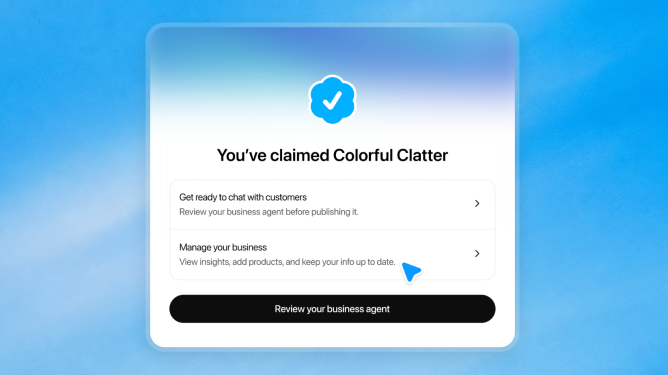
OpenAI’s Businesses in ChatGPT announcement introduces a place for eligible companies to claim their business, manage information and examine how people engage with them inside ChatGPT.
The geographic scope needs careful reading.
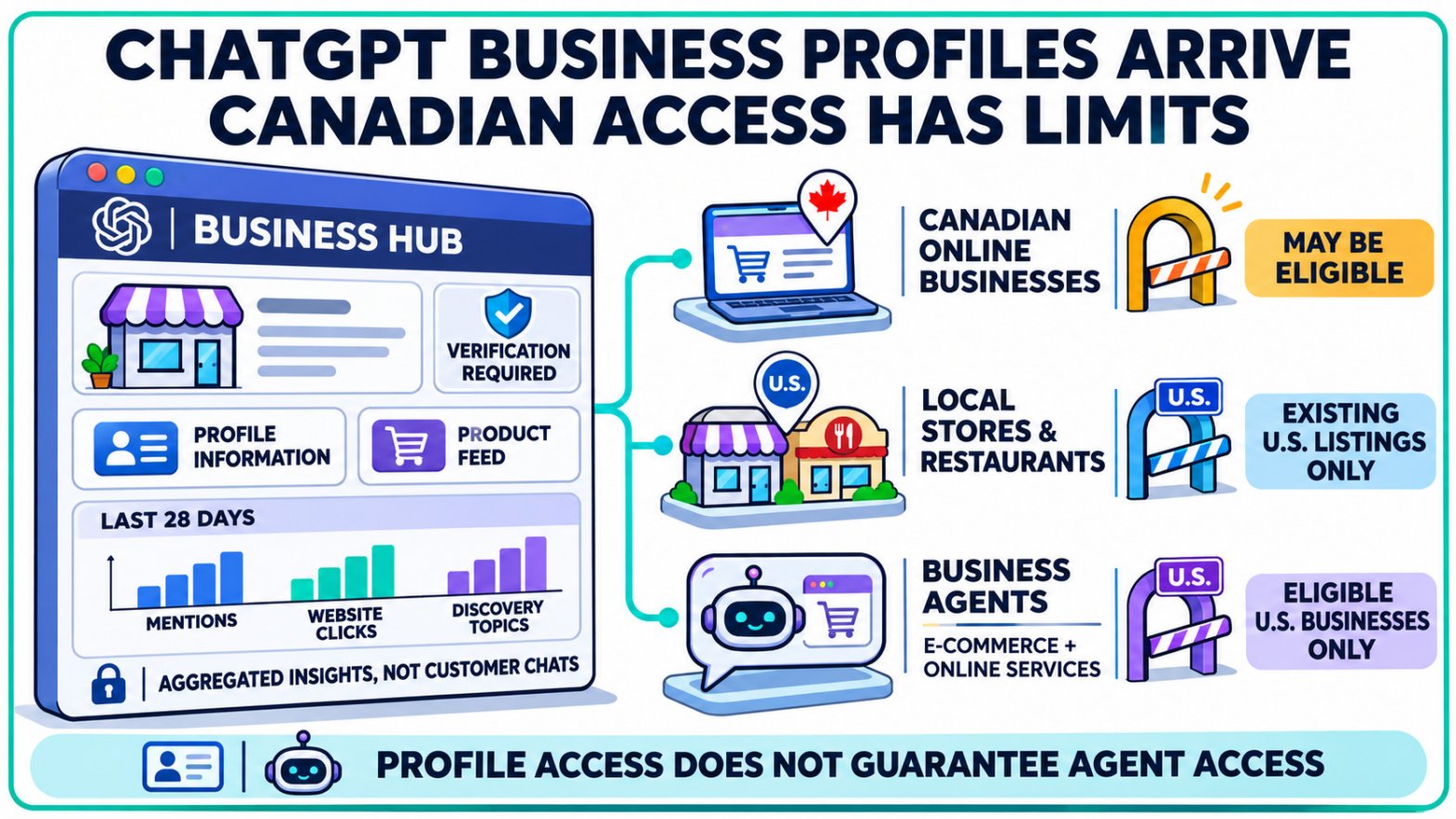
OpenAI’s setup documentation makes access conditional on business location, type and supported verification. Eligible online businesses can claim an existing business or may receive an option to add one. Local stores and restaurants can currently claim only an existing U.S. listing.
For Canadian companies, the distinction is between potential eligibility as an online business and access to local listing management. The announcement does not establish a general Canadian rollout for shops and restaurants.
Business Agents have another boundary: they are available to eligible U.S. e-commerce and online service businesses with websites. Access to a profile should not be confused with eligibility to publish an agent.
Verification Unlocks Information Management
OpenAI’s November 10 release notes describe two stages. An approved claim gives the owner or authorized representative access to the business in Business Hub. Approved identity verification through Persona then unlocks publishing information updates, connecting a product feed and viewing insights.
For retailers, that creates a direct route for supplying commercial information rather than relying entirely on what ChatGPT retrieves elsewhere.
The underlying data still needs maintenance. OpenAI’s product feed specification requires information including product identifiers, titles, descriptions, destination URLs, images, prices and availability. Merchants must update current prices and stock status when they change.
That adds an operational requirement to ChatGPT shopping: a connected catalogue is only as useful as the information maintained within it. Eligibility for display is not a promise that an item will appear.
OpenAI’s business profile policies also make companies responsible for keeping submitted information accurate. They prohibit misleading prices, availability claims, credentials and unsupported guarantees. Profiles may include information from other sources, and OpenAI says it does not verify every detail or resolve every factual dispute.
ChatGPT Business Hub Measures Engagement Without Exposing Chats
The launch confirms a reporting capability that had previously appeared in ChatGPT Business Hub coverage as an unconfirmed development.
OpenAI now describes aggregated reporting for mentions, website clicks and discovery topics. Its setup guidance says insights cover the previous 28 days, but the definitions differ by business type.
For an online business, a mention requires a reference to its website; the brand name alone does not count. For a local business, showing a result for that location counts even if the user does not open the listing or visit its website.
Those are different measurements, not interchangeable indicators of customer interest.
Discovery topics group common themes rather than reveal individual prompts or directly measure intent. Businesses do not receive consumer conversations, including chats with their agents.
Blank reporting also needs caution. It can reflect insufficient activity, data collection or unavailable reporting rather than zero engagement.
For marketers, the practical implication is to keep these figures separate from website visits, leads and sales. A recorded appearance describes exposure within ChatGPT; it does not establish that a customer visited, enquired or purchased. Reporting comparisons need consistent metric definitions and time periods.
Business Agents Speak for Companies, Not for ChatGPT
Business Agents add a customer-facing conversation to the profile experience.
When a business appears in a ChatGPT response, users can open its profile. If an agent is available, they can choose to start a separate conversation about the company’s offerings. OpenAI says that the exchange is clearly labelled and distinct from both the original conversation and ChatGPT’s independent answers.
The distinction concerns who is speaking.
Under OpenAI’s Business Agents Policy, an agent must identify itself as AI representing the business. It must not present itself as an independent adviser, a human or an entity endorsed by OpenAI.
Businesses are responsible for the information and instructions they provide. Agents cannot invent prices, credentials, reviews or guarantees, conceal material conditions, or pressure users after they decline an offer. Verification alone does not establish eligibility to publish an agent.
There is also a paid route. Businesses can sponsor their agents and use them as destinations for ChatGPT Ads. OpenAI says sponsored placements remain labelled and separate from its responses.
The profile, the company-representing conversation and the advertisement are related products, but they are not the same interaction.
Google Business Profile Offers a Familiar Reference Point
The comparison with Google Business Profile is straightforward at the information-management level. Both give businesses a way to maintain details customers encounter before visiting their websites.
Google’s official Business Profile page describes a free listing across Search and Maps, with tools for photos, operating hours, customer reviews, updates and supported booking or ordering connections. Its reporting includes information about how customers find and interact with a business.
OpenAI’s launch places business-managed information inside a conversational discovery experience. It adds aggregated engagement reporting and, for eligible U.S. companies, an optional agent representing the business.
That does not establish feature parity or make the two platforms substitutes. A business’s eligibility, customer interactions and available measurements differ between them. Canadian local operators, in particular, should not read the ChatGPT announcement as equivalent access to another broadly available local listing service.
OpenAI says it plans to expand Businesses in ChatGPT and Business Agents to additional markets and business categories. Its November 10 announcement does not provide a date for Canadian local listing claims or a Canadian Business Agent rollout.