
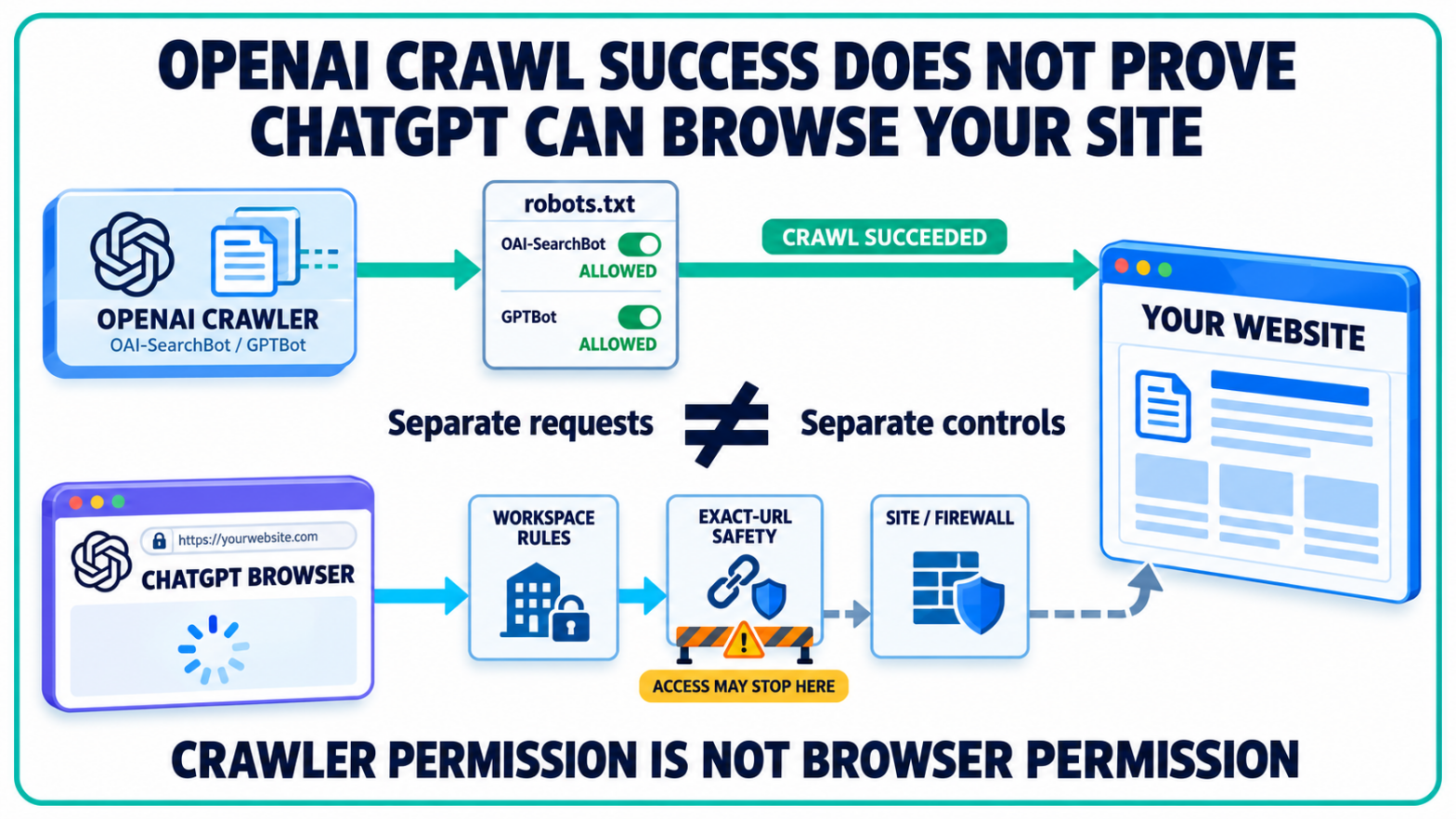
A website can allow OpenAI’s crawlers and still fail to open in ChatGPT’s browsing tools. The company documents separate controls for crawling, browser access and link safety, making successful bot visits an incomplete test of accessibility.
For publishers and businesses investigating missing AI traffic, that distinction changes the diagnosis. A crawl permission, a browser permission and a safety decision address different questions. Changing one does not establish that the others will permit access.
The verified issue is broader than a single reported blocking system: website owners cannot treat every OpenAI request as the same kind of interaction.
OpenAI Crawlers Do Not Share One Permission
OpenAI’s crawler documentation separates automated search crawling, model-training collection and certain user-triggered page visits.
OAI-SearchBot supports appearances in ChatGPT search results. GPTBot collects content that may be used to train OpenAI’s generative models. Their robots.txt settings operate independently, allowing a publisher to permit search crawling while declining training collection.
ChatGPT-User serves a different purpose. OpenAI describes it as a user agent for certain actions initiated through ChatGPT and Custom GPTs, rather than an automated web crawler. The company says robots.txt rules may not apply to those user-initiated requests.
TechWyse has previously examined these differences between OpenAI crawlers and user-triggered access.
A successful GPTBot request therefore establishes only that the request succeeded. It does not demonstrate that a separate browser session can open the same page, retrieve its current content or complete an interaction.
Nor does allowing search crawling guarantee a citation. Technical eligibility and selection for an answer remain different outcomes.
ChatGPT Browsing Has Separate Access Restrictions
OpenAI has explicitly documented restrictions beyond a website’s own crawler preferences.
Its ChatGPT agent help page describes website restrictions imposed for security, safety and compliance. The documentation says a restricted source will not be used when an attempted visit is blocked.
There is an important product qualification: the same page now states that ChatGPT agent is no longer available and directs users towards ChatGPT Work and supported cloud-browser workflows. Its remaining agent-specific sections should not be mistaken for a newly announced product policy.
Current managed browser documentation also describes administrator-controlled access rules. Managed restrictions can prevent access to particular browser origins, and local settings cannot relax a managed denial.
A refusal in one workspace consequently does not establish that a domain is blocked for every OpenAI user or product.
TechWyse’s earlier reporting on ChatGPT browsing examined why robots.txt is not a universal control for these interactions. The reverse assumption is equally unreliable: permissive crawler rules do not remove every other access restriction.
URL Safety Checks Are Not Domain Reputation Scores
OpenAI has published a separate explanation of safeguards against information leaking through links.
In its January 28 agent link-safety explanation, the company describes how an attacker could manipulate an AI system into requesting a URL containing private information. The destination could then capture that information in its logs.
The protection described checks whether an exact URL has previously appeared in an independent public web index. A matching address can be fetched automatically. An unverified address may require explicit user action or lead the agent towards another source.
That is not the same as declaring an entire website malicious.
OpenAI also explains why a familiar domain is insufficient protection: legitimate websites can support redirects that ultimately lead elsewhere. Its stated safeguard addresses whether a particular address could carry user-specific information, rather than relying solely on the apparent reputation of the hostname.
The company presents this as one layer of protection, not a guarantee that a page is trustworthy or free of malicious instructions.
These distinctions matter when interpreting an error. A URL-verification warning, a workspace restriction and a website-side denial are not interchangeable diagnoses.
Missing Server Requests Do Not Identify the Blocker
Server logs can help establish whether a request reached the systems being monitored. They cannot, by themselves, explain every failure that occurred before that point.
An origin server may show no request because an intermediary handled or rejected it. A browser may also encounter a connection problem before an HTTP request reaches the website. Incomplete logging creates another uncertainty.
An explicit policy error is stronger evidence of a policy refusal than a generic loading failure. Even then, its wording and product context matter.
Successful requests from one OpenAI user agent do not resolve the question for another tool. They may involve different infrastructure, authentication, permissions or request paths.
The commercial measurement is separate again. TechWyse’s coverage of AI search visibility has examined why automated access does not prove that content was recommended, cited or responsible for a customer visit.
Neither an empty request log nor a busy crawler dashboard is a complete visibility report.
Cloud Browser Allowlisting Addresses the Website Side
OpenAI’s current cloud-browser allowlisting guide gives website operators a documented way to recognize legitimate browser traffic.
The guide describes signed requests that allow a content delivery network or firewall to verify their origin. It includes provider-specific guidance for Akamai, Cloudflare, HUMAN and Vercel, alongside instructions for other infrastructure.
That addresses a website-side compatibility problem. It is not presented as a mechanism for overturning an OpenAI safety restriction or a managed workspace denial.
For marketers and technical teams, the practical implication is to record the affected product, exact URL, error message and timestamp, then compare browser behaviour with CDN, firewall and server evidence. Keeping that evidence together helps distinguish an access failure from a content-selection or attribution problem without weakening security controls unnecessarily.
OpenAI’s troubleshooting guidance specifically tells operators to check that intermediate proxies preserve the request-signature headers. Its instructions for other CDNs say access should be allowed only after those signatures have been successfully verified.