Canva no longer has to rely entirely on outside companies to power its image generation tools. Its first in-house foundation model is built to understand the structure of a design before rendering the pixels.
Called Canva Craft, the model is available globally through Dream Lab and Canva’s developer API. The larger shift is not simply who owns the model. It is how closely image generation can now be connected to Canva’s editing, design and automation systems.
Canva Now Owns More of Its AI Stack
Canva has offered generative image features for years, including models from OpenAI and Google alongside technology from Leonardo.Ai, which Canva acquired in 2024.
Craft moves the company further down the technology stack.
According to Canva’s launch announcement, Craft is the first foundation model developed and trained from scratch by Canva Research. Researchers from Leonardo.Ai contributed to the project, which is now positioned as a shared in-house model rather than a third-party integration.
Owning the model gives Canva more control over how image generation behaves inside its products. It can tune outputs for the formats people already create in Canva, connect the model to editing features and reduce its dependence on external model providers for performance, availability and cost.
That matters as competing platforms bring AI image generation closer to existing creative workflows. Google, OpenAI and Meta now operate their own image models, while design and productivity platforms are increasingly expected to offer generation as a built-in capability.
Canva says Craft debuted as the fourth-highest-ranked image model on DesignArena, a crowdsourced evaluation platform. The company also says it ranked first for people and portraits and for landscapes and nature, second for abstract images and patterns, and fourth for product imagery.
Those rankings reflect human preference tests on the platform. They do not establish how Craft will perform across every brand, language or production workflow.
Craft Plans the Composition Before Rendering It
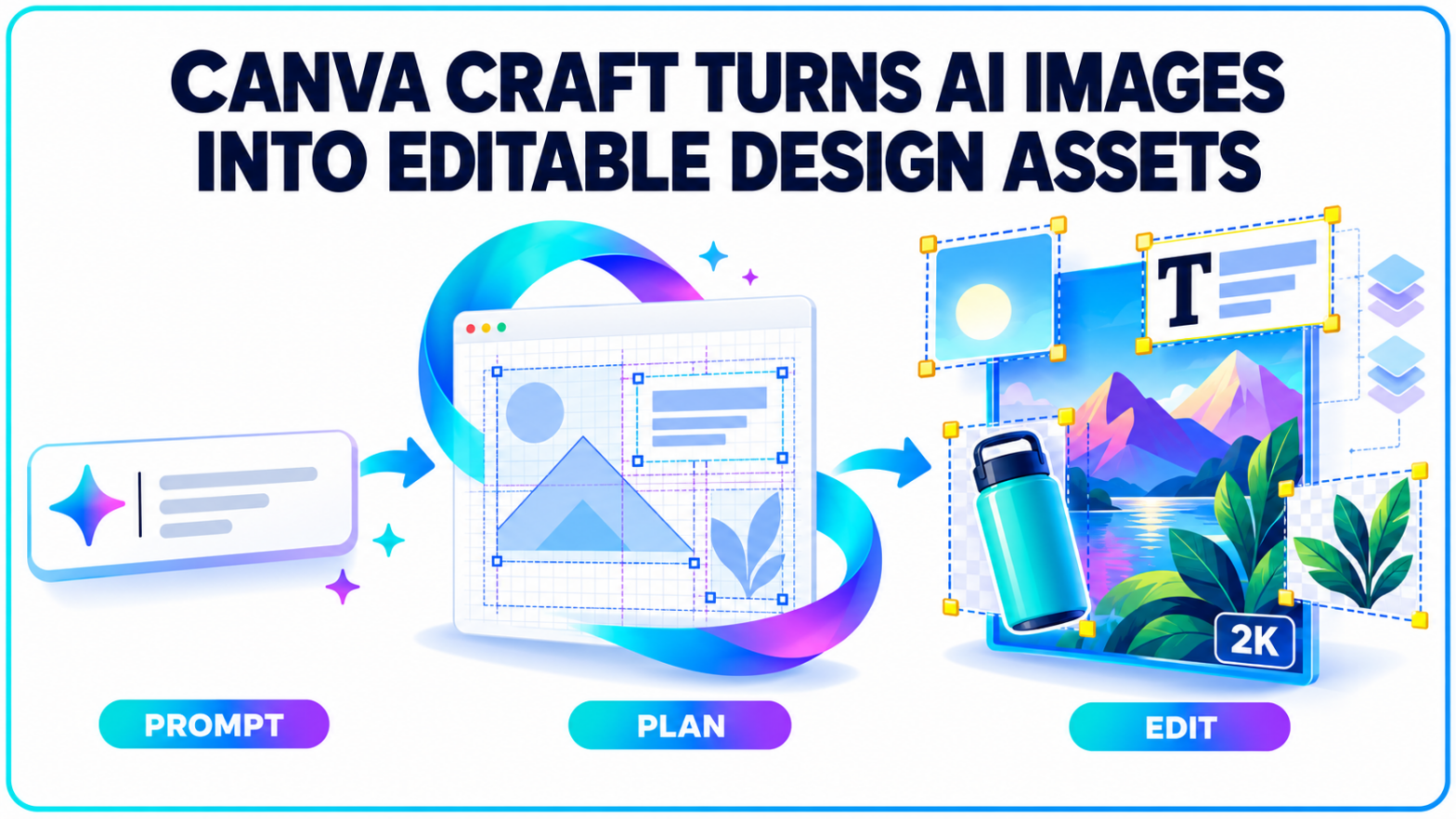
Most image generators turn a prompt directly into a visual output. Craft inserts a separate planning stage before the image is rendered.
The first model interprets the prompt and produces a structured composition plan. That plan can define which objects should appear, where they belong, how large they should be relative to one another, what visual hierarchy the image requires and where text should be placed.
A second model then renders the planned composition at up to 2K resolution.
Separating those stages is intended to improve areas where image generators frequently struggle: precise object placement, legible typography, spacing and consistency between visual elements. Craft supports more than 30 aspect ratios and can generate text in 55 languages, while prompts can be submitted in any language.
The planning stage also makes targeted editing more practical. When the model understands an image as a group of defined elements, a request to change the sky, move an object or adjust one line of text does not necessarily require the entire composition to be rebuilt.
That puts Craft in the same emerging category as editable AI images, where the initial generation is treated as a working asset rather than a finished, flattened picture.
There is still an important distinction. Craft ultimately renders an image. It does not automatically produce a conventional Canva design containing separately editable objects in every case.
Instead, its planning data and boundary boxes are designed to improve Canva’s Magic Layers process, which converts a generated or imported image into individual design elements. The model and the editing tool work together to move the result from a flat image toward an editable composition.
The Training Data Looks More Like a Design Library
Canva trained Craft with a stronger emphasis on designed material than models built primarily around photographic images.
The company says the training data includes millions of human-made templates from its content library. Those templates cover posters, presentations, social posts, infographics, menus and other typography-heavy formats.
That material provides more than examples of what finished designs look like. Canva says layered templates teach the model how layout, alignment, hierarchy and typography work together.
After pre-training, Canva used supervised fine-tuning and reinforcement learning to improve the model. Professional designers participated in evaluations covering more than 25,000 pairs of images, with human judgement taking priority when automated scores and designer assessments disagreed.
The approach is deliberately aligned with Canva’s core market. A general image model may excel at cinematic scenes or photorealistic portraits but struggle to produce a usable event poster, presentation graphic or advertisement with correctly positioned text.
Craft is designed around that production gap.
Canva’s announcement does not provide a detailed breakdown of the ownership and licensing categories represented within the template dataset. It identifies the source as Canva’s content library but does not explain how much of the training material came from Canva-created, commissioned, contributor-supplied or customer-facing content.
The company says the deployed model is covered by Canva Shield, which includes input and output moderation, privacy controls, safety testing and tools for reporting harmful or misleading content.
Dream Lab Is Only the First Distribution Channel
Canva Craft is available to users through Canva Dream Lab, where it can generate several image options from a prompt and accept follow-up editing instructions.
Canva says the model is available to all users globally. Access is still governed by the platform’s AI allowances, plan limits and organizational controls. Free accounts have limited monthly AI usage, while administrators on team, enterprise and education accounts can restrict access to Dream Lab.
Developers can also select Craft through Canva’s image generation endpoint using the craft_v1_2k model identifier. The API can return a temporary download URL or save the generated image to a user’s Canva account.
That API remains in preview. Canva’s developer documentation warns that unannounced breaking changes may occur and that public apps using the preview generation APIs cannot currently pass review for general availability. Each generation also consumes the connected user’s Canva AI allowance.
Canva plans to make Craft accessible through its MCP server as well. That would allow AI assistants and automated workflows to request an image as one step in a larger task, such as preparing a product launch, generating campaign assets or creating a social post.
No availability date has been announced for the MCP integration.
This external distribution strategy builds on Canva’s existing partnerships. Its design technology already supports creative work inside products such as Claude, while Canva actions can also begin from connected AI experiences. Craft gives the company its own image model to place behind more of those interactions.
Better Generation Still Requires Production Review
For marketing teams, Craft’s practical value sits between the prompt and the finished campaign asset.
Planning layouts before rendering could reduce the number of generations needed to achieve usable typography, object placement and visual hierarchy. Support for numerous aspect ratios may also shorten the process of producing related graphics for social posts, presentations, display ads and print materials.
Magic Layers can then provide a route into manual editing when the image needs different copy, colours or element placement.
The model does not remove the review work surrounding brand consistency, factual accuracy, rights or cultural context. Canva’s own Dream Lab guidance says the copyright treatment of AI-generated work differs by jurisdiction and that recognizable characters, trademarks and brands may require permission from their rights holders.
Dream Lab also applies a visible label to generated images to indicate that AI was used.
Canva is developing two additional versions, Craft-fast and Craft-ultrafast, using model distillation and a custom inference engine to reduce generation costs and latency. The company has not announced their release dates, while Craft’s planned MCP integration is also still listed as coming soon.