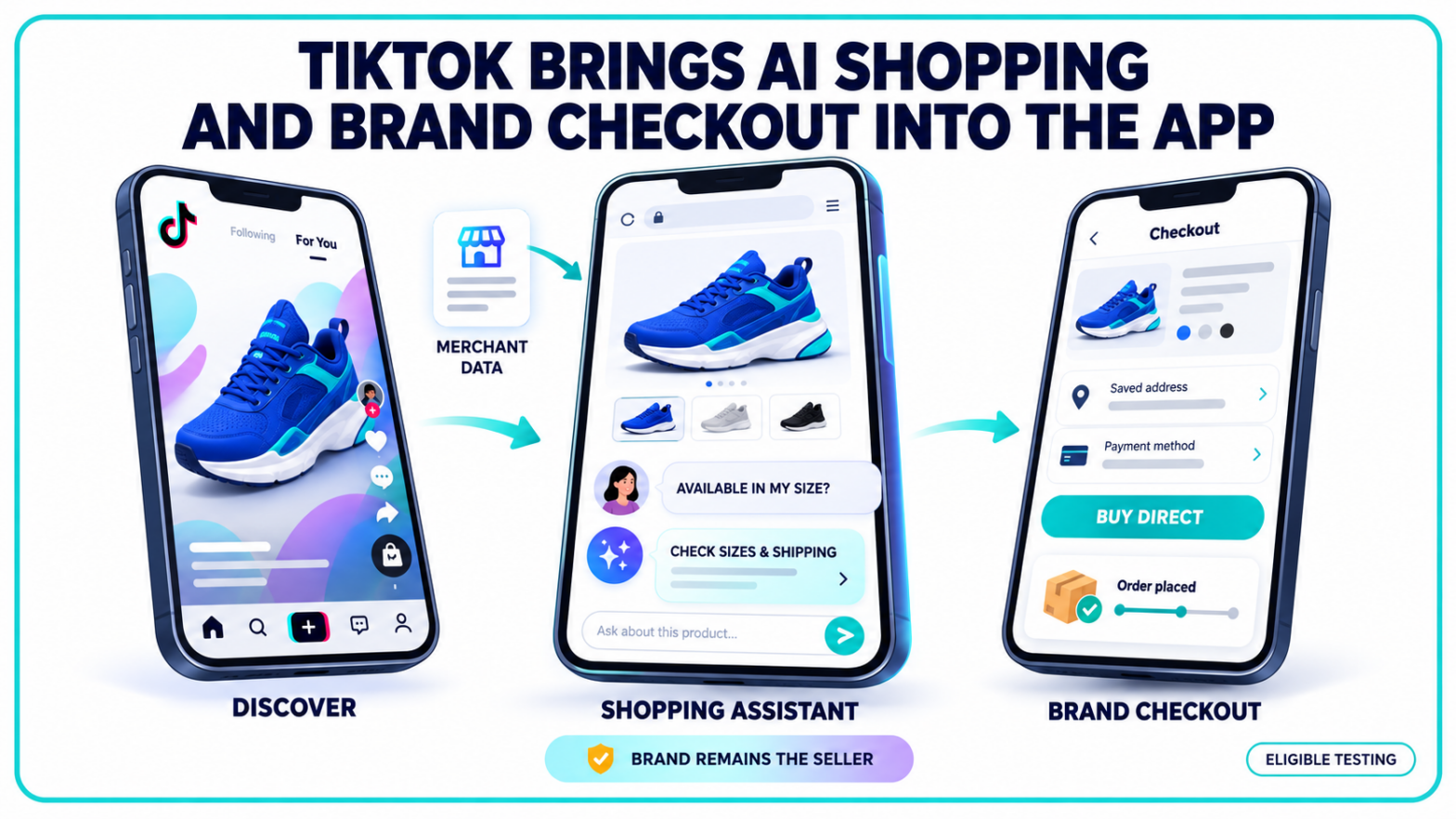
TikTok wants shoppers to resolve product questions and complete a purchase without leaving the app. Its new Shopping Assistant and Buy Direct features put conversational guidance and brand checkout closer to the ad that started the shopping journey.
The company introduced the tools on October 5 at Advertising Week New York 2026 as part of a broader agentic advertising announcement. For retailers, the central change is where the decision happens: inside TikTok, while the brand continues to sell the product.
AI Shopping Answers Draw on Merchant Information
Shopping Assistant is a conversational agent designed to retain context and respond to a shopper's needs. TikTok says its guidance can cover product specifications, shipping, sizes, availability and purchasing across several touchpoints.
The more detailed product explanation describes a chat window on a merchant's product page within TikTok's in-app browser. Answers use merchant-supplied information. Shoppers can then check out on the merchant's website inside that browser.
That places the assistant at a specific point in the purchase process. The person has encountered a product and is resolving questions before deciding whether to buy it.
The distinction between AI shopping assistance and autonomous spending matters here. TikTok describes a shopper asking questions and proceeding toward a purchase, rather than an agent receiving an open-ended instruction to spend money independently.
The information source matters, too. Merchant-backed answers are part of the shopping experience, not a substitute for the underlying product information.
Buy Direct Keeps the Brand as Merchant of Record
Buy Direct handles another part of the journey. TikTok describes purchases from the For You feed in one click, with checkout remaining inside the app.
Its native checkout uses saved payment methods and delivery addresses and includes order tracking. The brand remains the merchant of record.
The seller of record and the service hosting the shopping interface have different roles. Buy Direct preserves the brand's position as seller while placing the transaction experience within TikTok.
Shopping Assistant and Buy Direct therefore have distinct roles. One supports questions on a merchant page in the in-app browser; the other supplies a native transaction experience. Remaining within TikTok does not make the two checkout routes identical.
The company has previously supported purchases from an external retailer inside its app. In August 2024, TikTok announced an Amazon integration allowing users to link accounts and purchase through selected product ads.
That experience included Amazon pricing, Prime eligibility and delivery estimates for linked users in the United States. Account linking was optional, and users could disconnect their Amazon account through TikTok settings.
Buy Direct now addresses brand transactions through a commerce protocol and partner integrations. It adds a different route for purchasing within the app alongside that earlier retailer-specific approach.
Agentic Commerce Requires a Connection to Merchant Systems
Buy Direct requires an integration with Universal Commerce Protocol, or UCP. TikTok names Salesforce, Shopify, Shoplazza and Stripe among the commerce and payment companies supporting its developing experiences.
UCP's published capabilities cover catalogue search, cart creation, identity linking, checkout and order management. The standard provides a common way for platforms, agents and businesses to exchange the information needed across those stages.
A product recommendation and a completed order involve different systems. Catalogue information describes what can be bought; checkout handles the transaction; order management supports what follows. The protocol is designed to connect those functions while keeping the business as merchant of record.
TikTok's adoption also places its initiative within the broader development of agentic commerce. Google introduced Universal Cart in May, describing UCP as the foundation for checkout across participating merchants.
In Google's Universal Cart announcement, shoppers could use supported checkout or transfer their items to a merchant's website. The brand remained the merchant of record in either route.
UCP is open and extensible, with specifications and reference implementations available to developers. Its scope goes beyond a payment button to information exchange before and after a sale.
The shared protocol provides commerce infrastructure. Each platform still defines its own customer experience and access conditions.
TikTok Advertising Adds Agents on Both Sides of the Ad
The shopping products extend an existing push to connect AI agents with TikTok advertising.
TikTok's Agentic Hub, introduced in June, gives advertisers access to first-party and third-party AI Skills for tasks including campaign creation, creative production, performance analysis, audience insights and catalogue management.
That system uses TikTok for Business Model Context Protocol, or MCP, to connect agents with advertising capabilities. Advertisers can use ready-made Skills, build custom workflows or connect their own agents directly.
The October announcement expands the connector's presence across AI platforms and registries, naming Claude, Kimi, Manus, Perplexity, Replit, Snowflake, Tencent WorkBuddy and the IAB Tech Lab Agent Registry.
These advertiser tools serve a different user from Shopping Assistant. MCP connects agents to campaign operations and reporting. The shopping agent responds to a consumer considering a product. One works on the campaign; the other works within the customer experience.
TikTok also announced Agentic Leads for conversational lead generation in direct messages and on advertiser websites. That extends the approach to enquiries that need qualification rather than immediate checkout.
Shopping Assistant and Buy Direct Begin With Eligible Tests
For ecommerce teams, conversational product guidance makes accurate product attributes, stock information and shipping details part of the buying interface. Native checkout also brings order handling and transaction measurement into the implementation work. Evaluating these experiences involves completed purchases and service outcomes alongside ad engagement.
Availability remains a qualification, not a universal rollout. TikTok says Shopping Assistant, Buy Direct and Lead Agent are offered through eligibility-based testing opportunities.
Its product guidance directs advertisers to their TikTok sales partner to establish eligibility and the appropriate setup. Access to the tests depends on that process; the announcement does not make the features a default capability for every advertiser.