It's no secret that the global Software as a Service (SaaS) market is growing and expanding. However, this growth and expansion are no longer as simple as they used to be. What's with the fierce competition and shifting buyer expectations? The playbooks that worked five years ago don't cut it anymore!
Here's the challenge:
- Longer sales cycles – Enterprise deals now take an average of six to nine months to close.
- Rising acquisition costs – CAC has increased by more than 60% over the last five years to 2024.
- Independent buyers – 67% of the B2B buyer’s journey happens online before a prospect ever talks to sales.
In 2025, it's time to rethink SaaS growth not just as a funnel, but also as a flywheel. What does this mean? Creating strategies that win and keep customers at every stage of the journey.
This blog shares with you our SaaS growth marketing playbook for 2025. Read on to learn some advanced business-to-business (B2B) strategies, from funnel to flywheel.
The Evolving SaaS Growth Landscape
The SaaS market has grown and expanded. Nearly every business depends on this industry in one way or another. Its worldwide market is projected to grow from $315.68 billion this year to $1.13 trillion by 2030 at a 20% compound annual growth rate (CAGR).
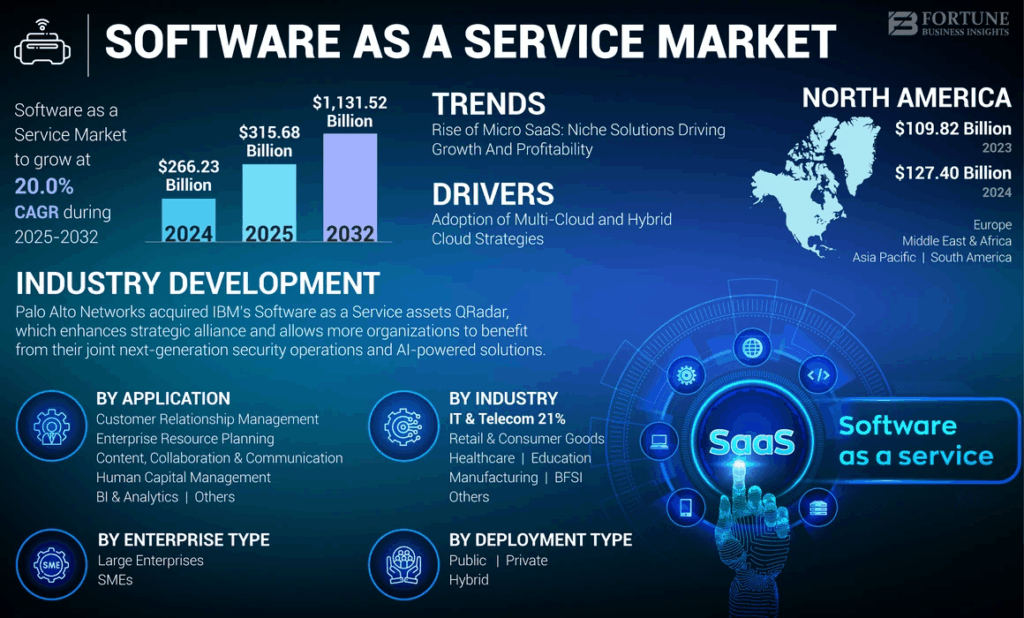
Source: Fortune Business Insights
Approximately 99% of companies use at least one SaaS application, and enterprises typically average over 100 tools. However, the competition has never been fiercer for both emerging providers and established players seeking sustainable growth.
Solutions like contract management software highlight this evolution. Companies and organizations increasingly expect SaaS products to deliver efficiency and measurable ROI. However, SaaS businesses are navigating several challenges that make growth harder than ever:
- CAC continues to climb across almost every channel.
- Organic reach on traditional platforms is fading fast.
- Buyers now expect highly personalized experiences at every step.
- The fight for talent and market share is tougher than ever.
- Economic uncertainty is slowing down buying decisions and making customers more cautious.
This playbook is designed to help you tackle these realities head-on. Applying advanced strategies will help you strengthen customer relationships and create predictable revenue streams.
The shift from funnel to flywheel thinking is at the heart of this transformation. Ultimately, it can be instrumental in turning satisfied customers into advocates who fuel sustainable growth.
Advanced B2B Strategies for SaaS Growth Marketing from Funnel to Flywheel
The traditional funnel has long guided SaaS marketing. However, by 2025, it will no longer be enough. You need modern growth hacking for your upcoming marketing campaign.
Today's most successful companies are embracing the flywheel model. This entails prioritizing retention, expansion, and advocacy just as much as acquisition. The shift enables SaaS businesses to transform customer success into their primary growth engine.
That said, here are advanced B2B strategies for your SaaS growth initiatives:
1. Pre-launch: Know the modern SaaS buyer journey
The SaaS buyer journey in 2025 is more complex and non-linear than ever. Buying committees now include 6 to 10 stakeholders with diverse priorities and interests. Buyers engage across 15+ touchpoints, from virtual events to peer communities. These make it essential for marketing teams to deliver value-driven experiences at every step.
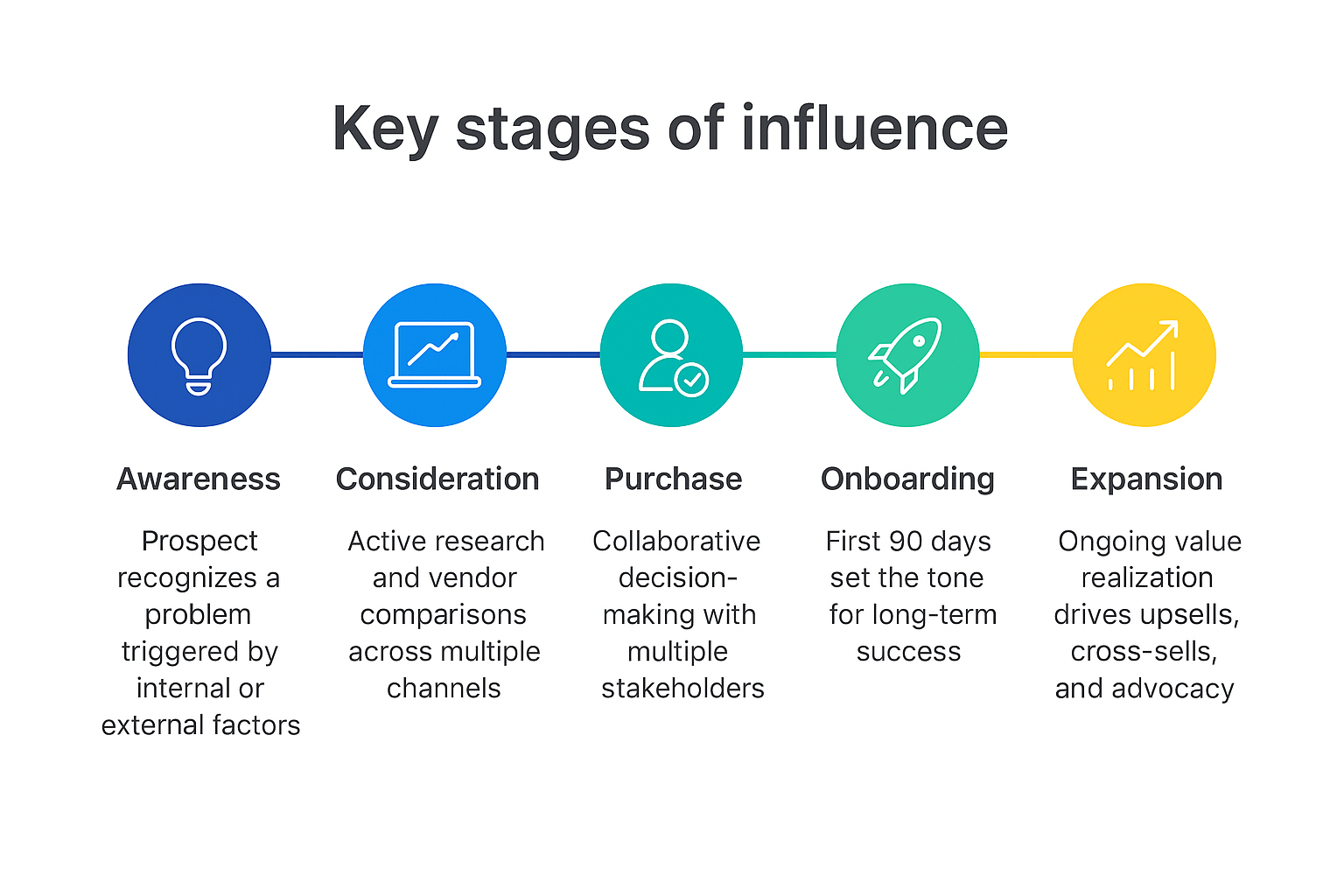
Key stages of influence:
Source: Photo generated via ChatGPT
- Awareness – Prospect recognizes a problem triggered by internal or external factors
- Consideration – Active research and vendor comparisons across multiple channels
- Purchase – Collaborative decision-making with multiple stakeholders
- Onboarding – First 90 days set the tone for long-term success
- Expansion – Ongoing value realization drives upsells, cross-sells, and advocacy
Ian Gardner, Director of Sales and Business Development at Sigma Tax Pro, recommends using the flywheel model. Their company applies this model to their growth marketing and sales initiative. However, he suggests understanding the buyer journey, to begin with.
Gardner says, "The flywheel model amplifies the moments of influence by turning customer success into a growth engine. Delighted customers fuel acquisition through case studies, client testimonials, stakeholder referrals, and business advocacy. This model helps your SaaS company achieve scalable and sustainable growth over time."
2. Laying the groundwork: Consider data, positioning, and fit
Before rolling out advanced growth strategies, you need a strong foundation built on three key pillars: a reliable data infrastructure, precise positioning, and a proven product-market fit. These factors ensure your marketing efforts match your long-term business goals and scale effectively. Here's how:
- Data management: Modern SaaS growth relies on sophisticated data tracking while employing data wrangling and risk management. Measure attribution across multiple touchpoints, analyze customer behaviour patterns, spot high-value prospects early in the journey, and make the necessary moves.
- Positioning and messaging: In a crowded market, clarity and differentiation are everything. Your SaaS solution needs a sharp value proposition that directly speaks to your ideal customer profile. Strong positioning includes:
- A clear problem statement in customer language
- Defined target markets based on firmographics and behaviours
- A compelling value proposition that stands apart
- Social proof, like key metrics, case studies, and testimonials
- A consistent messaging framework across every touchpoint
- Product-market fit: Product-market fit remains the cornerstone of scalable growth. As Marc Andreessen defined it, it's about having a great product in a strong market and delivering value that sticks. For your SaaS company, this means customers find real utility, renew at high rates, and recommend your product to others.
Pre-launch growth initiative audit checklist:
|
Key Areas To Cover |
Course of Action |
Check |
|
Analytics and attribution tracking |
Properly configured across all channels |
✔ |
|
Customer feedback |
Collected and analyzed to validate product-market fit |
✔ |
|
Ideal customer profile |
Documented with specific characteristics and behaviours |
✔ |
|
Competitive positioning |
Tested and refined based on win/loss analysis |
✔ |
|
Content audit |
Completed to ensure messaging consistency across all touchpoints |
✔ |
|
Sales and marketing alignment |
Established with shared definitions and processes |
✔ |
|
Customer success metrics |
Tracked to measure satisfaction and expansion potential |
✔ |
3. Top of funnel: Run a segmented, intent-driven LinkedIn campaign
In 2025, B2B SaaS lead generation is shifting away from traditional methods. While email and paid search still have a role, the strongest results now come from intent-driven platforms, community engagement, and strategic partnerships.
LinkedIn has become the go-to channel for B2B growth, but success depends on precision and a targeted approach. Here, organic posts drive engagements, while paid campaigns excel at targeting specific roles, industries, and behaviours.
Key steps for building segmented, intent-driven LinkedIn campaigns:
- Identify companies showing intent signals.
- Build custom audiences with firmographic filters.
- Personalize ad creative to segment needs.
- Test multiple calls-to-action (CTAs).
- Track both lead quantity and quality.
- Use attribution modelling to optimize ROI.
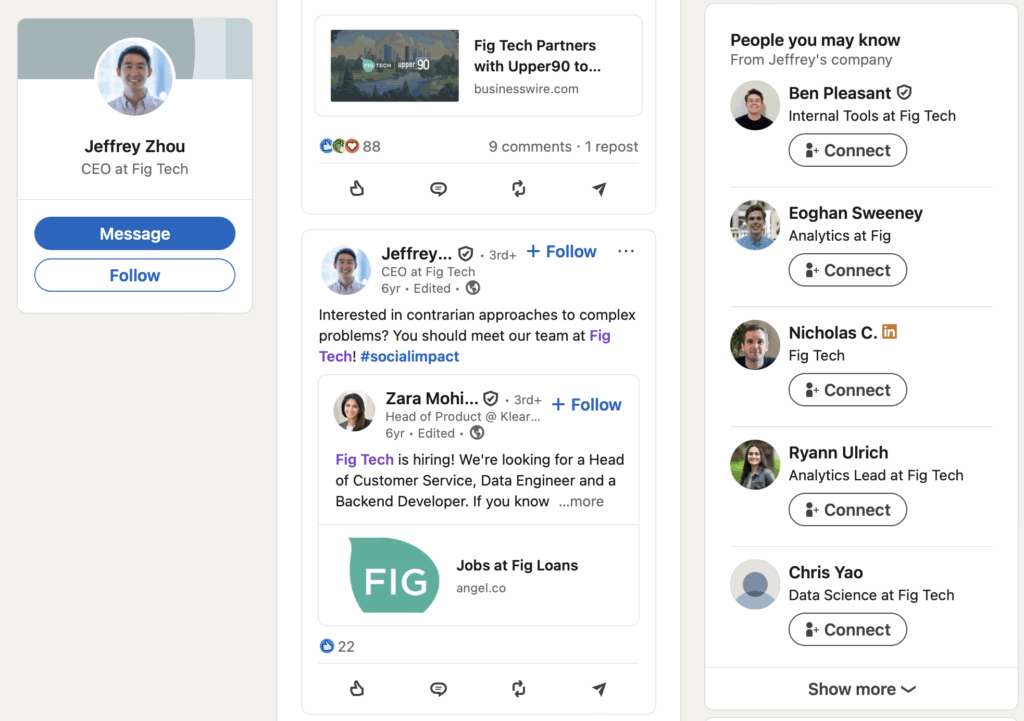
Jeffrey Zhou, CEO and Founder of Fig Loans, highlights the value of LinkedIn for growth initiatives. He also utilizes this online platform for professional networking, customer engagement, and business expansion.
Source: LinkedIn
Zhou explains, "LinkedIn has become one of the most effective platforms for B2B growth because it combines professional networking with precise targeting. When used strategically, it allows you to build meaningful relationships and open doors to long-term business opportunities."
4. Mid-Funnel: Nurture and convert leads to opportunities
The middle of the funnel is where prospects weigh your solution against competitors and internal priorities. However, you need to nurture leads and improve conversions for your B2B sales and marketing.
To win at this stage, your strategy needs to focus on building trust. You also have to consider educating buyers. Lastly, show precisely how your product delivers value for their unique situation. Consider the following strategies:
- Personalized drip sequences: Send sequences that flex with each prospect's role, behaviour, and niche, not just cookie-cutter emails. Remember, decision-makers and industry insiders all get content that feels made for them.
- Interactive product demos: Give prospects a chance to tinker with your product through self-serve demos. As they get freedom to explore, you get a window into what sparks their interest.
- Educational webinars and events: Webinars and virtual events create space for live Q&A, polls, discussions, and genuine back-and-forth. Follow up with context that matches how engaged each attendee really was.
- Content hubs: Create a central library filled with valuable resources, customer stories, industry insights, and thought leadership in B2B marketing. It positions you as a trusted guide while quietly capturing high-quality leads.
Sample mid-Funnel automation workflow:
Trigger: Prospect downloads product comparison guide
|
Day |
Actionable Steps |
|
Day 1 |
Send personalized email with additional resources specific to their industry |
|
Day 3 |
Invite to upcoming webinar relevant to their use case |
|
Day 7 |
Share customer case study from similar company (if no webinar attendance) |
|
Day 14 |
Offer personalized demo with solutions engineer |
|
Day 21 |
Send competitive differentiation content (if demo not scheduled) |
|
Day 28 |
Direct outreach from account executive with tailored proposal |
5. Bottom-of-funnel: Close the deal and onboard clients
Turning high-intent leads into customers requires precision. At this stage, success comes from understanding buyer psychology, recognizing signals of readiness, and providing proof and incentives that inspire confidence.
Closing tactics:
- Behavioural triggers: When someone keeps circling back to your demo or digs into the pricing page, it's a neon sign of interest. Automation should pick up on these cues and set up prompt, thoughtful follow-ups.
- Social proof: Bigger deals mean more eyes on the decision. Industry-specific case studies, peer nods, analyst reviews, or even awards can tip the scales by showing you walk the talk.
- Tailored incentives: Optimizing trial-to-paid conversion is key. Strategies such as guided onboarding and upgrade prompts tied to behaviour help accelerate adoption and demonstrate value early in the customer journey.
Onboarding best practices:
Seamless onboarding has a direct impact on retention and revenue expansion. Customers who achieve a meaningful outcome within 30 days are three times more likely to stay and two times more likely to grow with your product.
Best practices include:
- Clear milestones and progress tracking
- Automated onboarding emails with resources
- Proactive customer success outreach
- In-product walkthroughs for key features
- Regular 30/60/90-day success check-ins
6. From funnel to flywheel: Retain, expand, evangelize
The flywheel approach shifts the focus from linear acquisition to ongoing customer success. Happy customers fuel growth by staying longer and spending more, not to mention referring others. This creates momentum that compounds revenue and lowers acquisition costs.
- Retention: Retention thrives on staying one step ahead. Health scores that monitor patients, track usage, support needs, and billing patterns flag risks early. AI now helps predict churn before it happens.
- Expansion: Expansion doesn't only mean pushing harder, but also proving your value over and over. QBRs highlight wins, while smart pricing models and feature nudges naturally drive account growth.
- Evangelism: Evangelism is where happy customers become your loudest advocates. Think of special recognition, VIP access, exclusive deals, and career perks. These inspire clients to share stories and even give referrals.
Anna Zhang, Head of Marketing at U7BUY, suggests focusing on three steps for growth initiatives: Retention, expansion, and evangelism. She claims these go beyond the funnel into the flywheel, enabling startups and SMEs to scale and grow their businesses.
Zhang shares, "The flywheel works best when teams collaborate across marketing, sales, product, and customer success. By aligning around retention, expansion, and evangelism, companies turn their existing customers into their most powerful growth channel. The result is growth that compounds over time instead of resetting with every new deal."
7. SaaS growth stack: Invest, measure, and optimize
Modern SaaS growth depends on an integrated stack that connects data and automation. The right tools provide complete visibility into the customer journey while enabling optimization and personalization at scale.
- Analytics tools: Google Analytics covers B2B basics, while Mixpanel and Amplitude dig into product usage. Segment ties everything together and gives you one clear customer view.
Source: Google Analytics
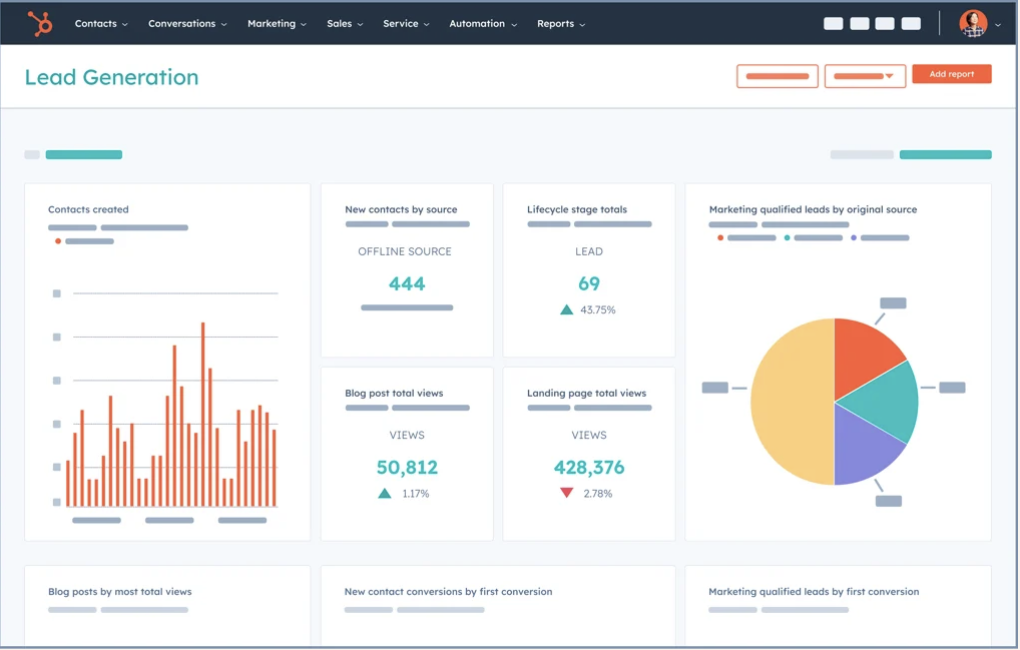
- Marketing automation: Platforms like HubSpot and Marketo make it easier to nurture leads with personalized touches. The trick is picking marketing automation that fits your stack and scales with you.
- CRM systems: A CRM keeps customer data and sales workflows in one place. From Salesforce to HubSpot, today's CRM systems now come with AI, automation, and forecasting built in.
Source: HubSpot
- Customer success platforms: Gainsight and ChurnZero help track performance metrics, manage onboarding, spot upsell opportunities, and more. These customer success platforms keep growth and retention on track.
In addition to selecting the right tools, SaaS companies must continuously refine how their growth stack is used to maximize impact and efficiency. They can do so through technological integration, process optimization, and constant testing.
Final Note
Pursuing SaaS growth today isn't just squeezing more leads into your funnel but building a flywheel that compounds momentum for good. What does this mean? Aligning sales and marketing around the same goals and commitment to delivering value at every stage!
SaaS companies that adapt will reap benefits: Lower acquisition costs, increased client engagement, more predictable growth, and overall business success. But on the flip side, the ones that don't will keep burning resources on tactics that no longer match how buyers actually make decisions in 2025.
Your course of action: What better way to succeed than to start small, track your progress, scale what works, and repeat the process? The sooner you shift from funnel to flywheel thinking, the faster you'll be ready for whatever the SaaS market throws at you next!
What are you waiting for? Don't wait for growth to stall. Start by auditing your current funnel and testing one new strategy from this playbook today by working with TechWyse, your go-to, full-service digital marketing agency. Get in touch with them today to see how they can help!