
In September 2023, HouseFresh was one of the most thorough independent air-purifier review sites on the web, running real devices in a real house and publishing genuinely useful buying advice. Then it was welcoming around 4,000 visitors a day from Google. By early 2024, that number was 200, a collapse the site pins directly to Google's March 2024 core update. Retro Dodo, a retro-gaming site built by hands-on enthusiasts, reported a similar story: roughly 85% of its organic traffic and revenue, gone.
These weren't content farms. They were exactly the kind of independent, experience-driven publishers Google's Helpful Content System claimed to protect. Their collapse, set against who rose in their place, tells a more uncomfortable story than "Google cleaned up the web." The system didn't reliably punish bad content. It punished honest niches, and it rewarded brand authority.
What the system was sold as
The Helpful Content Update arrived in 2022 and sharpened through 2023 with a promise in its name: reward content written for people, demote content written for search engines. In March 2024, Google folded the helpful-content signals into its core ranking systems and paired them with new spam policies, stating the aim of reducing unhelpful, unoriginal content in results by a large margin.
Nobody sensible argues with the goal. The open web genuinely was drowning in thin, AI-spun, affiliate-stuffed pages, and something had to give. The problem is not the intention. It's the collateral, and the collateral fell into a pattern too consistent to dismiss as noise.
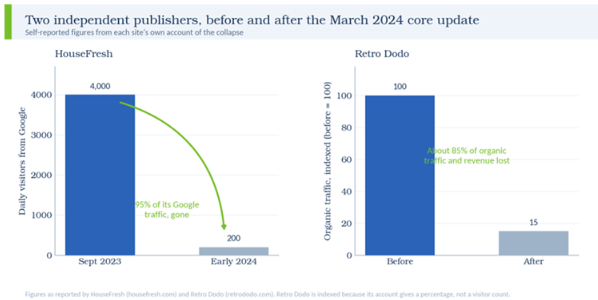
Figure 1. HouseFresh went from about 4,000 daily Google visitors to 200, and Retro Dodo reports losing roughly 85% of its organic traffic and revenue. Data as published by HouseFresh and Retro Dodo. Original graphic.
Who actually fell, and who actually rose
Follow the visibility data and the pattern is stark. The single biggest winner of 2024, by SISTRIX's measurement of US search, was Reddit, with visibility up more than 190%. Anonymous forum posts, un-fact-checked and un-credentialed, surged while credentialed independent experts cratered. At the same time, large publishers ran "reputation" plays, hosting commercial review content under a trusted domain's authority, the practice Google itself would later name site reputation abuse. One analysis of a prominent example estimated a single such operation was pulling tens of millions of monthly search visits ranking for exactly the commercial terms independent reviewers used to own. (That estimate is one analyst's, so weight it as a claim rather than an audited figure, but the ranking positions are checkable.)
Put those together and the mechanism becomes visible. A hands-on review from a small site that tested the product lost. A forum thread and a review section rented out under a big brand's domain won. If the system were truly measuring helpfulness, that outcome would be inexplicable. If it were substantially measuring brand authority signals, domain strength, size, established trust, it's exactly what you'd predict. The independent expert's disadvantage came down to a weaker domain, not worse content.
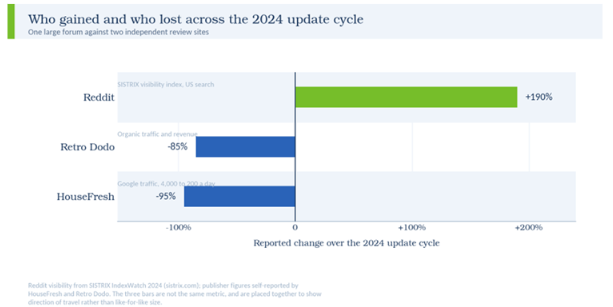
Figure 2. Across the 2024 update cycle, Reddit's US visibility rose more than 190% while both independent review sites lost most of their traffic. Visibility measured by SISTRIX IndexWatch 2024; publisher figures self-reported. The three bars are not the same metric. Chart built for this article.
The signal Google leaned on, and its blind spot
Here's the structural critique, stated fairly. Google cannot directly measure whether content is helpful; helpfulness lives in a reader's head. So it relies on proxies, and many of its strongest proxies, brand searches, link authority, engagement signals, size, correlate heavily with being a large, established brand. A genuinely helpful post on a two-person site and an adequate post on a hundred-person brand's domain send very different proxy signals, and the system reads the proxies, not the helpfulness.
That's how a system designed to reward people-first content can systematically favor authority-first content. Call it a measurement problem rather than a conspiracy against small publishers: the metrics that scale happen to be the metrics big brands win, and "helpful" and "authoritative" quietly became the same signal in the ranking, even though they are very different things to a reader who just wants to know which air purifier to buy.
Google's side, in fairness
To be even-handed, Google disputes the framing. It maintains that core updates are not penalties and that there's nothing specific to "fix," and that it wants to surface a range of high-quality sites including small and independent ones. Its March 2024 update explicitly cited creator feedback, and the company has continued adjusting the site-reputation-abuse policy since.
But its own spokesperson conceded the hard part when he told publishers hoping to bounce back that recovery isn't guaranteed, because "September doesn't exist anymore." Most affected sites, by the same reporting, saw no meaningful recovery across the updates that followed. Whatever the intent, the lived outcome for a large cohort of independent experts was a permanent demotion they could neither predict nor undo.
What this means for how you build
For marketers and site owners, the practical lesson is bleak but clear, and it's worth stating without the usual optimism. In the current system, being genuinely helpful is necessary but not sufficient. The signals that move rankings, brand authority chief among them, are the ones large or well-known entities accumulate, and a small site producing better content than a big one can still lose to it on those proxies alone.
Quality remains the price of entry, so this is no argument for abandoning it. Rather, it means recognizing that quality now has to be paired with authority-building: earning brand searches, real citations, and a presence beyond your own domain, on the platforms and communities the algorithm currently rewards, so you're not relying on the ranking system to notice helpfulness it isn't equipped to measure. It's not the meritocratic web the update promised, and pretending otherwise helps no one. The honest niches that got punished weren't doing content wrong. They were doing authority small, in a system that had quietly decided the two were the same thing.
For the latest digital marketing news, check out our blog. To book an appointment, contact us here.