

Removing a website from Google’s AI search features may affect more than clicks on AI citations, a small case study suggests. SEO consultant Cyrus Shepard reported that conventional organic clicks also declined after a site opted out, raising a question about how AI appearances influence the wider results page.
The observation does not establish a ranking penalty or prove that AI citations improve organic performance. It does challenge the assumption that their value can be measured entirely through direct referrals.
AI Citations Could Influence Clicks on Other Results
In his original LinkedIn post, Shepard proposed that appearing in both an AI answer and conventional listings could make a user more likely to click somewhere on the results page.
He described the hypothesis as a “Search SERP Halo Effect”: additional appearances could reinforce recognition or trust, even when the eventual click comes through a regular organic result.
That would make attribution more complicated. A visit could arrive through a conventional listing while an earlier AI appearance contributed to the decision to click.
But the proposed mechanism remains unproven.
The case study does not track individual users from seeing a citation to clicking another result. It therefore cannot distinguish that possible influence from other explanations for the traffic change.
For publishers, the question is whether direct citation clicks capture the full contribution of AI visibility. The evidence available here raises that question without answering it.
The 0.9% Estimate Is Not a Native AI Click Metric
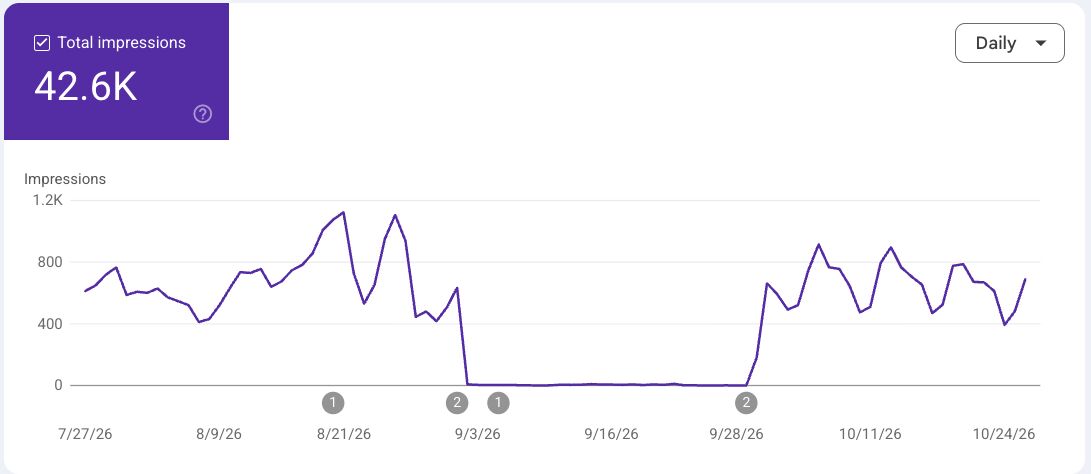
Shepard reported that AI impressions fell to zero after the exclusion. He also estimated an AI click-through rate of approximately 0.9%, using overall click data from before and after the change.
The number was inferred, not read from a dedicated AI click-through-rate report.
Google’s generative AI performance report documentation describes impressions from AI Overviews and AI Mode, with breakdowns by page, country, device and date. The documented report does not include a separate AI click count or click-through rate.
That leaves a gap between knowing that a website appeared and knowing which visits those appearances generated.
TechWyse has previously examined the difficulty of reconciling AI search traffic claims with the information available to individual site owners.
A before-and-after estimate depends on what would have happened without the intervention. If conventional search activity changes during the same period, isolating the contribution of AI becomes harder.
The reported 0.9% should consequently not be treated as a general benchmark for AI Overviews, AI Mode or another publisher’s website.
Google’s AI Opt-Out Preserves Conventional Search Eligibility
Google’s dedicated exclusion control separates participation in generative search from eligibility elsewhere in Search.
According to its Search generative AI control documentation, website owners can exclude links and content from AI Overviews, AI Mode and generative AI features in Discover. Excluded content cannot appear in those features or help ground their responses.
Google says the setting is not used as a ranking or inclusion signal affecting other parts of Search.
That statement concerns how the control is used by Google’s systems. It is not a guarantee that traffic will remain stable after a website changes its participation.
A site’s eligibility, its position and a searcher’s decision to click are separate parts of the same journey. Traffic can change without an exclusion setting being used to demote the site.
TechWyse covered the development of Google AI opt-out options earlier this year. Google’s updated announcement says the control became available worldwide on August 31, 2026.
The case study is therefore an observation about withdrawal from existing features, not evidence of a newly introduced ranking rule.
The Unreported Method Prevents a Clean Comparison
The public post does not disclose the tested website, traffic volume, test dates, magnitude of the organic decline or exact exclusion method.
Those details determine how confidently the result can be interpreted.
Without traffic volumes, readers cannot judge how sensitive the finding might be to ordinary variation. Without dates, they cannot examine whether demand shifts or other search changes overlapped with the comparison.
The method is particularly important. A test of Google’s dedicated AI control would need to establish that other settings affecting conventional search presentation remained unchanged.
Likewise, an overall click decline does not reveal whether fewer people searched, fewer listings appeared, or fewer searchers clicked after seeing them. Those possibilities require different evidence.
Shepard acknowledged the limitations, writing: “Results not guaranteed. Always test your own data.”
His finding provides a reason for further testing, rather than a basis for predicting what every website will experience.
Search Visibility Controls Require Separate Measures
The distinction between participation and performance extends beyond this case. Different search visibility controls govern crawling, indexing, snippets and generative AI inclusion. They should not be treated as interchangeable switches.
For marketers and SEOs evaluating an exclusion, a useful analysis would record the exact setting and timing, compare similar periods, and examine page-level impressions, clicks, positions and business outcomes. An unchanged comparison group, where feasible, would help separate the intervention from broader movement.
That would still require care. More visibility does not automatically produce more valuable visits, and a change in visits does not establish a change in revenue.
Timing adds another complication. Google says a change to its dedicated control generally takes a few days to process. Once the control becomes active, applicable content is normally excluded within one to two days, although caching and propagation can delay removal.