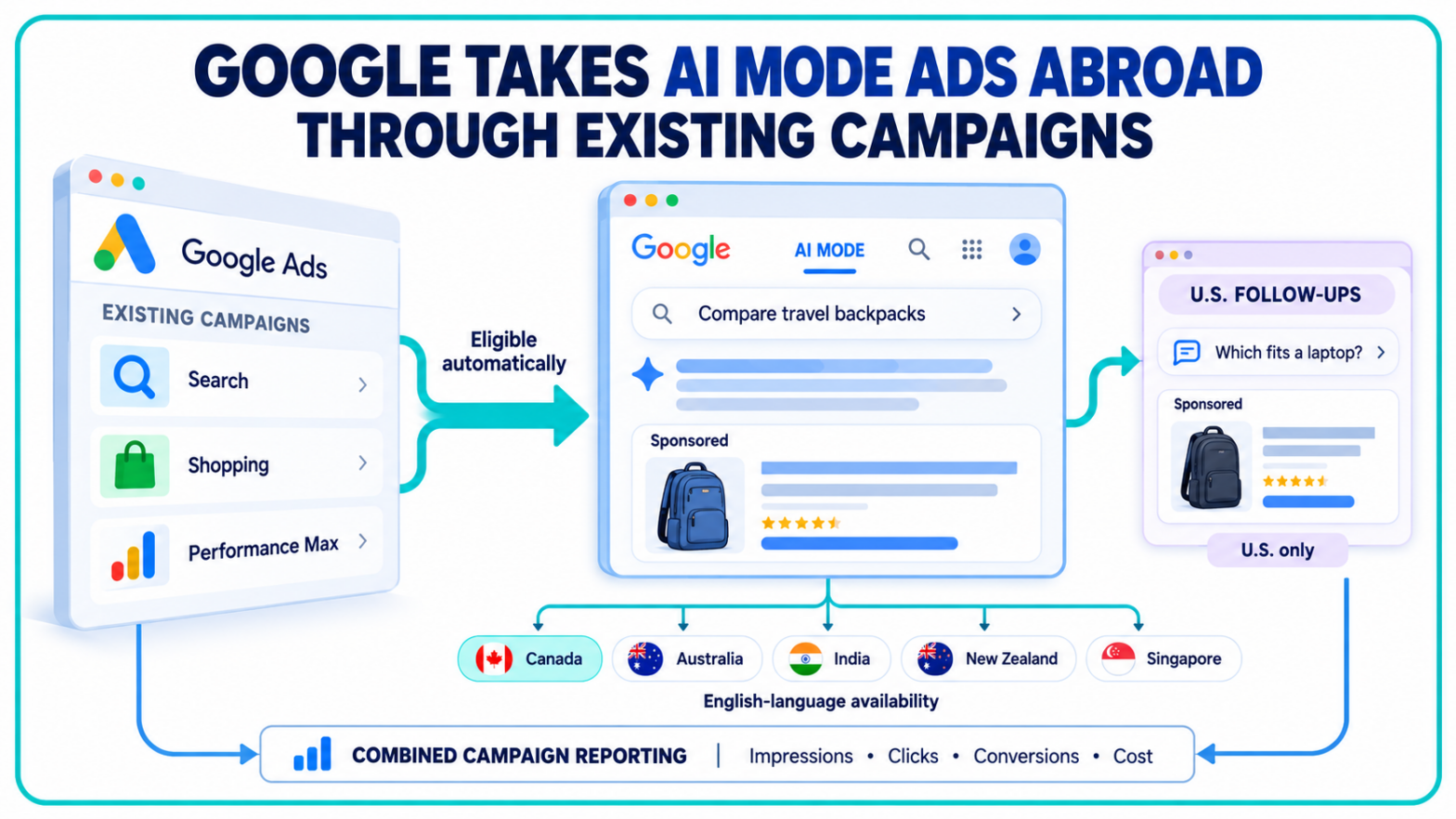
Google is expanding advertising inside AI Mode while acknowledging that the experience’s weaker monetization weighed on Search revenue growth. For advertisers, the expansion runs through existing campaigns, without a separate AI Mode budget or placement switch.
On Alphabet’s October 28 earnings call, Chief Business Officer Philipp Schindler announced international expansion and multi-turn ads in the United States. The latter extends advertising into follow-up exchanges rather than limiting it to an initial question. The developments were outlined in the earnings-call transcript.
The immediate question for marketers is less about opening another advertising account than understanding where their current campaigns can now appear.
Canada Appears in Google’s AI Mode Ad Availability
Google’s current AI advertising guidance lists Canada among the countries where ads within AI Mode are available in English. Australia, India, New Zealand and Singapore are also included.
That language restriction matters for Canadian campaigns. The listing does not establish equivalent availability for French-language searches.
Nor does availability guarantee an impression. Campaign eligibility, relevance and the auction still determine whether an ad appears.
The expansion follows an existing advertising footprint. TechWyse previously covered Google AI Mode ads appearing across selected U.S. commercial queries in SE Ranking’s research. That study was a snapshot of particular keywords, not a measure of every AI Mode conversation or today’s international coverage.
The distinction is important: a market becoming eligible is different from advertising appearing consistently across its searches.
Search Revenue Growth and Query Growth Tell Different Stories
Alphabet’s earnings materials show Search and other advertising revenue growing 12% year over year. Separately, CEO Sundar Pichai said Google’s year-over-year query growth rate was its highest in five years. Those are different measures, not competing descriptions of the same metric. Google published the figures in Pichai’s quarterly remarks.
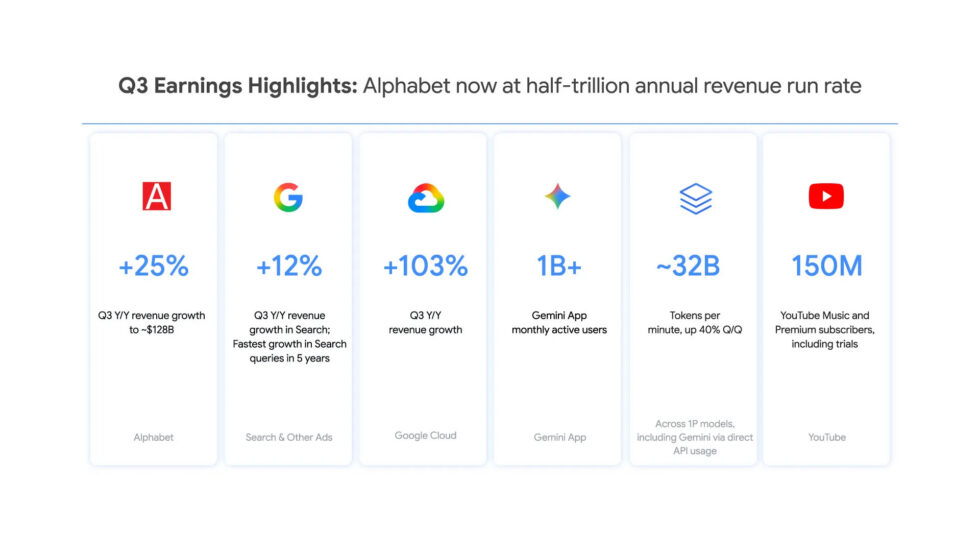
Schindler identified foreign exchange as the largest contributor to Search’s revenue-growth slowdown relative to the previous quarter. He also cited sector-specific advertising patterns and lower monetization in AI Mode as its query volume grew.
He did not provide a percentage gap between AI Mode and traditional Search monetization in that explanation.
Lower monetization also should not be confused with a disclosed profitability figure. Revenue generated by an experience and the cost of providing it are separate questions.
For advertisers, Google’s revenue per query is not a substitute for campaign return. A placement that generates less revenue for the platform does not automatically deliver cheaper leads, stronger purchase intent or better conversion rates for a business.
Longer AI Search Conversations Create Different Ad Context
Pichai said AI Mode queries average three times the length of traditional searches. One in five AI Mode searches globally uses voice, images or documents.
Google is trying to connect those behaviours across AI Overviews, AI Mode and traditional Search, rather than treating them as unrelated products. Pichai described the company’s sequence as improving the user experience first, followed by monetization.
Longer questions can contain more context, but context is not the same as readiness to buy. Someone comparing possible solutions may still be deciding what they need.
Google’s AI Mode advertising overview describes tests of more visual formats, including ads with explanations connecting an offer to a question. The company identifies AI Max and Performance Max as technologies supporting those formats.
These are Google’s descriptions of its product direction, not independent evidence that every advertiser will receive better results.
The distinction between visibility and measurable business outcomes already runs through AI search reporting. Platform-wide engagement claims cannot establish what an individual advertiser or publisher receives.
Existing Campaigns Enter Without Separate Placement Controls
Google says eligible Search, Shopping and Performance Max campaigns can participate automatically. Advertisers cannot target AI Mode exclusively or opt out of it separately from Search.
Matching also differs by targeting method. Exact and phrase match can qualify for directly commercial queries. AI-powered targeting can additionally match the context of a question and its AI response.
Existing controls, including negative keywords, continue to apply.
In practice, marketers evaluating the expansion need to distinguish additional reach from additional value. Accurate conversion tracking, lead-quality assessment and current product information remain the basis for judging performance. A broader set of eligible searches does not, by itself, justify a larger budget.
Google Ads Reporting Combines AI Placements With Campaign Results
Google Ads reporting includes AI Mode and AI Overviews activity in aggregate campaign metrics and search terms reports. Those totals include impressions, clicks, conversions and cost.
An improvement in a campaign-wide result therefore cannot automatically be attributed to the AI Mode expansion. Other changes in demand, bids, targeting or creative may also affect the same figures.
Google says paid advertising does not influence its organic AI responses. Ads remain labelled as sponsored content, including when they appear within or alongside an AI-generated answer.