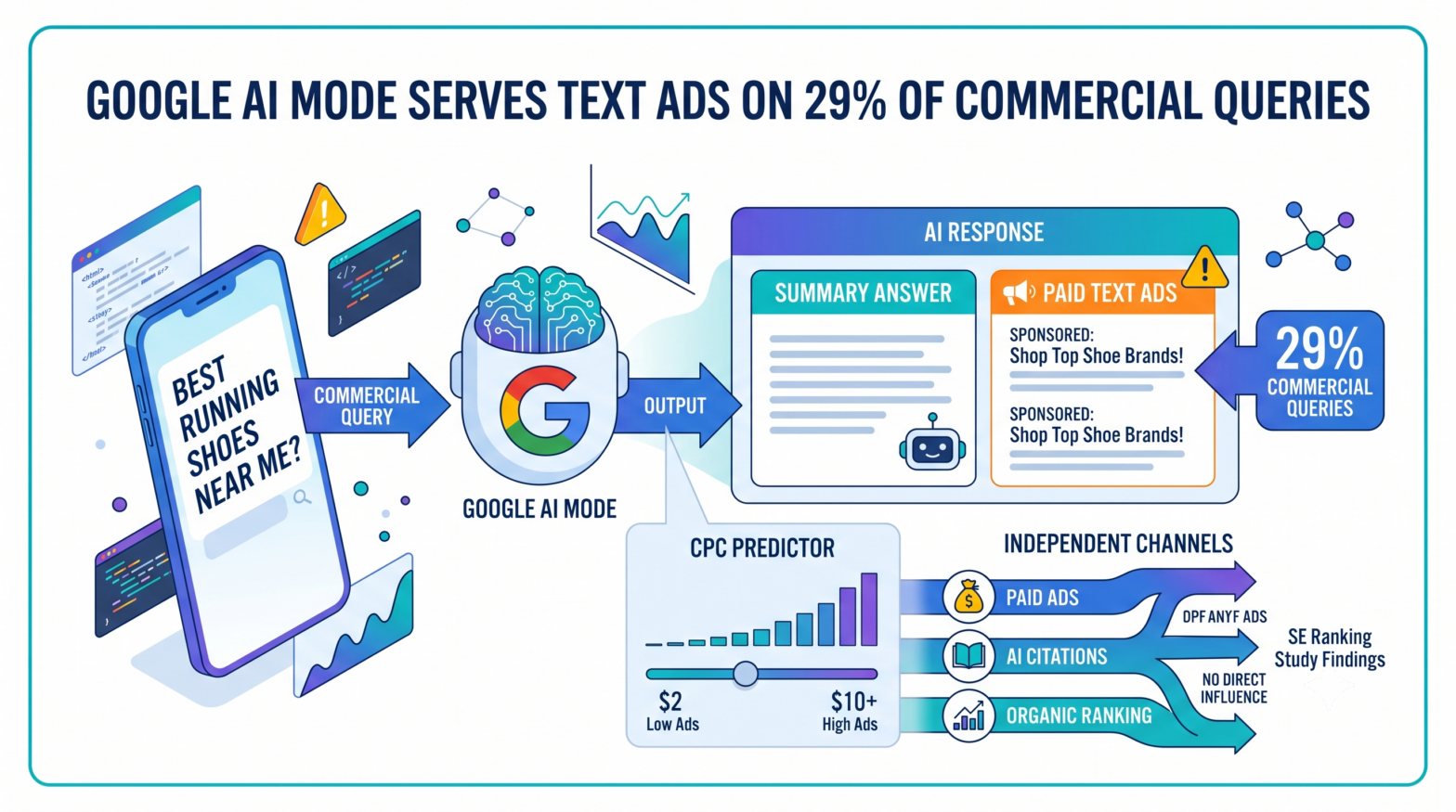
Text ads now appear inside Google AI Mode on nearly one in three commercial searches in the United States. SE Ranking published the finding on July 14, 2026, after analyzing 50,032 commercial keywords collected on June 30, 2026, across 20 niches, the largest dataset to date focused specifically on AI Mode ad placement.
Text Ad Coverage Across Commercial Queries
SE Ranking analyzed 50,032 commercial keywords across 20 niches, roughly 2,500 per niche, all selected to trigger text ads rather than product carousels. Of those, 14,733, or 29.45%, returned a text ad in AI Mode. The data was collected on June 30, 2026, and reflects U.S. results only.
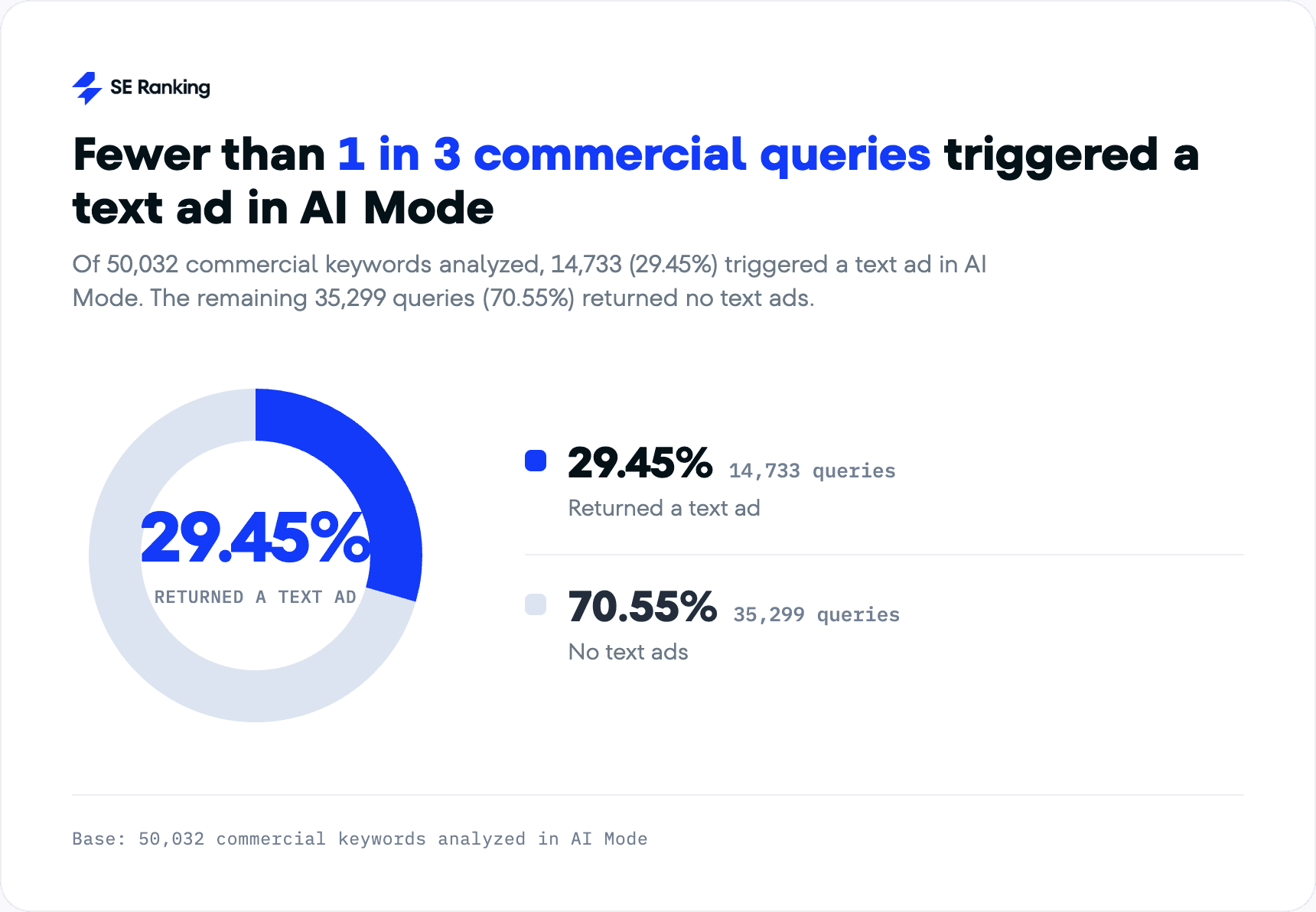
SE Ranking said ads began appearing in AI Mode responses in late 2025. By mid-2026, nearly one in three commercial queries in the dataset showed a text ad. SE Ranking also noted the real ad rate may be higher because AI Mode results are inconsistent across sessions. Google announced two new AI Mode-specific ad formats, Conversational Discovery ads and Highlighted Answers, at Google Marketing Live 2026 on May 20, signalling that the platform is actively expanding its monetization of the AI search surface.
How Ad Blocks Are Structured
Most AI Mode ad blocks included more than one advertiser. SE Ranking found that 71.1% of ad-triggering queries showed two ads in the same AI Mode response, while 28.9% showed only one. That means advertisers entering the ad block are almost always placed directly beside a competitor answering the same query.
Across all keywords that returned a text ad, 25,243 total ad appearances came from 2,930 unique advertisers, averaging approximately 8.6 appearances each, though distribution across niches was far from even.
Cost-Per-Click as the Primary Predictor of Ad Placement
CPC was the strongest predictor of ad visibility. Higher-cost keywords were much more likely to trigger AI Mode ads. Ad presence was 24.33% for keywords with CPCs below $2, rising to 32.45% for keywords between $2 and $10, and jumping to 53.56% for keywords at $10 or more. SE Ranking also checked search volume and keyword difficulty against ad frequency, and neither showed a direct correlation.
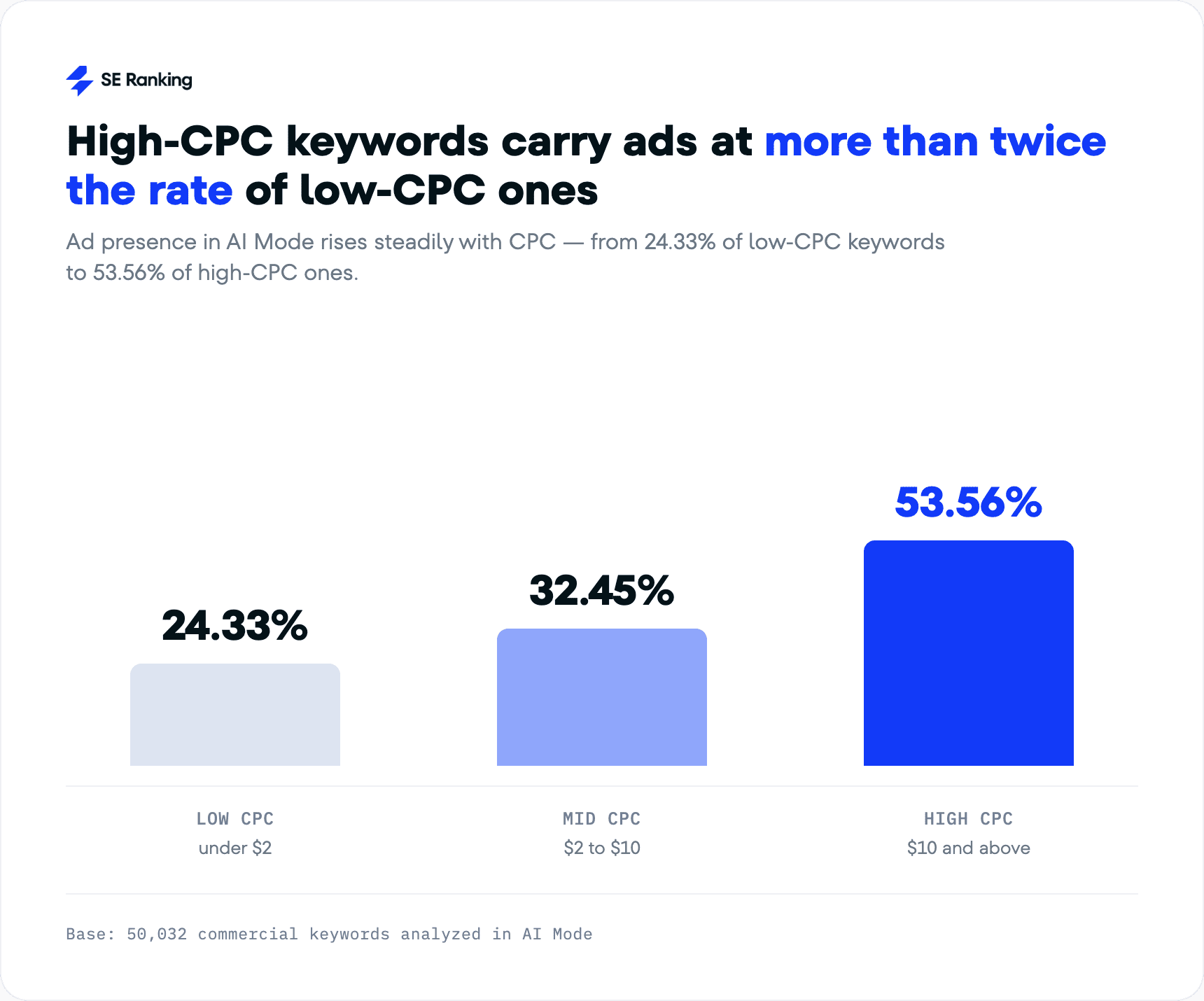
The CPC gradient indicates that AI Mode is not distributing ads uniformly across commercial intent. AI Mode is placing ads where the keyword already carries commercial weight. A high CPC reflects market demand for that click, and AI Mode appears to follow that signal.
Ad Rates Vary Dramatically by Industry
Ad presence across the 20 analyzed niches ranged from 2.64% in Healthcare to 72.38% in Pets, a gap of roughly 70 percentage points. Niche determines how likely any keyword in a category is to attract an ad, and the range is wide.
The high-ad niches are predominantly lead-generation markets with clear commercial intent and established paid search demand. Healthcare is one of Google's most regulated advertising categories. If Google is willing to bring ads into AI Mode for healthcare, the broader rollout to other categories is likely a matter of when, not if. The SE Ranking study notes that low-ad categories tend to cluster around informational or YMYL intent, where commercial advertiser demand is thinner or where Google itself may apply greater caution.
On the concentration of ad spend within niches, the data shows uneven distribution at the advertiser level. Entertainment and Hobbies recorded 49 unique advertisers sharing 2,622 ad appearances, an average of 53.51 each. Pets had 68 advertisers splitting 3,514 appearances, averaging 51.68 each. By contrast, Healthcare had 36 advertisers splitting just 91 appearances, averaging 2.53 per advertiser, and News and Politics averaged 2.6 appearances across 81 advertisers. SE Ranking noted that these advertiser-level figures are sensitive to keyword selection and should be read as indicators of market shape, not fixed rankings.
Paid Ads Do Not Increase Citation or Organic Visibility
One of the study's most strategically significant findings concerns the relationship between ad placement and AI Mode citations. For every keyword with a text ad, SE Ranking checked whether the advertised page or its domain appeared in the source list AI Mode generated for that same query. They almost never did. Only 11.53% of advertiser domains showed up among the cited sources, and just 1.95% at the exact URL.
SE Ranking compared advertisers against non-advertising domains of similar strength for the same queries, matched on Domain Trust, backlinks, referring domains, and organic standing. Even controlling for those variables, advertisers received no citation advantage over non-advertisers of equivalent domain authority. Buying an ad slot did not improve a brand's chances of being cited in the accompanying AI-generated answer.
The study found a similarly weak relationship between ad placement and organic search presence. Only 2.32% of advertised URLs also ranked organically for the same keyword where their ad appeared. At the domain level, that figure rose to 15.35%, meaning approximately 85% of advertisers did not appear anywhere in organic results for the queries on which they were running ads.
What This Means for Advertisers and PPC Strategists
Based on the study's findings, paid placement in AI Mode, organic rankings, and AI-generated citations function as three independent visibility channels. An advertiser's presence in one does not lift performance in the others. For PPC teams, this means AI Mode ad budgets should be planned and evaluated on their own terms, with separate KPIs from SEO and content visibility efforts.
Google is introducing a new generation of Gemini-powered ad formats across AI Mode and Search, which means the ad layer is still evolving. SE Ranking noted that the results describe patterns in this specific dataset and may not hold for every keyword, niche, region, or point in time, and that AI Mode's ad behaviour may look different as Google expands its AI Mode-specific formats.
Just one year after its debut, AI Mode has surpassed one billion monthly users, with queries more than doubling every quarter since launch, according to Google's announcement at I/O 2026 in May. At that scale, the ad surface SE Ranking measured on June 30 is reaching a substantial and rapidly growing audience, one that PPC strategy will increasingly need to account for.