
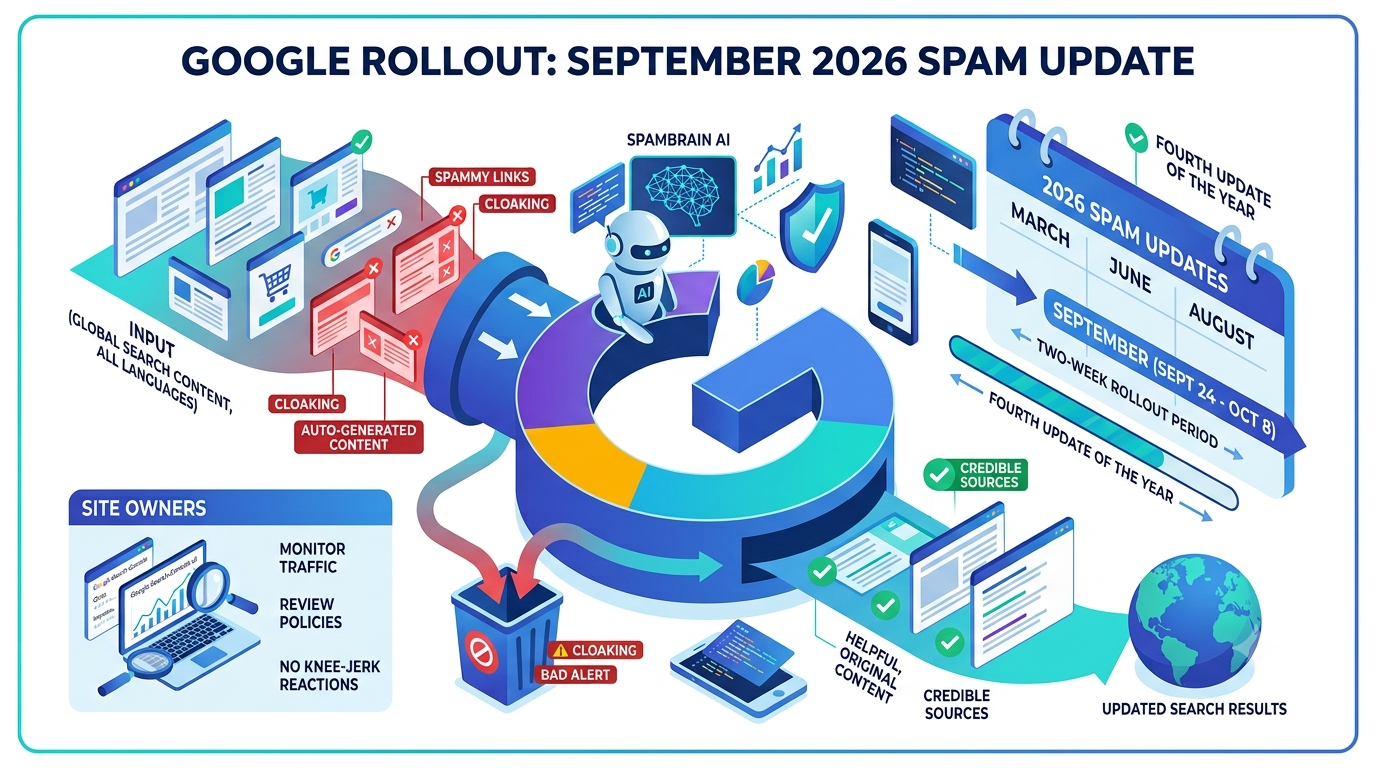
Google Search rankings are subject to active enforcement changes as of September 24, 2026. Google's Search Status Dashboard records the rollout as beginning at 9:15 a.m. PDT on September 24, with the company announcing that the September 2026 spam update applies globally and to all languages, and the rollout may take up to two weeks to complete.
The Fourth Spam Update of 2026
The September update is the fourth confirmed spam update of 2026, following updates in March, June, and August. Each of those earlier updates concluded within days. The August 2026 spam update took about two and a half days, while the June update took just over two days. The September rollout's two-week window marks a significant departure from that pattern.
The March spam update began March 24 and finished the following day. The June spam update started June 24 and ended June 26. Google then released another spam update on August 18, with that rollout ending August 21.
Scope and Disclosure
Google has confirmed the scope and expected duration of the rollout but has not disclosed what specific spam behaviour, system change, or detection improvement prompted it. The September update is also not specifically a link spam update, and Google has not announced that it is targeting one particular spam category with this release.
Google's automated systems to detect search spam are constantly operating, and the company occasionally makes notable improvements to how they work. When it does, it refers to this as a spam update and shares when they happen on its list of Google Search ranking updates. SpamBrain is Google's AI-based spam-prevention system, which the company improves from time to time to better identify spam and catch new types of it.
How Google's Spam Policies Apply
Sites that see a change after a spam update should review Google's spam policies to ensure they are complying with them. Sites that violate those policies may rank lower in results or not appear in results at all.
Making changes may help a site improve if Google's automated systems learn over a period of months that the site complies with its spam policies. However, recovery timelines are not immediate. In the case of a link spam update, one that specifically targets link spam, making changes might not generate an improvement. When Google's systems remove the effects of spammy links, any ranking benefit those links previously generated for a site is lost and cannot be regained.
Interpreting Ranking Volatility During the Rollout
The rollout is still active, so sudden traffic or visibility changes during this period should not automatically be treated as a permanent result of the update. What remains unknown is equally important: Google has not disclosed the particular spam tactics being addressed, the percentage of searches affected, or the likely magnitude of ranking changes.
For site owners and SEO teams monitoring performance, standard industry practice during an active spam rollout is to use Google Search Console to track changes in clicks, impressions, and landing-page performance at the page level rather than drawing sitewide conclusions from short-term fluctuations. Reactive content or link changes made before the rollout completes cannot be accurately attributed to the update's specific enforcement actions.
Google Search Central confirmed the release on September 24 via its official X account, noting it will update its ranking release history page when the rollout is complete.