
Translating ad copy is easy. Rebuilding an entire video campaign for another language is not.
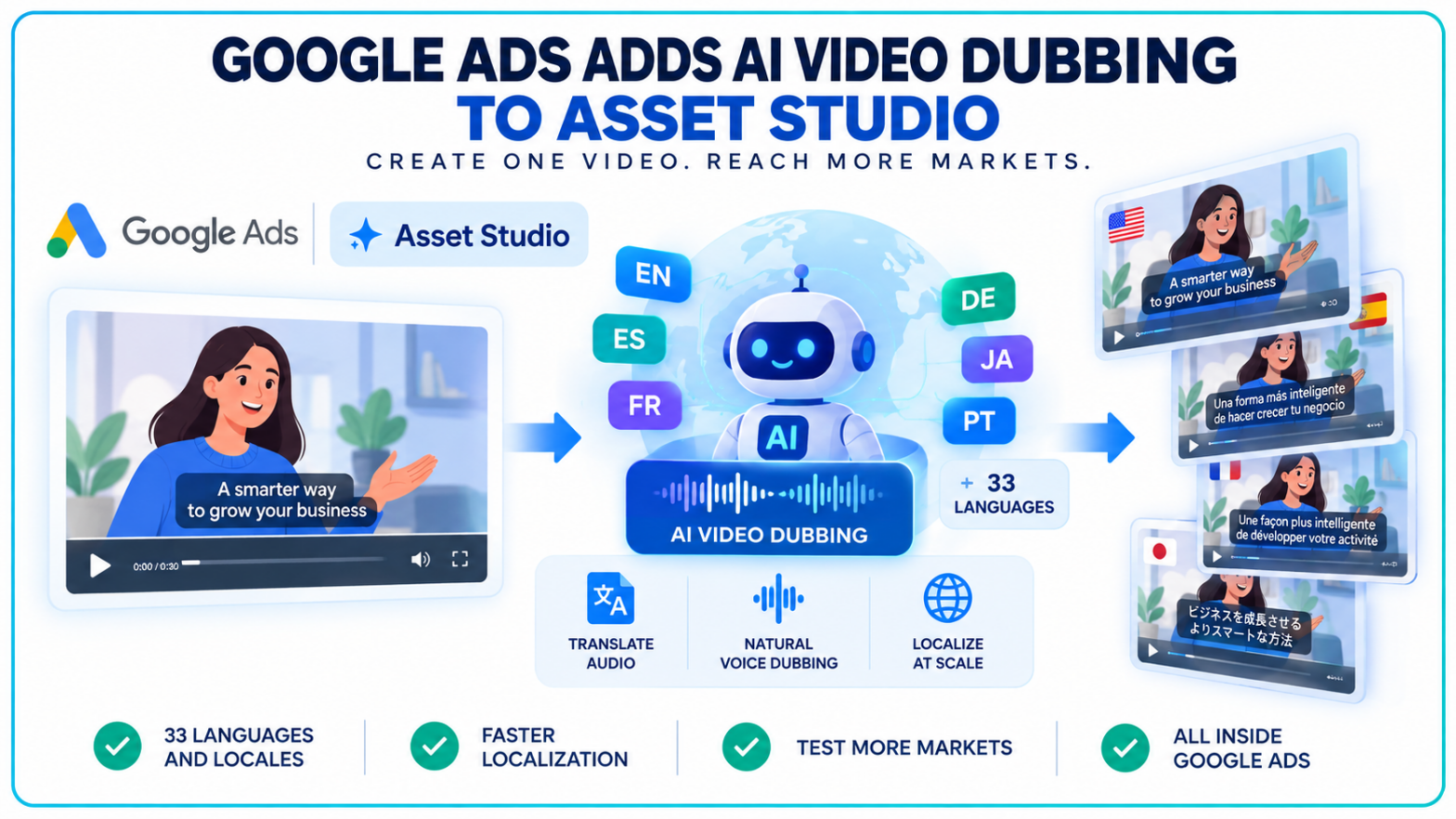
Google Ads is starting to close that production gap with AI-powered video dubbing inside Asset Studio, giving select advertisers a way to translate and revoice existing video creative without leaving the Google Ads workflow.
The rollout supports 33 languages and locales, according to early access reports, and turns localization into another editable asset task alongside trimming, voice-over, image generation and video creation.
For advertisers running campaigns across several markets, that changes a familiar constraint: the creative may already exist, but producing a usable version for every language has traditionally required another round of scripting, recording and editing.
Video Dubbing Moves Localization Into the Ad Account
Google has steadily expanded Asset Studio from an asset library into a production environment.
The platform already lets advertisers generate and edit images, build videos, shorten existing footage and add AI-assisted voice-overs. Google describes Asset Studio as a centralized workspace for creating, editing, managing and sharing campaign assets, with AI tools built directly into those workflows.
Video Ads Dubbing pushes that model further.
Rather than adding a newly written voice-over to an existing video, the newer capability is designed to translate and dub the creative itself into another language. Early rollout reporting indicates that advertisers can use the tool across 33 languages and locales, although access remains limited and Google has not published a full public availability schedule.
That makes the distinction from Google Ads’ existing voice-over tool important.
The current Google Ads voice-over workflow lets advertisers choose a language and voice, enter messages and place those messages at specific points in a video. Video dubbing is aimed at localization of existing spoken creative rather than simply layering new narration over footage.
One Video Can Now Produce More Market Variants
Video localization has usually been a production decision before it becomes a media decision.
A campaign may perform well in English, but testing the same concept in French, Spanish or another language can mean creating translated scripts, recording new audio, editing the track back into the original footage and checking that the final version still works visually.
AI dubbing compresses more of that work into Google Ads.
The immediate advantage is not that every international campaign can suddenly use identical creative. Language is only one part of localization. Offers, legal disclosures, cultural references and on-screen text may still need separate review.
What changes is the cost of getting a first viable version into testing.
A creative team can take an existing video, generate a localized audio treatment and assess whether the underlying concept has enough potential in another market to justify deeper production investment.
That fits a wider pattern inside Google Ads. Earlier this year, Google expanded Asset Studio around multimodal AI, describing it as a place where advertisers can generate and refine multiple creative asset types from a marketing brief, brand guidelines, website and campaign goals.
TechWyse has also covered Google’s expansion of Gemini-powered creative tools in Demand Gen, including AI-assisted video resizing and creative recommendations. Video dubbing extends that production automation into language.
Multilingual Testing Gets Cheaper Before It Gets Easier
The most immediate use case is campaign experimentation.
An advertiser with a proven English-language video no longer has to treat every additional language as a full production project before learning whether there is demand. A localized version can be created earlier in the media-testing process and evaluated against market-specific performance data.
That can make multilingual ads more accessible to businesses that previously restricted video campaigns to a small number of languages because of production cost.
It also changes how creative budgets can be allocated.
Instead of committing heavily to localized production before launch, advertisers can potentially use AI-generated versions as an initial testing layer, then invest in professionally adapted creative where results justify it.
The caveat is quality control.
Translation accuracy, pronunciation, pacing and tone all affect how a localized ad is received. A technically correct dub can still sound unnatural, flatten a brand voice or create awkward timing against the visuals.
Advertisers also need to check elements that dubbing does not automatically solve, including text embedded in the video, calls to action, product terminology and market-specific claims.
AI Creative Now Carries Compliance Questions Too
AI-assisted production is becoming easier at the same time that disclosure requirements are becoming more complicated.
Google now provides AI content labelling controls across its advertising products for certain AI-generated or edited assets. Its own Demand Gen documentation notes that regulations in jurisdictions including the European Union, India and New York can require disclosures for some forms of AI-created advertising content. Google also cautions that using its labelling controls does not automatically guarantee legal compliance.
TechWyse previously reported on Google’s rollout of AI ad disclosure labels, which made creative provenance a more explicit part of campaign management.
AI dubbing adds another production step advertisers will need to document.
A localized voice track may be generated automatically, but the campaign still has to meet the advertising, disclosure and consumer-protection requirements of the market where it runs.
For enterprise advertisers operating across several jurisdictions, that workflow may become almost as important as the dubbing itself.
Asset Studio Is Becoming a Creative Production Layer
Google’s larger direction is becoming difficult to miss.
Asset Studio is no longer just where finished creative is stored. It increasingly sits between the original campaign concept and the final versions that run across Google and YouTube.
Advertisers can already use Google AI to generate imagery, modify existing visuals, create video variants, trim footage and add voice-over. Google’s video enhancements can also automatically create different aspect ratios and shorter versions of existing videos, while Gemini selects sections of the source creative to preserve the original message.
Dubbing brings language adaptation into that same system.
That matters because creative variation is becoming more closely tied to media optimization. TechWyse recently covered Google data showing that YouTube creative choices can materially affect campaign performance, including differences associated with voice, text overlays and early brand visibility.
For paid media teams, the practical implication is straightforward. Multilingual expansion can now begin with the strongest existing video assets rather than a separate production cycle for every target language. Those AI-generated versions still require human review for translation, brand tone, compliance and on-screen text before they are treated as finished campaign creative.
Google has not yet published detailed public documentation covering the full Video Ads Dubbing workflow, supported language list or broader eligibility criteria.
For now, the feature is rolling out to select advertisers. But its arrival inside Asset Studio puts another traditionally external production task directly inside the campaign platform.