
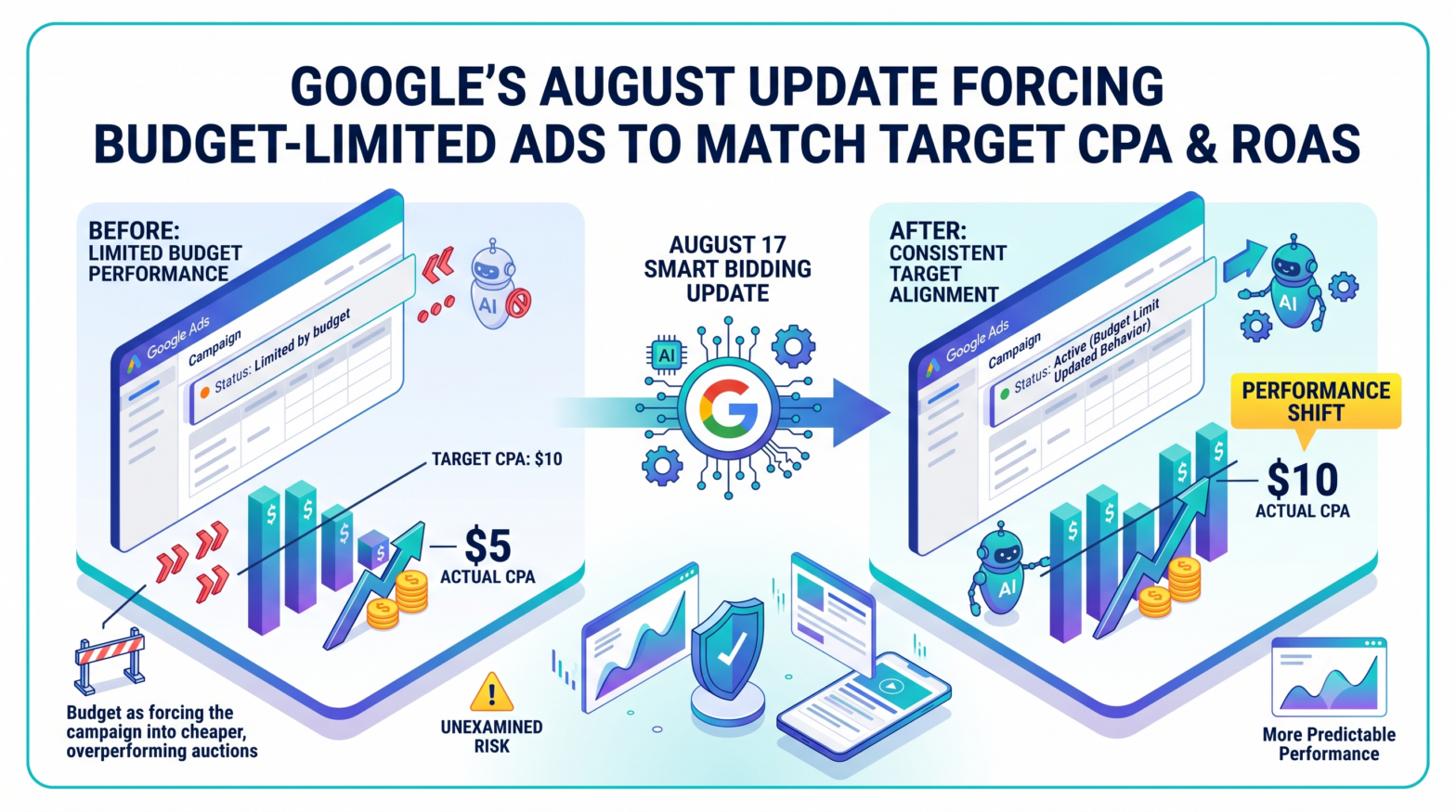
Advertisers running budget-limited campaigns on Target CPA or Target ROAS are set to see their performance numbers shift on August 17, 2026, whether or not they take any action. Google first announced the change on June 15, 2026, through Ads Product Liaison Ginny Marvin's LinkedIn post and a companion entry on the Accelerate with Google blog. Marvin has since responded directly to advertiser concerns to clarify the scope of the change.
What Google Is Changing
Starting August 17, 2026, Google will be making changes to its bidding systems, making it easier for advertisers to get more consistent and predictable performance based on the targets they set, even when budget adjustments are made.
Today, when a campaign has a "Limited by budget" status and uses a Target-based bid strategy such as Target CPA or Target ROAS, some campaigns may be overperforming on bidding targets and see performance fluctuations when budgets are adjusted. Google says that was not the intended behaviour. Instead, Smart Bidding will optimize more closely toward the Target CPA or Target ROAS advertisers actually set.
The practical consequence is direct. A budget-constrained campaign with a Target CPA of $10 that has been achieving a $5 CPA, without any changes made by the advertiser, will start delivering closer to the $10 target once the update takes effect.
Which Campaigns Are Affected
This change applies to Target CPA and Target ROAS across most campaign types, and specifically Target CPC for Demand Gen campaigns. It does not impact manual CPC or Target Impression Share bid strategies. The change covers Search, Shopping, Performance Max, Demand Gen, and Travel campaigns. App, Video reach, and Video view campaigns keep their current behaviour. Display and Hotel campaigns are already using this tighter bidding behaviour.
Google Ads Liaison Ginny Marvin confirmed that the update only impacts budget-constrained campaigns using a target because this is already the bidding behaviour when campaigns using a target are not budget-constrained. The change ensures expected bidding behaviour will be the same regardless of whether a campaign using a target is budget-constrained or not, and that if advertisers opt to change budgets on budget-constrained campaigns, they should expect more stable performance behaviour as the campaign scales.
Why Google Says This Creates a Risk for Advertisers on Autopilot
The current bidding behaviour, where budget-constrained campaigns may overperform their stated targets, can be confusing and create unpredictable results when budgets are adjusted. That unpredictability has worked silently in many advertisers' favour, budgets caps inadvertently forced Smart Bidding to compete only in the cheapest, highest-converting auctions, producing efficiency that exceeded what the target required.
Google Ads Liaison Ginny Marvin responded directly to concerns that the update would push spending higher. One of the biggest misconceptions was that Google was encouraging advertisers to simply spend more money. Marvin clarified: "This won't result in campaign spend changes… Our guidance for those with budget-constrained campaigns currently over-performing on their target is to ensure the targets are in line with your goals." She also emphasized that advertisers will only spend more if they choose to raise their campaign budgets. The update itself does not change campaign budgets or automatically adjust bidding targets.
The Bid Target Adjustment Tool
To manage the transition, Google introduced a new tool called the Bid Target Adjustment Tool, available in Google Ads starting July 6, 2026. The tool is triggered by account notifications sent to advertisers whose campaigns were limited by budget in the last 12 months and use a target-based bid strategy affected by the upcoming changes.
Advertisers who want to maintain current performance for campaigns performing better than their targets can select "Apply" to update targets based on the performance shown in the tool. Advertisers happy with their current bidding targets need not take any action. Budgets will not increase automatically as a result of the changes, nor will CPA or ROAS targets be altered without manual input.
What Advertisers Should Review Before August 17
Advertisers whose campaigns carry a "Limited by budget" status and whose actual CPA or ROAS has consistently outperformed their stated target face the most direct exposure. Google Ads Liaison Ginny Marvin noted that advertisers may need to revisit their CPA or ROAS targets to ensure they still reflect actual business goals before the rollout begins. Campaigns where a meaningful gap exists between the stated target and actual performance, for example, a $35 Target CPA with a consistent $20 actual CPA, are the accounts most likely to experience a measurable performance shift after August 17 without any change in settings.
In practice, advertisers managing budget-limited campaigns should identify which accounts carry a "Limited by budget" status, compare recent actual CPA or ROAS against the stated target, and use the Bid Target Adjustment Tool to lower targets if the goal is to preserve current efficiency levels. Google has noted directly in its Help Center that these changes may cause temporary performance and traffic fluctuations for campaigns using Target CPA or Target ROAS.
Starting August 17, 2026, Google will be making changes to its bidding systems, making it easier for advertisers to get more consistent and predictable performance based on the targets they set, even when budget adjustments are made. Advertisers whose targets have not been reviewed since they were initially configured are carrying unexamined risk into that date.