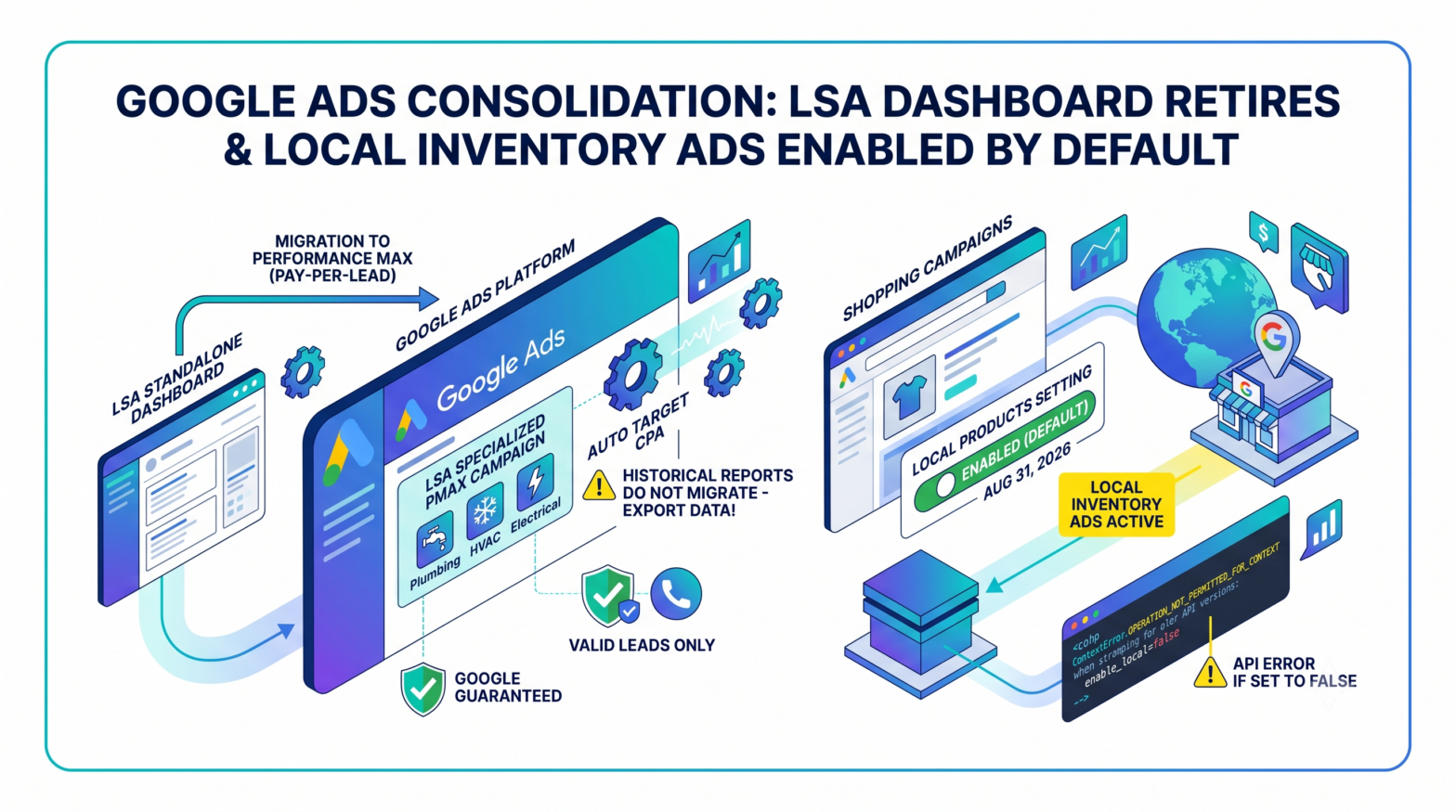
Google is retiring the standalone Local Services Ads dashboard and migrating every existing pay-per-lead campaign into the main Google Ads platform, a change that directly affects plumbers, HVAC contractors, electricians, lawyers, and other local service businesses that rely on the Google Guaranteed and Google Screened programs for lead generation. The shift converts all Local Services Ads campaigns into a specialized Performance Max campaign type built for pay-per-lead goals, ends manual bidding, and leaves historical performance reports behind, a change documented in a Google Ads Help Center article and confirmed publicly by Ginny Marvin, Ads Product Liaison at Google. Separately, on July 20, 2026, the Google Ads Developer Blog published a post by Dora Sun of the Google Ads API Team announcing that Local Inventory Ads will be enabled by default for all Shopping campaigns beginning August 31, 2026.
Local Services Ads Move Into Google Ads as Performance Max Campaigns
Google will retire the standalone Local Services Ads dashboard and move its campaigns into the main Google Ads platform, beginning in August 2026 with home and storefront service advertisers in the United States. The standalone dashboard, the primary interface through which local service businesses have managed their Google Guaranteed listings, tracked leads, and controlled budgets, will cease to exist after each account's individual migration date.
The new campaign type is built exclusively for Local Services advertisers. Ads continue to appear only on Search and Maps, campaigns remain keywordless and draw on information from the advertiser's Google Business Profile, and advertisers continue to pay only for valid leads, such as calls, messages, and bookings, not clicks. Despite the Performance Max name, these campaigns will not expand into Display, YouTube, Gmail, or other Google properties the way a standard Performance Max campaign would.
The migration does introduce concrete changes to how campaigns are structured and managed. The shift ends manual bidding and leaves past performance reports behind unless advertisers export them before their transition date. Advertisers who currently set a maximum cost per lead through manual bidding will lose that capability; Google will instead calculate a single campaign-level Target CPA. The Target CPA change could affect businesses that advertise several services within one campaign, for example, a contractor managing separate targets for plumbing and HVAC leads, since Google will calculate one campaign-level target covering both categories after migration. Advertisers requiring separate bidding control by service type will need to create distinct campaigns.
Google Guarantee and Google Screened badges, lead history, and pay-per-lead pricing all carry forward without any action required by the advertiser. Existing budgets, settings, and creative assets will transfer automatically, although historical performance reports will not migrate to Google Ads. Advertisers also transition from managing an average weekly budget to an average daily budget in the new interface.
One functional addition accompanies the migration: real-time syncing with Google Business Profile. Campaigns will draw on information from the advertiser's Google Business Profile, meaning business name, physical address, standard hours, and photos update campaigns automatically without separate manual entry in the LSA dashboard.
Advertisers will manage Local Services campaigns and respond to leads within Google Ads. The separate Local Services Ads dashboard will no longer be available after migration.
Migration Timeline and Rollout Phases
The first phase of the migration begins in August 2026 for select home and storefront service advertisers in the United States, including plumbing, HVAC, electrical, appliance repair, house cleaning, lawn care, roofing, pest control, and moving. In late 2026, the migration expands to broader advertiser groups, including service-area businesses without physical storefronts and accounts with custom bidding or booking configurations. Non-U.S. accounts and all remaining business categories not migrated in 2026 will transition to Google Ads in 2027.
Account administrators receive an email 14 days before the migration date, accompanied by warning banners inside the current dashboard, followed by a reminder email seven days later and a confirmation email once migration completes.
What Advertisers Must Do Before Migration
Previous performance reports will not carry over to Google Ads. Advertisers that rely on year-over-year comparisons, seasonal benchmarking, or client performance reporting should download all historical data from the Local Services Ads dashboard before their account's migration date. Lead history transfers, but aggregate metrics describing how campaigns performed over time do not.
After migration, advertisers should verify that daily budgets, campaign-level Target CPA, service categories, locations, ad schedules, and lead-routing phone numbers align with current business objectives. Performance should be expected to take up to two weeks to fully stabilize following migration.
For service businesses with multiple verticals at meaningfully different lead costs, such as a home services company running both plumbing and electrical, advertisers can create separate campaigns if those services require different targets. Separate campaigns provide more granular bidding control, but each will carry less historical conversion data to inform Google's bidding algorithm.
Local Inventory Ads Enabled by Default for All Shopping Campaigns
In a separate announcement also published July 20, 2026, the Google Ads Developer Blog confirmed the change removes the practical effect of the `enable_local` field for Shopping campaigns and forces the value to `true` across the board. The move aligns Shopping campaigns with Performance Max for Retail campaigns, which already treat local product serving as standard behaviour.
Beginning August 31, Local Inventory Ads will be enabled by default in Shopping campaigns linked to Merchant Center accounts with the Local Inventory Ads add-on enabled. The "Local products" setting will be removed. Advertisers will instead manage Local Inventory Ads using the Inventory filter, which allows campaigns to be configured using Channel = Local or Channel = Online.
The change has direct implications for how developers interact with the Google Ads API. For API version 25.1 and later, code that sets the `enable_local` field to `false` will trigger a `ContextError.OPERATION_NOT_PERMITTED_FOR_CONTEXT` error; for earlier versions, such requests are simply treated as `true`. Advertisers who want online-only serving must instead use `CampaignCriterionService` with `product_channel` set to `ONLINE`, or the inventory filter in campaign settings.
The change applies only to Shopping campaigns. For other campaign types that support the field, including Performance Max and Demand Gen, `enable_local` will continue to behave exactly as it does today.
Practical Implications for Advertisers and Developers
For local service businesses, the LSA migration requires action primarily around data preservation and campaign structure review. Advertisers running services with different lead economics across a single campaign should evaluate whether separate campaigns will be needed post-migration, balancing bidding control against the reduced conversion data that comes with campaign splitting. Agencies managing multiple LSA accounts may want to begin historical data exports before migration notices arrive.
For retail advertisers using Shopping campaigns with a Merchant Center local inventory add-on, any campaign logic that depended on `enable_local` being set to `false` to exclude local products will stop working on August 31, 2026. Budget separation between online and in-store inventory must be managed through the Inventory filter before that date. Developers running Google Ads API v25.1 or later must remove code that attempts to set the field to `false` to avoid API errors.
Google Local Services Ads is transitioning to a more integrated, self-service experience inside the Google Ads platform, with the company confirming in its Google Ads Help Center documentation that the phased rollout is structured to minimize downtime for individual accounts during migration.