
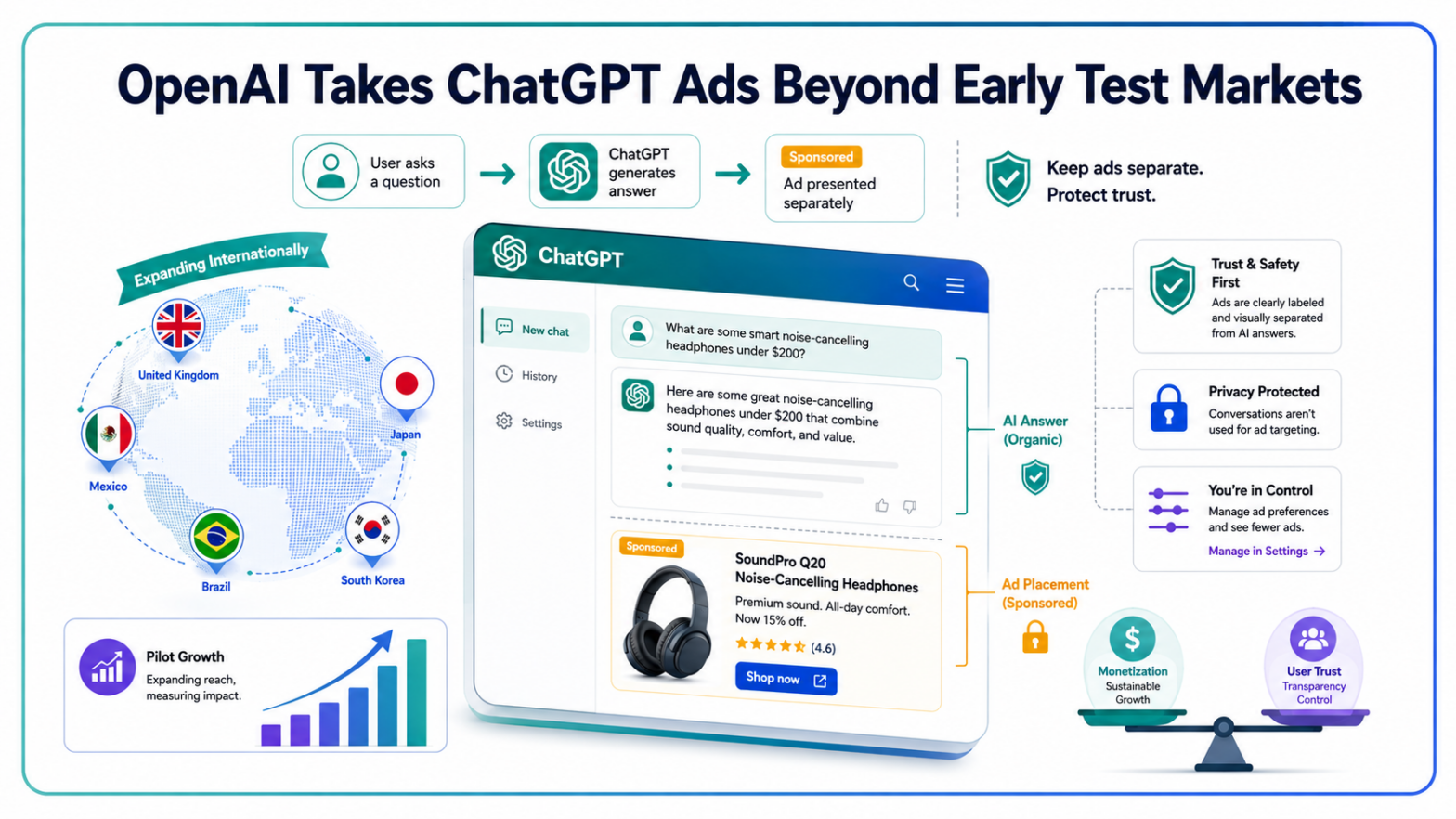
OpenAI is expanding its ads pilot to five more countries, marking another step toward a broader commercial model inside one of the world’s most-used AI products.
Five New Markets Enter the Test
OpenAI said on May 7, 2026, that its ChatGPT ads pilot will expand in the coming weeks to the United Kingdom, Mexico, Brazil, Japan, and South Korea.
The company framed the move as a regional learning phase. Each market gives OpenAI a different advertising environment to test, from language and regulation to consumer expectations and category demand.
That matters because ChatGPT ads are not being introduced as a standard display unit bolted onto a feed. They appear inside a conversational product where users may be researching, comparing, planning, or making decisions in real time.
The Pilot Has Already Moved Past the U.S.
The program began in the United States on February 9, 2026, for logged-in adult users on ChatGPT’s Free and Go tiers. OpenAI later said it would expand the pilot to Canada, Australia, and New Zealand.
The company has kept ads away from higher-paid and organizational plans. Plus, Pro, Business, Enterprise, and Education tiers are not included in the ad experience.
That split gives OpenAI a clear line between monetizing lower-cost access and preserving ad-free experiences for paid consumer and workplace users.
OpenAI Is Selling Reach, But Guarding the Answer
The central tension is simple: ads can fund broader access, but they cannot appear to steer the assistant.
OpenAI says ChatGPT’s answers remain independent from ads, with sponsored placements visually separated from organic responses. Ads are selected based on factors such as the topic of the conversation, past chats, and prior ad interactions, according to the company’s public explanation of the pilot.
Advertisers do not receive users’ chats, chat history, memories, or personal details. OpenAI says advertisers get aggregate performance data, such as views and clicks.
The company has also said it is not showing ads to users it identifies or predicts as under 18, and that ads are not eligible to appear near sensitive or regulated topics such as health, mental health, or politics.
Early Signals Gave OpenAI Room to Expand
OpenAI said in a March 26 update that early results showed no impact on consumer trust metrics, low ad dismissal rates, and improving ad relevance as feedback came in.
Those are the metrics OpenAI needs to defend if it wants ads to scale inside ChatGPT. Relevance is only one part of the equation. Trust is the harder one.
A search ad can sit beside results without changing the search index. A social ad can appear between posts without pretending to be part of the post itself. ChatGPT has a narrower margin because the user experience is built around one assistant voice.
That makes labelling, separation, and user control central to the ad product rather than secondary interface details.
Controls Are Part of the Product Pitch
OpenAI says users can dismiss ads, give feedback, learn why an ad appeared, delete ad data, and manage personalization settings.
The company has also said Free users can opt out of ads in exchange for fewer daily free messages, while users who want an ad-free experience can move to paid plans.
That trade-off places advertising directly inside OpenAI’s access strategy. Free usage remains available, but the cost is increasingly being paid through sponsored discovery rather than subscription revenue alone.
What Marketers Should Watch
For marketers, ChatGPT ads represent a potential shift from keyword-driven intent to task-driven intent. A user planning a trip, comparing software, researching recipes, or evaluating purchases may create ad opportunities that are tied to the context of a conversation rather than a traditional search query. The practical challenge will be brand safety, measurement quality, creative relevance, and whether advertisers can participate without disrupting user trust in the assistant experience.
A New Ad Surface With Unusual Limits
OpenAI is also inviting businesses interested in the expanded markets to register for advertising updates through its advertiser program.
For now, the pilot remains controlled. The company is still testing where ads appear, how users respond, and how different markets handle sponsored content inside AI conversations.
The next phase will show whether ChatGPT can turn high-intent conversations into an ad business while keeping the answer itself out of the auction.