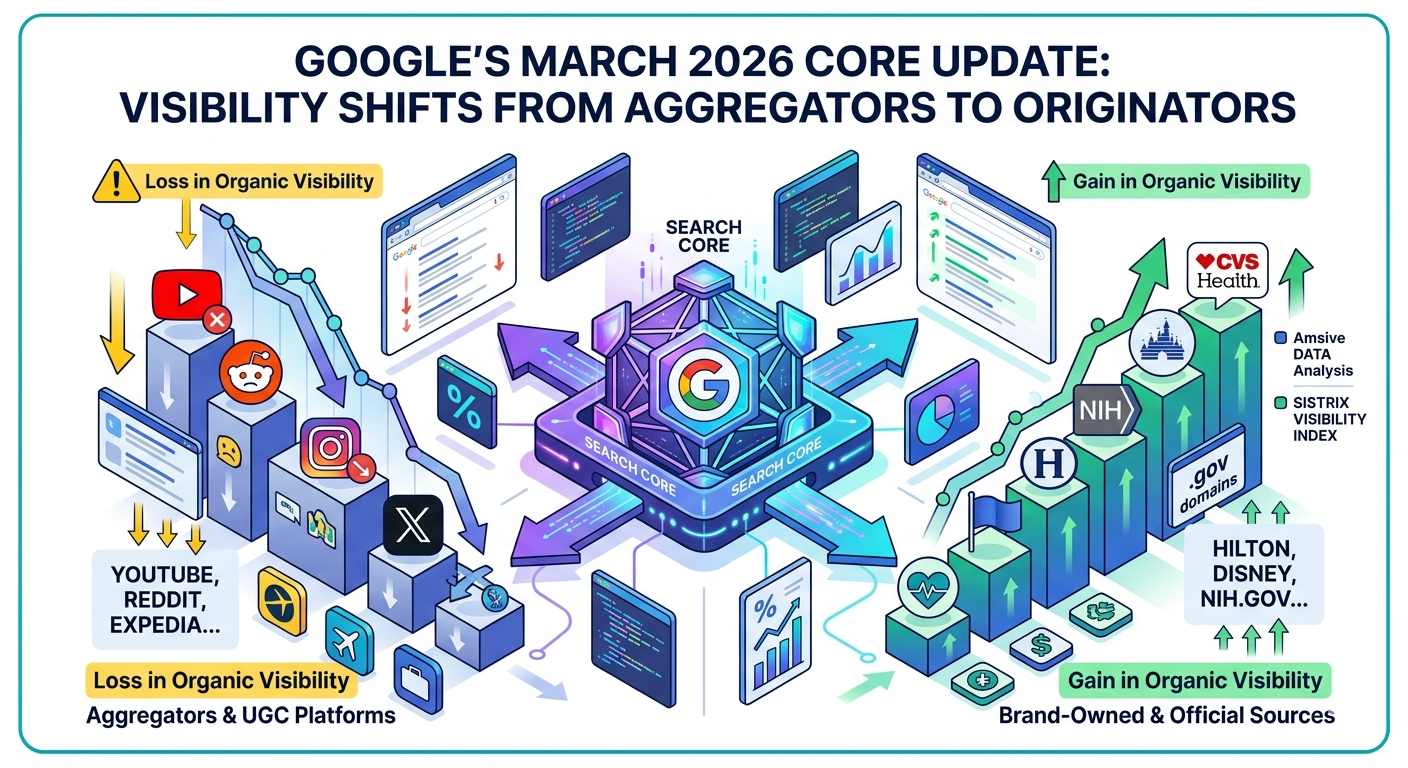
Brand-owned websites, government domains, and content originators gained U.S. search visibility during Google's March 2026 core update while aggregators, user-generated content platforms, and social media sites lost ground. Amsive's post-update analysis, published April 2026, confirmed that Google rolled out its first major core algorithm update of 2026 starting March 27, with the rollout finishing on April 8, lasting just under two weeks. Google described the update as "a regular update" and did not publish a companion blog post or announce specific goals alongside the rollout.
Google's Search Status Dashboard confirmed the March 2026 core update finished rolling out on April 8, 2026, at 6:12 AM PDT, exactly 12 days and 4 hours after it started on March 27. This was the first core update of 2026, and it followed the March 2026 spam update and the February 2026 Discover update.
Amsive's Methodology and Data Scope
Lily Ray of Amsive examined over 2,000 domains using SISTRIX Visibility Index data and categorized them with Google Product Taxonomy tags via the DataForSEO API, comparing visibility on March 27, the rollout start, versus April 8, when the rollout completed.
A key caveat in the analysis: SISTRIX measures keyword-level visibility, not raw organic traffic. The dates compared are March 27, 2026, vs. April 8, 2026, close enough to the rollout that algorithmic shifts are likely the dominant driver, but other factors, including tracking changes, indexing, and on-site updates, can also affect visibility trends.
Amsive characterized the March 2026 update as a first-party, official-source correction, with Google tilting visibility toward authoritative, brand-owned, and government domains, and away from user-generated content, comparison aggregators, and content built primarily for search visibility.
YouTube Recorded the Largest Single-Domain Decline
YouTube's drop of 567 visibility points in less than two weeks stands as the largest single-domain decline in Amsive's dataset. To put it in context, Wikipedia's 435-point drop in December 2025 was the biggest individual loss of that year, and YouTube's March 2026 decline is roughly 30% larger.
However, YouTube's visibility dropped back to where it was before a surge in early March 2026, not to a new historical low. Reddit, Instagram, and X also posted significant losses, representing the three pillars of the UGC and social media expansion that defined organic SERPs from 2023 through 2025.
The Amsive report notes that some domains on the loser list saw partial rebounds shortly after the update window closed. Reddit and Indeed both recovered visibility following the rollout, which means the loser rankings reflect conditions during the update period rather than where those domains ultimately settled.
Travel, Jobs, and Health Sector Patterns
In travel, TripAdvisor, Yelp, and Expedia were hit hard. Hotel chains and government sites moved in the opposite direction, with Hilton, Hotels.com, and Trivago all recording visibility gains, while National Park Service and airport websites saw increases. The pattern across the travel vertical mirrors the broader update trend: aggregators and online travel agencies lost ground to the properties they list.
In the jobs and education sector, job board aggregators declined while employer career pages and government labour sites rose. Indeed lost 18 visibility points and ZipRecruiter fell 13, while BLS.gov gained 5.4 points, USAJobs.gov rose 16%, Disney Careers gained 59%, and CVS Health Careers increased 45%.
Health results showed a more mixed picture. GoodRx rose 55% (9.5 points), and NIH.gov gained 9.3 points. However, the Cleveland Clinic dropped 12 points, WebMD fell 9, and Mayo Clinic declined 6. The divergence between government and institutional health sources versus consumer health publishers is visible in the data, though Amsive cautions that interpreting a directional cause from Google requires speculation about ranking intent.
Corroborating Research from Zyppy and SISTRIX
A separate analysis published April 9, 2026, put concrete numbers to what separates gaining and losing sites. Cyrus Shepard, founder of Zyppy SEO, analyzed more than 400 winning and losing websites and identified five features that, taken together, predict Google traffic outcomes with consistency.
The five features identified were: offering a product or service (0.391 Spearman correlation), allowing task completion (0.381), owning proprietary assets (0.357), maintaining tight topical focus (0.250), and building a strong brand (0.206). Sites with four or five of these features achieved win rates of 68.1% and 69.7%, respectively, versus 13.5% for sites with none.
Shepard measured correlations using third-party traffic estimates rather than verified Search Console data, which Amsive noted when citing the research. The two analyses used different methodologies. Amsive tracked SISTRIX visibility during the update window, while Shepard measured traffic correlations across a 12-month period, but the directional findings aligned.
A SISTRIX analysis of German data found similar results, with online shops and utility sites losing ground while official websites and brands proved more resilient.
What the Pattern Means for Brand and Direct-Ownership Strategy
The consistency of the winner-loser divide across travel, jobs, health, finance, and entertainment suggests a structural pattern rather than vertical-specific volatility. Across the March 2026 core update, Google appears to have dialled back the visibility of platforms that aggregate, host, or syndicate other people's content, while elevating the sites that originally created it.
For marketers and brand managers, the practical implication is that sites with owned, first-party content, direct employer career pages, brand product pages, official government information, and original-source health or financial data appear better positioned in this update's aftermath than intermediary platforms or review-based aggregators. This is based on the directional patterns in Amsive's visibility data and should be evaluated against individual site performance data from the same March 27–April 8 window before drawing site-specific conclusions.
Google did not publish a companion blog post alongside the March 2026 core update, and it did not share new guidance with the completion notice on April 8.