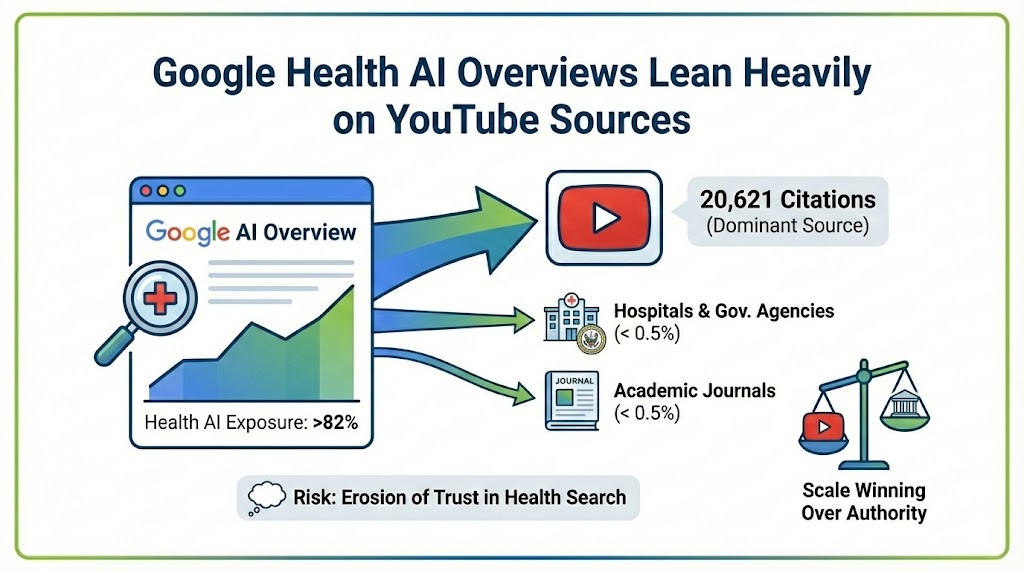
New research suggests Google’s AI Overviews rely on YouTube more than hospitals, government agencies, or academic institutions when responding to health-related searches—raising renewed questions about authority and trust in AI-generated medical information.
The findings surface at a sensitive moment for Google, following recent reporting that prompted the company to remove AI Overviews for some medical queries after concerns about misleading summaries.
Health Is One of the Most AI-Saturated Search Categories
An analysis by SEO platform SE Ranking examined 50,807 German-language health queries, using searches conducted from Berlin in a one-time snapshot captured in December.
The data shows AI Overviews appeared on over 82% of health-related searches, making health one of the most heavily influenced categories for AI-generated answers. That level of exposure matters because health queries are high-stakes, and users increasingly treat AI responses as substitutes for traditional search results.
YouTube Emerges as the Dominant Citation Source
Across all AI Overview citations in the dataset, YouTube ranked first by a wide margin.
SE Ranking found YouTube accounted for 20,621 citations, representing 4.43% of all sources referenced in health-related AI Overviews. That placed it ahead of hospital sites, medical publishers, and government health institutions.
Other frequently cited domains included Germany’s public broadcaster ndr.de and MSD Manuals, but neither approached YouTube’s overall citation volume.
Scale Is Winning Over Institutional Authority
The prominence of YouTube reflects a structural tension in AI search systems.
YouTube is a general-purpose platform with enormous content scale, not a medically governed publisher. While licensed clinicians and hospitals publish health content on YouTube, the platform also hosts videos from creators without medical credentials.
To assess quality at the top end, SE Ranking reviewed the 25 most-cited YouTube videos in its dataset. Most came from medical-focused channels, and the majority clearly identified licensed or trusted sources. However, the researchers emphasized that these videos represent less than 1% of all YouTube links cited—limiting how far those findings can be generalized.
Official Medical Sources Barely Register
When SE Ranking grouped citations by source type, the imbalance became clearer.
Academic journals and medical research accounted for less than 0.5% of citations. German government health institutions appeared in 0.39% of cases, while international government bodies accounted for 0.35%.
Overall, nearly two-thirds of AI Overview citations came from sources not designed to meet formal medical or evidence-based publishing standards.
AI Citations Don’t Closely Match Organic Rankings
The study also compared AI Overview sources with traditional organic search rankings.
While many of the same domains appeared in both systems, the specific URLs often differed. Only about a third of AI-cited links ranked in Google’s top 10 organic results, and roughly three-quarters appeared somewhere within the top 100.
YouTube stood out as the biggest divergence. It ranked first in AI citations but only 11th in organic visibility for the same health queries.
Why This Is Getting Scrutiny Now
The research follows an investigation by The Guardian that highlighted misleading medical advice appearing in Google AI Overviews. After that reporting, Google confirmed it removed AI summaries for some health-related searches.
SE Ranking framed its analysis as a systemic look at sourcing patterns rather than a critique of individual answers—showing how Google’s AI systems behave at scale.
The Real Risk Isn’t SEO—It’s Trust
For health-related searches, the core issue isn’t ranking mechanics or optimization tactics. It’s whether AI systems consistently surface sources that users can safely rely on.
When platform-scale content outweighs institutional authority, the risk isn’t just misinformation—it’s erosion of trust in search itself.
What This Signals Going Forward
SE Ranking notes its findings reflect a single snapshot limited to German-language searches and could change by region, timing, or query phrasing.
Even with those caveats, the data underscores a growing challenge for AI-powered search: balancing speed, scale, and synthesis with credibility and accountability—especially in areas where getting the answer wrong can have real-world consequences.