


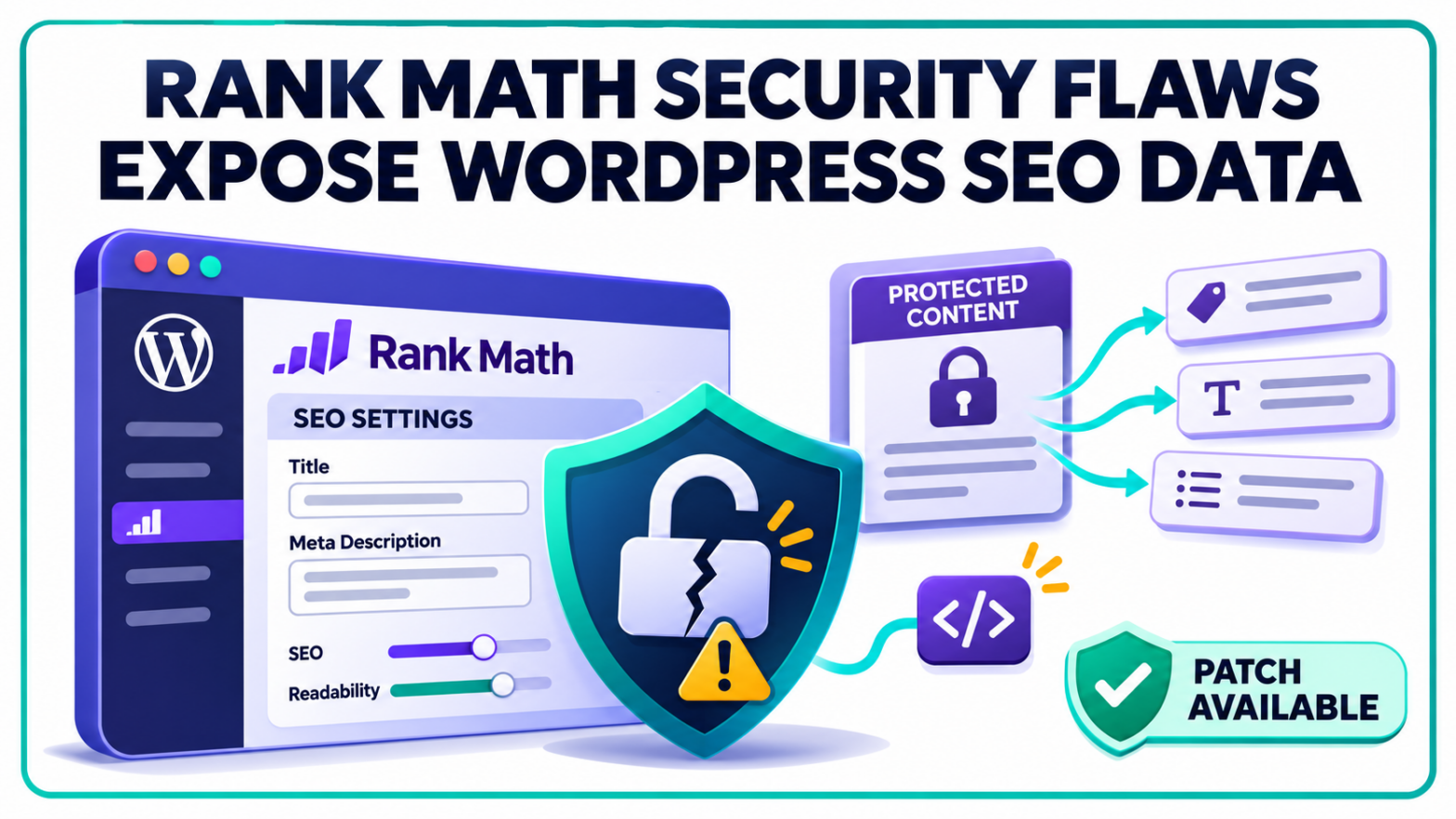
An SEO plugin is supposed to control how a website appears in search. But security weaknesses in Rank Math have shown how those same controls can become an entry point for attackers.
Security researchers documented 16 vulnerabilities in the popular WordPress SEO plugin during 2026, including flaws that could allow unauthorized changes to website metadata, expose password-protected content and execute malicious code on affected servers.
According to Wordfence's vulnerability database, the findings range from relatively limited permission failures to high-severity remote code execution vulnerabilities. Two received severity scores of 8.8 out of 10.
Rank Math has released fixes for the reported issues, but the disclosures raise questions about how much access an SEO plugin has to a website's underlying content and configuration.
The plugin has approximately four million active installations, according to Wordfence. That figure reflects its reach, not the number of websites affected or compromised by the vulnerabilities.
Sixteen Rank Math Vulnerabilities, but Different Levels of Risk
The security findings were disclosed between May and October 2026. They involve several weaknesses in how older versions of Rank Math handled user permissions, processed input and exposed information.
Not all 16 vulnerabilities presented the same level of danger.
Some required an attacker to have an existing WordPress account with Author or Contributor permissions. Others could be triggered without authentication, potentially making them accessible to anyone who could reach an affected website.
Wordfence's records include vulnerabilities involving remote code execution, cross-site scripting, information disclosure, SQL injection, unauthorized metadata changes and insufficient access controls.
One distinction matters when interpreting the count: the 16 records have publication dates in 2026, although one vulnerability, CVE-2025-12714, carries a 2025 identifier. The year in a CVE identifier does not necessarily match its public disclosure date.
The number of disclosures also does not establish how many successful attacks occurred. Wordfence's database identifies vulnerabilities and affected software versions; it does not demonstrate that every installation was vulnerable or that the flaws were exploited across millions of websites.
The disclosures concern the free Rank Math SEO plugin distributed through WordPress.org. They are separate from the October 2026 security incident involving a compromised Rank Math PRO release.
Two High-Severity Flaws Could Allow Attackers to Execute Server Code
Among the most serious findings were two vulnerabilities that could allow attackers with relatively limited WordPress permissions to execute code on a website's server.
The first, CVE-2026-81757, was publicly disclosed on August 27, 2026.
Wordfence assigned it a severity score of 8.8 and identified insufficient validation of user-supplied input as the underlying problem.
The vulnerability affected Rank Math versions up to and including 1.0.276. An authenticated attacker with Author-level access or higher could potentially execute arbitrary code on the server.
A second vulnerability, CVE-2026-1928, was disclosed on October 27 and received the same 8.8 severity rating.
This flaw involved PHP object injection through the plugin's REST API. Wordfence reported that attackers with Contributor-level access or higher could exploit the weakness and, with an additional PHP object chain, potentially achieve remote code execution.
Both vulnerabilities affected versions up to 1.0.276 and were addressed in version 1.0.277.
Neither flaw gave every anonymous website visitor direct access to server code. The required user permissions are an important part of the risk assessment.
Still, Contributor and Author accounts are common on publishing websites, particularly where businesses use freelancers, content editors or external agencies.
A compromised account with those permissions could present risks beyond its intended editorial access when a vulnerable plugin is installed.
Another October disclosure, CVE-2026-104752, involved arbitrary file uploads and carried a severity score of 7.2. That vulnerability required Administrator-level access, making its exploitation conditions different from the two lower-privilege code execution flaws.
A WordPress SEO Metadata Flaw Allowed Changes Without Login
Some of the findings directly affected the information websites use to communicate with search engines.
One vulnerability, CVE-2025-12714, was publicly disclosed on May 28, 2026.
The issue involved a missing permission check in the function responsible for updating homepage SEO settings.
According to Wordfence, an unauthenticated attacker could modify several Rank Math settings, including the homepage SEO title, meta description, breadcrumb label and social media metadata.
The flaw affected versions up to 1.0.271 and was corrected in version 1.0.271.1.
Unlike the remote code execution vulnerabilities, this issue did not require the attacker to hold an existing WordPress account.
Its potential impact was also unusually relevant to search visibility.
SEO titles and descriptions help define how publishers present their pages to search engines, although Google may generate its own titles and snippets. Breadcrumb labels and social metadata can influence website navigation and how content is represented in other contexts.
Unauthorized changes could replace legitimate information with misleading text or unwanted content. Such modifications could interfere with a site's search presentation without necessarily altering the visible body of the homepage.
Another vulnerability, CVE-2026-77784, allowed authenticated users with Author-level permissions or higher to update SEO objects without the required authorization checks.
That issue was addressed in version 1.0.277.
Wordfence also disclosed an October authorization failure affecting older versions below 1.0.280, classified as an unauthorized SEO data deletion vulnerability.
These findings show how weaknesses in plugin permissions can affect SEO configuration independently of ordinary page editing.
They do not establish that websites experienced ranking declines or that Google imposed penalties because of the vulnerabilities.
Password-Protected Content Could Leak Through Search Metadata
One of the more unusual security findings involved content that WordPress site owners had deliberately protected with passwords.
Normally, a password-protected post should prevent unauthorized visitors from reading its contents.
However, CVE-2026-77782 exposed a weakness in how Rank Math generated SEO information for protected posts.
Wordfence reported that the plugin failed to perform the necessary password-protection checks before using post content to produce metadata.
An unauthenticated attacker could consequently access protected information through publicly generated structured data, meta descriptions or Open Graph metadata.
The vulnerability received a medium-severity score of 5.3 and was patched in Rank Math version 1.0.277.1.
The distinction between protecting a webpage and protecting its metadata is significant.
A website can restrict access to its main content while still producing information intended for search engines, social platforms and other automated systems.
When that generated information includes protected text, the content may become accessible outside the page's normal password requirements.
A separate stored cross-site scripting vulnerability, CVE-2026-66702, also affected earlier Rank Math releases. Wordfence rated it 7.2 and reported that unauthenticated attackers could inject scripts into pages because of insufficient input sanitization and output escaping.
That issue was patched in version 1.0.275.
The broader WordPress ecosystem has faced similar challenges involving the permissions and functions granted to SEO plugins.
Rank Math Security Updates Have Addressed the Reported Flaws
The Rank Math findings span multiple plugin releases rather than a single unresolved security problem.
The developer's official changelog documents security hardening and related improvements throughout 2026.
Version 1.0.275, released in July, strengthened the plugin's security. Version 1.0.277 followed in August with additional protections and acknowledgements of researchers who responsibly reported vulnerabilities.
October's version 1.0.280 introduced further input validation and output escaping safeguards. Wordfence identifies that release as the fix for several vulnerabilities affecting versions up to 1.0.279.
As of November 19, 2026, Rank Math's latest listed free release is version 1.0.282, published November 10.
For website administrators and SEO teams, the immediate operational issue is whether installed versions include the necessary patches. Reviewing plugin versions, controlling publishing permissions and checking for unauthorized changes to SEO metadata are established parts of WordPress security maintenance.
Updating software addresses known vulnerabilities, but it does not independently establish whether an older installation was previously compromised.
The distinction between WordPress Core and third-party plugins also remains relevant. TechWyse previously covered WordPress's Core Security Initiative, which focuses on improving vulnerability handling and patch delivery for the WordPress platform itself.
Third-party plugins continue to rely on their respective maintainers to investigate and correct security weaknesses.
Wordfence's individual records identify patches for the Rank Math vulnerabilities examined, including the two 8.8-severity code execution flaws. The database continues to document the affected historical versions, even though newer releases are available.