AI search has not made the product page obsolete.
Quite the opposite.
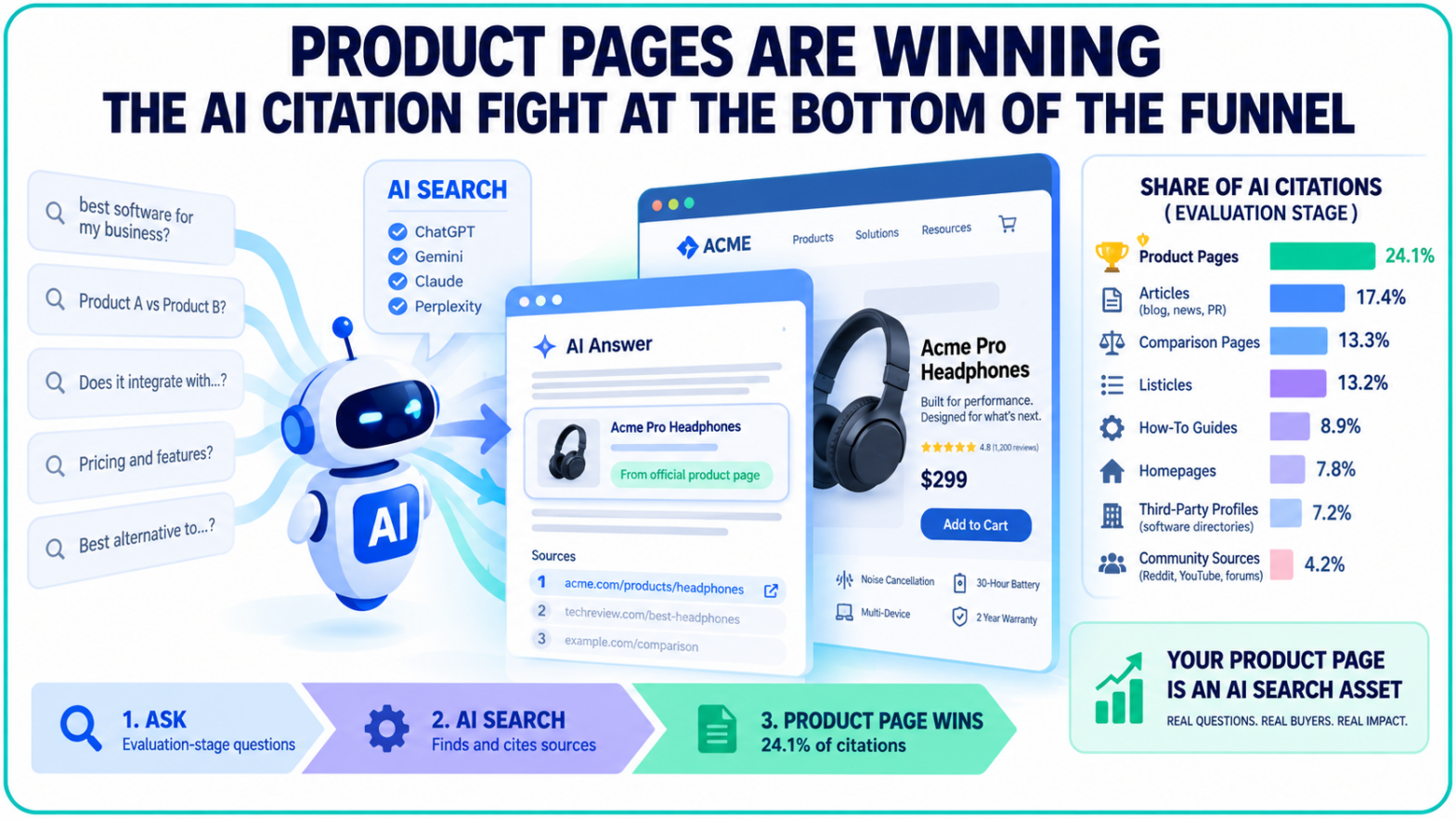
New research into more than 7,000 citations from evaluation-stage AI prompts found that product pages were the single most-cited page type, accounting for 24.1% of all citations. Community sources such as Reddit, YouTube and forums collectively captured just 4.2%.
For marketers scrambling to manufacture visibility on third-party platforms, that changes the conversation. At the point where buyers are comparing products, integrations, features and alternatives, the pages a company already owns may carry considerably more weight than the AI-search narrative has suggested.
AI Citation Behaviour Changes When Buyers Get Serious
A Reddit discussion and a product page can both appear in an AI-generated answer.
That does not make them equally likely to appear at every stage of the buying journey.
Ten Speed's study of evaluation-stage AI citations examined B2B and SaaS prompts built around commercial intent rather than broad informational searches. The dataset included direct comparisons, alternatives, use-case questions, integration queries, buying-intent prompts and brand-specific searches.
Examples included queries about the best software for a defined business need, how a specific product handles a particular requirement, and what one platform offers compared with another.
The researchers analyzed 7,387 citations generated from responses monitored through Peec AI. The underlying systems included ChatGPT, Perplexity, Claude and Gemini. Each citation represented a linked URL surfaced by an AI response, and repeated appearances of the same URL counted separately.
That distinction matters.
Many studies of AI citations examine broad query sets where informational articles, publishers, forums and community discussions have a natural advantage. Ten Speed deliberately excluded top-of-funnel questions and focused on users who were closer to evaluating a purchase.
The citation mix changed sharply.
Product Pages Took 24.1% of the Citation Pool
Product pages ranked first among every page type measured, capturing 24.1% of citations.
Articles, including blog posts, news and PR content, came next at 17.4%. Comparison pages accounted for 13.3%, listicles 13.2%, how-to guides 8.9% and homepages 7.8%. Third-party profile pages, including software directories, represented another 7.2%.
Taken together, product pages, articles, comparisons, listicles, how-to guides and homepages accounted for 88.3% of citation volume.
Those are surfaces marketing teams can largely control.
Community-driven sources told a very different story. Reddit discussions, YouTube videos, forums and similar pages represented 4.2% of citations across the evaluation-stage dataset. Video pages alone accounted for just 0.5% of the classified citation pool, although Ten Speed described YouTube's overall presence as approximately 1%.
That does not establish that Reddit or YouTube are unimportant to AI search optimization.
It does show that source preference is heavily dependent on intent.
A person asking for firsthand experiences with a category may invite forum content. Someone asking whether Product A integrates with Product B gives the AI system a different retrieval problem. The manufacturer's own integration or product page may simply contain the most direct evidence.
The Product Page Has Become an AI Retrieval Asset
Product pages have traditionally been built around two jobs: rank for commercially relevant searches and convert visitors who arrive.
AI search introduces a third.
The page can become evidence used before the buyer ever visits the website.
Google's own documentation offers some support for that broader pattern, even though the Ten Speed dataset extends well beyond Google. Google says AI Overviews and AI Mode surface supporting web links and may use a query fan-out process that runs multiple related searches across subtopics and data sources before constructing a response. Pages must be indexed and eligible to appear in conventional Google Search to qualify as supporting links.
Google has also maintained that the fundamentals of conventional SEO continue to apply to its generative search products. Its Search Central guidance recommends useful original content, accessible pages and clear supporting information rather than a separate technical formula designed only for AI systems.
That fits the pattern in the new research.
At the bottom of the funnel, an AI system answering a question about pricing, features, compatibility, use cases or positioning needs specific factual material. A well-developed product page often has exactly that information.
A thin page with a headline, a few vague benefit statements and a demo button has much less to retrieve.
The findings add another dimension to Google's argument that AI visibility still starts with SEO. Ranking remains relevant, but the information available within commercial pages is also becoming part of what AI systems can use to construct an answer.
Comparison Content Punches Above Its Weight
Product pages were not the study's only bottom-of-funnel standout.
Comparison prompts generated more citations than their share of the prompt set would suggest.
About 20% of the analyzed prompts used comparison formats such as "X vs. Y" or direct product comparisons. Those prompts produced 26.7% of the study's citations, or 1,970 of the 7,387 total. Ten Speed calculated that comparison prompts produced roughly one-third more citations than their share of the dataset would predict.
That gives commercial comparison content an unusual role in AI search.
A buyer asking an AI assistant to compare two products is effectively requesting a synthesized decision document. The model needs information about features, positioning, integrations, pricing or intended use cases from somewhere.
Brands that publish clear comparison material create another source the model can consult.
The finding also complicates the familiar separation between SEO content and sales content. A comparison page can support organic discovery, sales enablement and AI citations at the same time.
For marketers already watching AI Search performance become separately measurable in Search Console, that makes bottom-of-funnel page types increasingly difficult to evaluate only through traditional organic traffic.
Reddit Still Matters, Just Not Equally Everywhere
The study does not invalidate community marketing.
In fact, Ten Speed found that the Reddit threads appearing in its citation pool tended to be cited relatively heavily when they did surface. The researchers also explicitly cautioned that the results apply to B2B evaluation-stage prompts and should not be generalized to top-of-funnel searches, consumer queries, ecommerce or media.
The dataset is also not a universal AI citation benchmark.
It reflects Ten Speed's own B2B SaaS and professional-services client base, uses a hand-written evaluation-stage prompt set and represents a single point-in-time export. The research was not peer-reviewed, and the study did not provide a clean platform-by-platform breakdown showing whether ChatGPT, Gemini, Claude and Perplexity behaved differently.
Those limitations are important because citation behaviour can shift quickly.
They do not erase the central result.
For the commercial prompts measured, AI systems were far more likely to cite brand-controlled web content than community platforms.
Bottom-of-Funnel SEO Now Has an AI Audience Too
For marketers, the practical implication is straightforward: product page SEO can no longer be judged exclusively by rankings, sessions and conversion rates.
Commercial pages should give search engines and AI systems enough concrete material to answer the questions prospects ask during evaluation. Product capabilities, intended users, integrations, limitations, comparisons and specific use cases are retrieval material as well as conversion copy.
That does not require rewriting every product page for a chatbot.
Google explicitly says there are no additional technical requirements for appearing in AI Overviews or AI Mode beyond the existing conditions for Search eligibility. Strong conventional search foundations remain the starting point.
The new data changes where marketers may want to look next.
The race for AI citations is not happening exclusively on Reddit threads, YouTube channels or third-party publishers. At the point where a prospect starts deciding what to buy, one of the most valuable AI-search assets may already be sitting on the company website.