
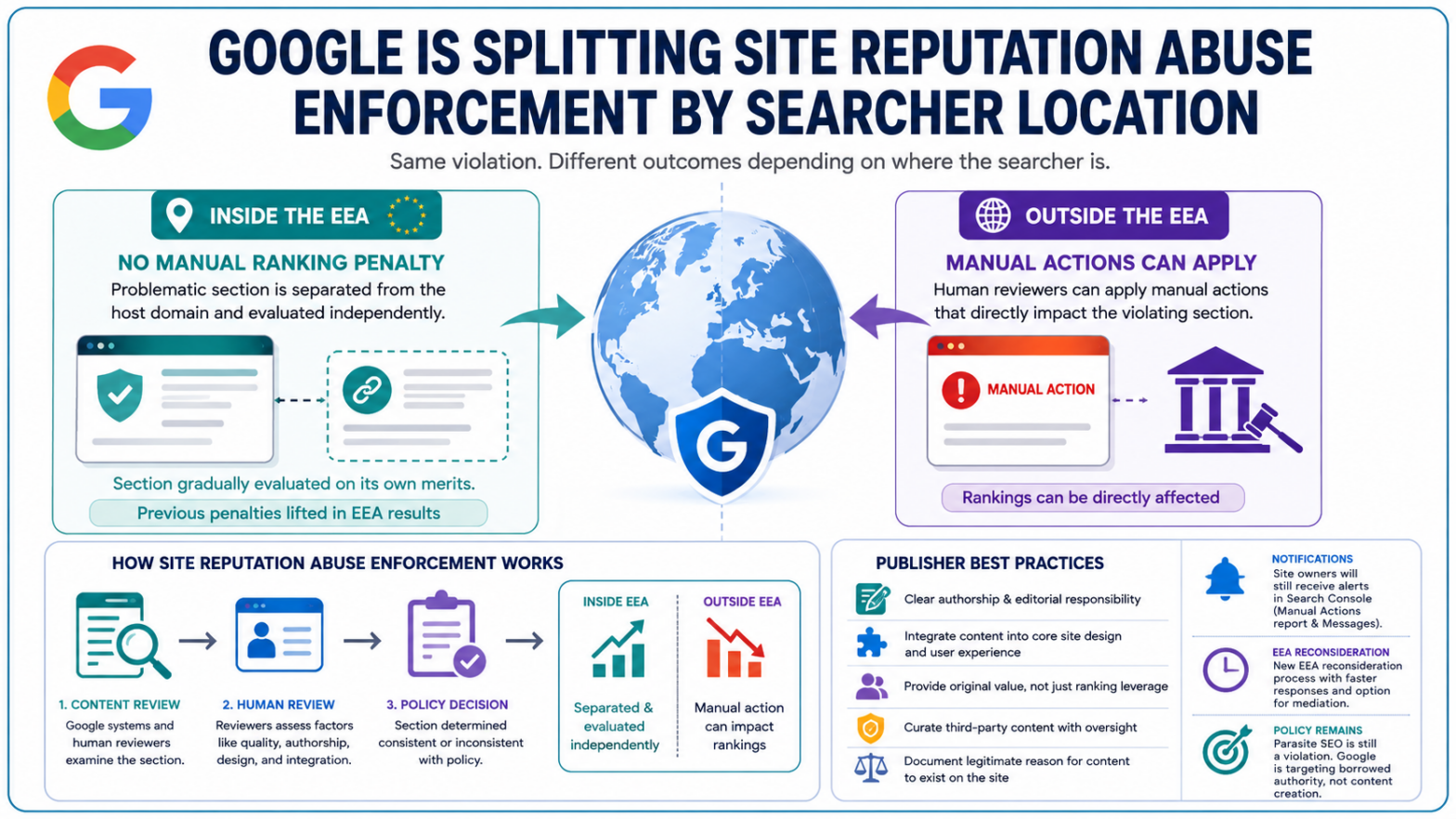
Google can now treat the same problematic section of a website differently depending on where the person searching happens to be.
Starting August 30, pages caught under Google's site reputation abuse policy can still face direct manual-action consequences outside the European Economic Area. Inside the EEA, Google is taking another route: separating the affected section from the reputation of its host domain and allowing it to rank more independently.
The policy against exploiting established domains has not disappeared.
The enforcement mechanism has split in two.
The Same Violation Can Now Produce Two Search Outcomes
Google introduced its site reputation policy in 2024 to target third-party content published primarily to exploit a host website's existing ranking signals.
The tactic is commonly described in the SEO industry as parasite SEO: a third party gains access to an authoritative domain and publishes content there partly because that domain gives the material a ranking advantage it would struggle to earn independently.
Google's August 28 update says the company changed its EEA approach following discussions with the European Commission.
For searches made outside the EEA, the existing enforcement structure remains. A human reviewer can determine that a section violates the policy, and a manual action can directly affect that portion of the website in Search.
Inside the EEA, the manual action itself will not affect rankings.
Instead, Google's systems may classify the problematic section separately from the main website. That allows the content to gradually be evaluated without automatically benefiting from the stronger reputation signals associated with the rest of the domain.
The distinction matters because Google has not declared the content compliant. It has changed what happens after the violation is identified.
TechWyse previously examined how Google's broader manual actions framework can affect sites when human reviewers identify violations of its search policies. With site reputation abuse, that enforcement consequence is now geographically conditional.
Google Is Targeting the Borrowed Authority, Not Just the Page
The EEA model gets closer to the underlying problem Google says it is trying to solve.
Google generally assumes that individual pages on a domain broadly reflect the quality and reputation of the website hosting them. That assumption can help new pages benefit from signals already accumulated by an established publication or brand.
Site reputation abuse attempts to exploit that relationship.
Under the updated approach, Google can effectively remove that presumption for a particular part of the website. The section is then expected to earn visibility based more heavily on its own characteristics rather than inheriting the standing of the host domain.
Google is careful about the timing.
Being separated does not mean a section instantly loses every ranking signal connected with the main website. Google says its ranking systems learn over time to assess the sections independently, meaning ranking changes may develop rather than appear immediately. The categorization itself also is not used as a negative ranking signal.
That makes the EEA system different from a simple automated penalty.
For publishers that have built commercial directories, coupon areas, affiliate hubs or sponsored-content sections under established domains, the important question becomes whether those sections are legitimately part of the publication or primarily using its authority as a ranking vehicle.
That distinction sits at the centre of Google's current Google spam policy enforcement environment.
Third-Party Content Is Still Allowed
Google's policy does not say publishers must produce every page internally.
Freelancers are not automatically a problem. Affiliate content is not automatically a problem. Syndicated news, forums, comments, native advertising and other forms of third-party material can also remain compliant.
Google's test is more specific: was the content placed on the established domain mainly because that domain's existing ranking signals could make it perform better in Search?
The updated documentation also gives publishers more information about what human reviewers may examine.
Google lists consistency of design and user experience, differences in content quality, clarity around authorship and responsibility, and whether substantially identical material appears on other websites among the possible factors. No single factor is enough by itself to determine a violation.
One example involves a publisher running a coupon section with an outside partner. Google says action would be unlikely where the area is visibly integrated into the publication, editorial responsibility is clear, offers are curated and the section is accessible through the site's ordinary navigation.
Another example goes the opposite direction: an established business publication carries a disconnected affiliate article copied from a third-party marketplace, without clear authorship, editorial responsibility or integration into the publisher's normal sections. Google says that scenario would likely lead to enforcement outside the EEA.
An original article written by a freelancer can still pass the test when it is created specifically for the publisher, subject to meaningful editorial oversight and presented consistently with the publication's other work.
So the policy is not a blanket prohibition on outsourced publishing.
It is aimed at borrowed search authority.
Existing EEA Penalties Are Being Lifted
The change also applies backward.
Google says previous site reputation abuse manual penalties will be lifted for pages when those pages appear to users searching within the EEA. Those pages will no longer be demoted there because of the previous manual penalty.
They are not guaranteed their old positions.
Google may instead categorize the section separately and allow its systems to establish how that content should rank independently. The fact that it previously received a manual action will not be used as a ranking signal in EEA results.
Outside the EEA, those same pages can remain affected by enforcement.
A publisher could therefore see materially different performance for the same URL across European and non-European markets without having separate versions of the page.
Search Console remains part of the process. Google says site owners will still receive notifications through its Manual Actions report and message centre when the policy is applied, including when the ranking impact itself does not operate in EEA results.
Google has also added an EEA reconsideration process that it says will provide responses within a short timeframe and more detail about the reasoning behind a decision. Eligible disputes can proceed to alternative dispute resolution through mediation.
Parasite SEO Has Not Been Given an EEA Exemption
Removing the manual ranking penalty inside the EEA could easily be read as Google stepping away from enforcement.
Its documentation says otherwise.
The company will continue human reviews globally. It can continue identifying sections as inconsistent with the policy. And it can still prevent those sections from leaning indefinitely on the reputation that made the tactic attractive in the first place.
That keeps parasite SEO inside Google's spam enforcement framework even where the mechanism has changed.
For marketers and SEO teams, the practical implication is largely analytical. International sites should now segment organic performance by market when investigating a site reputation abuse action rather than assuming one ranking effect applies worldwide. Publishers using outside contributors or commercial partners should also be able to demonstrate editorial integration, responsibility, original value and a legitimate reason for the material to exist on the host site beyond ranking leverage.
The timing adds another layer. Google has already run several spam-related ranking changes during 2026, including an August 2026 spam update that returned attention to the company's automated enforcement systems. Site reputation abuse remains distinct because human review is explicitly built into the process.
Google's policy documentation now draws a geographic line through that process.
A reviewer can reach the same conclusion about a section of a website globally. What Google does with that conclusion in Search depends on whether the user is searching from inside or outside the EEA.