Website owners affected by ranking changes in late September now have a fixed window to work from. Google confirmed on October 8, 2026, via its Search Status Dashboard, that the September 2026 spam update had completed its global rollout.
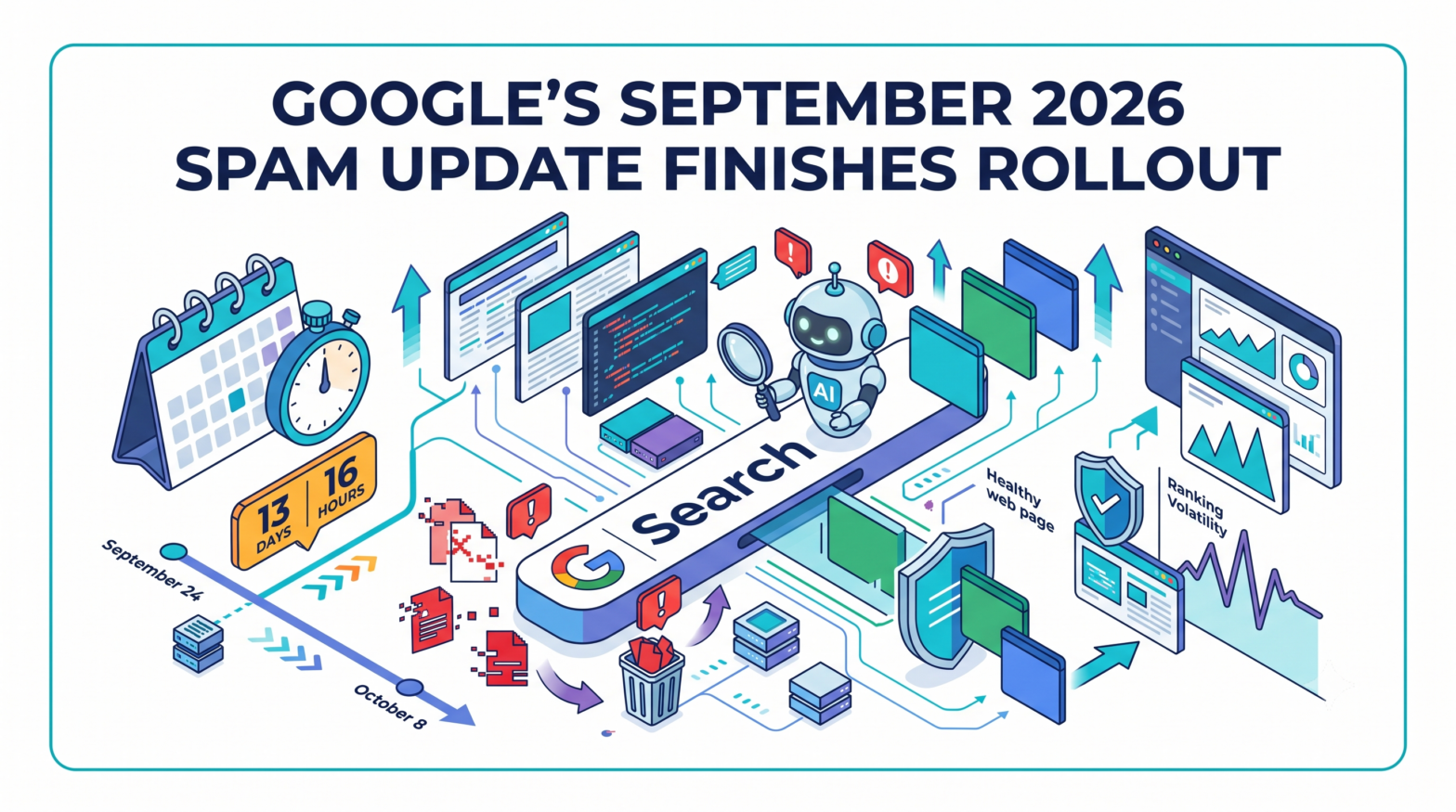
The update ran from September 24 at 9:15 a.m. PDT to October 8 at 1:00 a.m. PDT. Google's ranking update history records the total duration as 13 days and 16 hours. A second line appeared on the Search Status Dashboard on October 8 at 1:37 a.m. PDT, reading: "The rollout was complete as of October 8, 2026."
A Significantly Longer Rollout Than Earlier 2026 Updates
The September update's duration stands apart from the three spam updates that preceded it this year. The March 2026 spam update ran for 19 hours and 30 minutes, the June 2026 update took 2 days and 1 hour, and the August 2026 update completed in 2 days and 16 hours. The September rollout used nearly the full period Google had allocated.
The Search Status Dashboard entry for September said the rollout would take "up to two weeks." For March, June, and August, the same field had read "a few days." Google has not stated which spam policies the update addresses, even after completion.
Google Search Central posted on LinkedIn and X that this was "a normal spam update," applying to all languages and locations, and linked to its spam-updates documentation. No new spam policies accompanied the release.
What Google's Spam Updates Do
Google's automated systems to detect search spam operate continuously. When the company makes notable improvements to how those systems work, it designates the change a spam update and lists it on its ranking updates page. SpamBrain, Google's AI-based spam-prevention system, is one such system. Google improves it periodically to better detect spam and to catch new types of spam as they emerge.
Google's documentation states that changes made to a site can take months for its automated systems to recognize and respond to. There is no reconsideration request process for an algorithmic spam update, because no manual action is involved.
Ranking Volatility During the Rollout
Tracking services recorded multiple periods of elevated ranking movement across the 14-day window. The update began rolling out globally on September 24 at 9:15 a.m. Pacific time, according to Google's Search Status Dashboard. Volatility was reported on September 25 and through that weekend, with a further spike around September 30 and a final wave between October 4 and October 7.
For sites using third-party rank trackers, the data that appeared during the rollout requires additional scrutiny. According to SEOmonitor, many rank trackers showed sudden ranking changes starting September 26 that were not reflected in actual Google search results, attributing the discrepancy to incomplete and incorrect results returned during automated queries. The company noted that spam-related changes typically hold over several days and tend to appear in Search Console impressions and clicks data when they are genuine.
How Site Owners Can Assess Impact
With the rollout now confirmed complete, September 24 through October 8 forms a defined window for comparing Search Console performance before, during, and after the update. Marketers and SEOs reviewing traffic data from this period should distinguish between sustained changes in impressions and clicks, which carry more diagnostic weight, and short-term fluctuations visible only in third-party tools. Sites that experienced ranking movement after a spam update should review Google's spam policies. Sites that violate those policies can rank lower or drop out of results entirely. When recovery occurs, it unfolds over months as Google's automated systems register that the site is complying.
The September 2026 spam update is the fourth confirmed spam update of the year, following updates in March, June, and August. As of publication, neither Google's spam updates documentation page nor the two Search Status Dashboard notes specify what the September rollout addressed.