
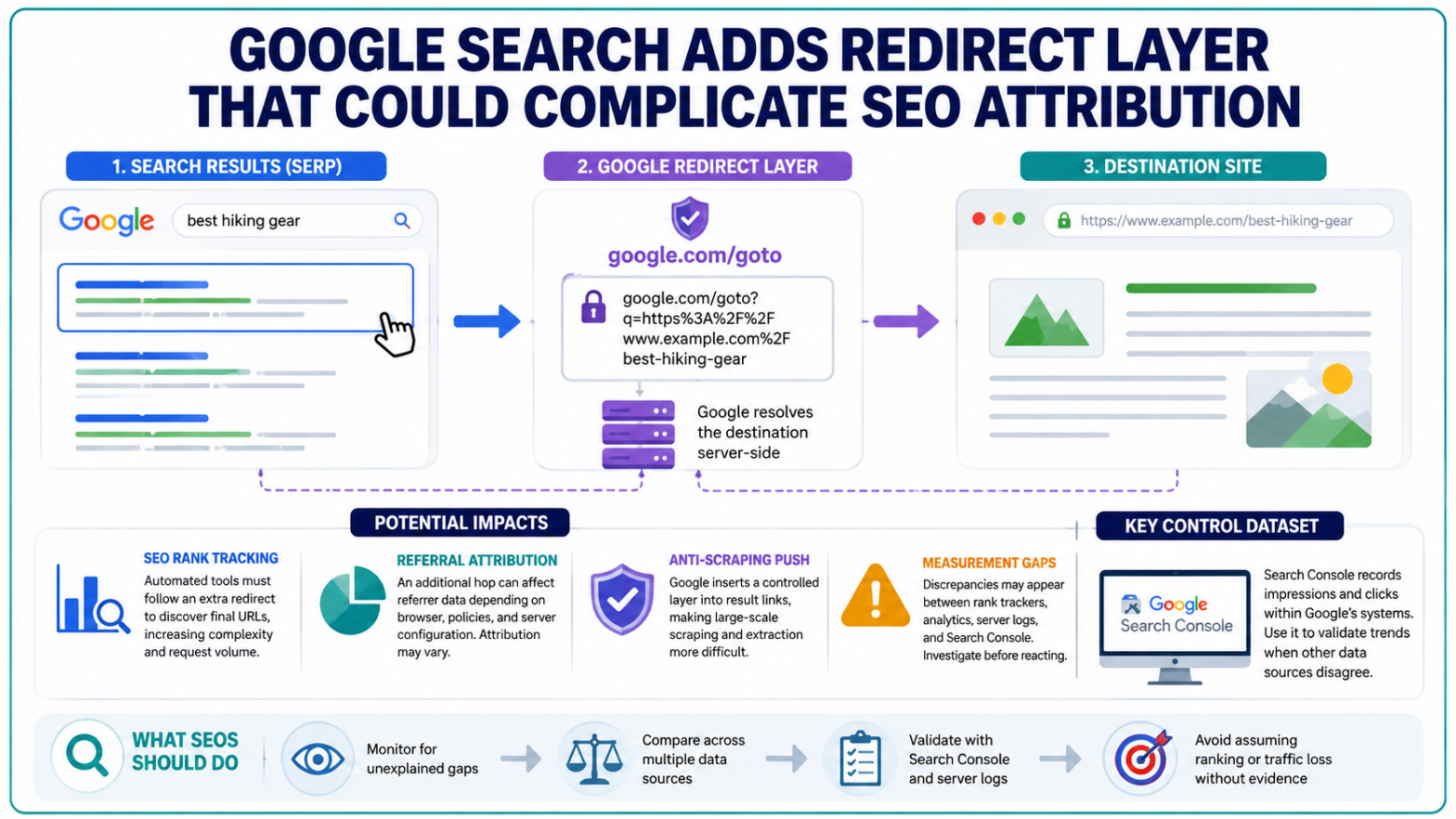
A click on a Google result may no longer travel directly from the search page to the publisher.
Google has confirmed it is rolling out google.com/goto redirects across Search, inserting a Google-controlled hop between some search result links and their final destinations. The company describes the change as an anti-abuse measure. For SEOs, analytics teams, and rank-tracking providers, it also introduces another variable into a part of search measurement that already depends heavily on Google-controlled data.
Google confirmed the rollout after the redirect format began appearing more broadly across live search results. A company spokesperson said:
"We have a long history of deploying technical measures against evolving forms of abuse, and we regularly take steps to protect our services and users."
The redirect itself is straightforward. Instead of pointing directly to the destination page, a result can route through a URL beginning with google.com/goto, which then sends the visitor to the intended website.
What happens around that redirect is where things get more complicated.
Google Search Is Putting Another Layer Between the SERP and the Site
Traditional organic listings have generally exposed a destination URL that browsers, users, and automated systems could identify before following the result.
The new format changes that path.
A search result can now point first to an encoded google.com/goto address. Google resolves that address server-side and redirects the request to the destination website. The final page still opens normally for the user, but the underlying link is no longer a simple direct reference to the publisher's URL.
Nozzle founder Derek Perkins reported seeing the format on nearly all results fetched through several residential IP providers after months of testing. His data showed usage increasing sharply as the experiment expanded.
Google has been testing anti-bot measures that eliminate all client side links in favor of google. com/goto... server side redirects. It was widely reported the first week of August from the first major test, and as of this morning, we're seeing near 100% rollout across several… pic.twitter.com/xLEtH4jjL4
— Derek Perkins (@Derek_Perkins) August 26, 2026
The encoded destination also creates a hurdle for systems that extract links directly from search result HTML. A crawler cannot necessarily look at the hyperlink, identify the destination, and move on. It may need to request Google's redirect first to discover where the result leads.
That distinction matters because automated result collection remains central to many SEO tools.
Google already classifies automated queries used for purposes such as rank checking as machine-generated traffic. Its published spam policies state that scraping Search results without express permission violates its policies and Terms of Service. Google's machine-generated traffic policy
The goto layer gives Google another technical mechanism for making that activity harder.
SEO Rank Tracking Tools Have the Most Immediate Exposure
The clearest impact is not necessarily on the person clicking a normal organic result.
It is on software trying to understand the SERP at scale.
Many SEO rank tracking systems depend on collecting search results, identifying URLs, matching those destinations to domains, and recording positions. An opaque redirect introduces another request into that process.
Following one redirect is trivial. Following hundreds of links across thousands or millions of search result pages is a different problem.
That could increase request volume, processing requirements, and exposure to Google's existing anti-automation controls. Providers may need to change how they resolve destination URLs or validate rankings as the new format spreads.
There is no evidence that the redirect changes Google's ranking systems themselves. A page appearing in position three is still appearing in position three. The disruption sits in the collection layer used by external systems to observe that ranking.
That distinction will matter when SEO platforms report unusual gaps, unidentified URLs, delayed rankings, or sudden changes in coverage. A tracking anomaly should not automatically be treated as a search visibility change.
Referral Attribution Is More Nuanced Than a Missing Google Click
There is a second measurement question: what does the redirect do to referral information when a visitor reaches a website?
An additional redirect can affect the information passed between requests, but it does not automatically erase every Google referral.
Browsers use the HTTP Referer header to tell a destination where a request originated. How much information reaches the destination depends partly on referrer policy and the browser's handling of the navigation. The widely used strict-origin-when-cross-origin policy, for example, generally sends the referring origin on a cross-domain request rather than the complete originating URL.
The new redirect therefore creates another point in the request chain where attribution behaviour needs to be tested rather than assumed.
For analytics teams, the concern is less that all organic sessions will suddenly become unattributed and more that some measurement stacks could interpret traffic differently depending on browser behaviour, redirects, server configuration, analytics implementation, and Google's own redirect response.
Google has not announced that the rollout is intended to change publisher attribution.
Teams watching organic search analytics should therefore avoid treating every shift in source or referral reporting as evidence of lost search traffic. Comparing analytics data against server logs and Google's own performance reporting can help separate a measurement issue from an actual decline in clicks.
Search Console Becomes a More Important Control Dataset
Google's own reporting operates differently from third-party web analytics.
Search Console records Search impressions and clicks inside Google's systems. Its documentation states that Performance reports measure when users see and click links to a site in Google Search, while click data is generally assigned to the canonical URL Google selects for the page.
That makes Search Console particularly useful when investigating discrepancies created outside Google's reporting environment.
Suppose an analytics platform suddenly reports fewer Google organic sessions while Search Console clicks remain steady. That gap would point toward attribution, tracking, consent, redirect handling, or another measurement issue rather than an immediate loss of search demand.
The reverse also holds. If Search Console clicks fall alongside analytics sessions, the problem is less likely to be explained by the new redirect alone.
Search Console is not a substitute for analytics. It measures Google Search activity using Google's own methodology, while analytics platforms observe what happens after a visitor reaches the site. The two systems have never matched perfectly.
Another Google-controlled hop gives marketers one more reason not to expect them to.
Google's Anti-Scraping Push Is Reaching the Links Themselves
The broader story is not a new ranking factor or a conventional Search algorithm update.
Google is changing the infrastructure through which result clicks are delivered.
For years, scraping protections could be encountered through rate limits, CAPTCHAs, blocked requests, JavaScript requirements, and other anti-automation systems. The goto rollout moves part of that defensive layer directly into the result links.
That has practical consequences for the ecosystem built around Google Search. Rank trackers, SERP monitoring services, research platforms, and other tools that rely on extracting destination URLs may need to account for a search result that no longer exposes its final destination as cleanly as before.
For marketers and SEOs, the immediate response is measurement rather than remediation. Watch for unexplained gaps between third-party rankings, Search Console clicks, analytics sessions, and server-side referral data before attributing a change to rankings or user behaviour.
Google has not published technical documentation for the goto system, nor has it said whether every search result, user, region, or interface will eventually use the redirect.
What it has confirmed is the direction: the redirect is intentional, it is being deployed as an anti-abuse measure, and direct access to the underlying structure of a Google result is becoming a little less direct.