

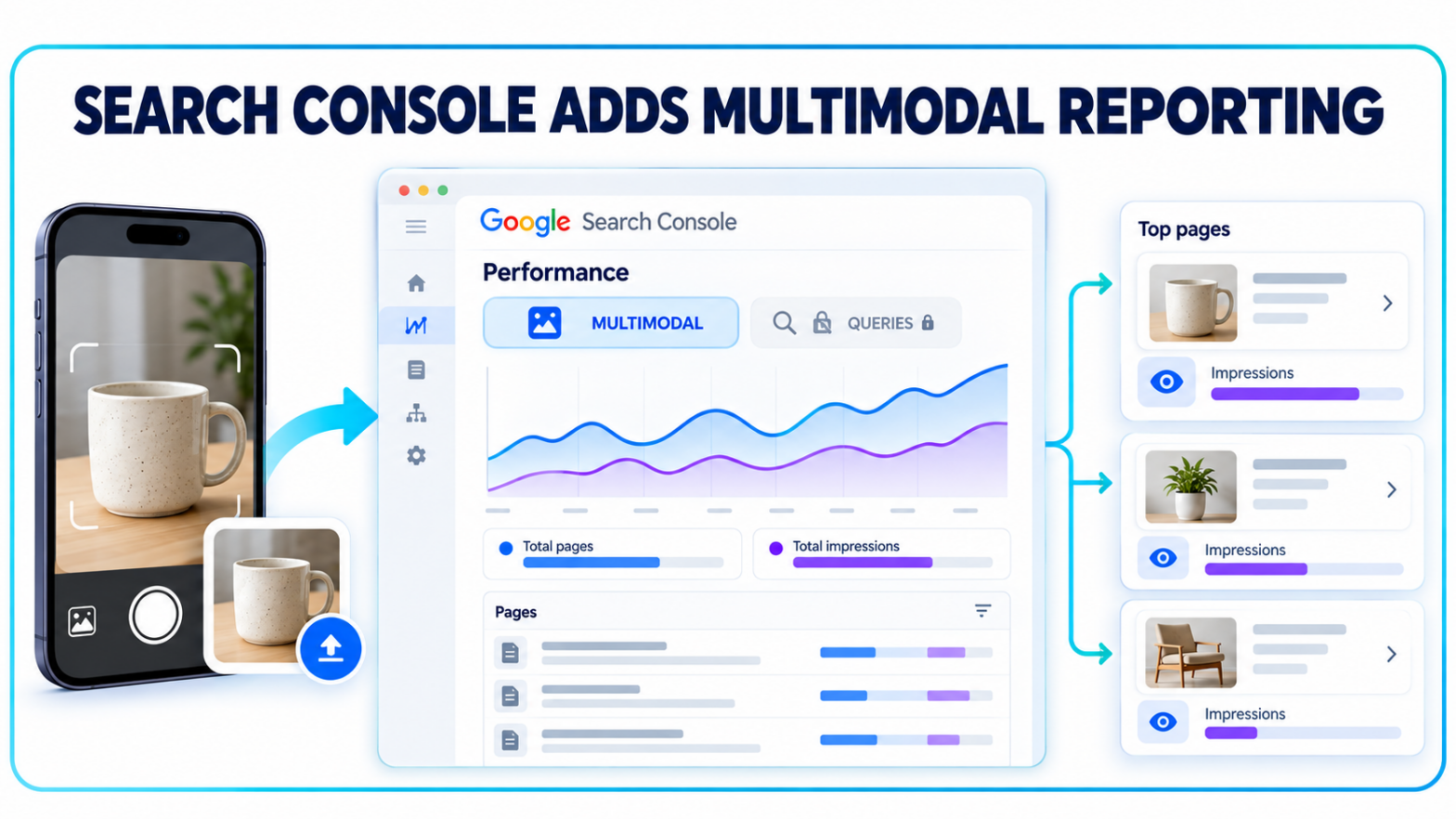
A search can bring someone to a website without starting with a typed phrase. Google Search Console now gives publishers a dedicated way to measure that discovery, although the searches themselves remain absent from its query reports.
Google began rolling out web multimodal reporting globally on September 24. The update covers searches made through Lens, Circle to Search on Android, image uploads to Google Search and Chrome’s image-search command. It appears in both the Search results performance report and the report for generative AI features.
For marketers, the distinction is consequential: the new view can identify pages gaining visibility through image-led searches, but it cannot supply the familiar keyword list used to explain that performance.
Multimodal Search Describes the Input, Not the Result’s Appearance
Google’s Search results report documentation now separates web searches into text-based and multimodal categories. Its definition of the latter is direct:
“Includes web search results where an image was used as part of the search.”
The existing Image search type remains a separate option, alongside Video and News. The new category therefore should not be read as another name for Google Images traffic. It identifies web searches involving an image as input.
That distinction helps explain the scope of multimodal search reporting. A photograph or screenshot supplies information that a person might otherwise struggle to describe in words. The report measures how website content appears in the resulting search experience.
Google’s launch announcement, written by Google Lens Product Manager Lead Harsh Kharbanda and Search Console Product Manager Lead Moshe Samet, explicitly includes several routes into that experience. The coverage extends beyond smartphone cameras to uploaded images and searches initiated inside Chrome.
The Missing Query Tab Changes the Analysis
Selecting multimodal search removes the query dimension. Google explains in its dimensions and data groupings guidance that these searches primarily use images, so specific text query data is unavailable.
This is a limitation of the reporting category, rather than a short list of keywords waiting to populate.
Pages, countries and devices provide other ways to examine performance. Page reporting generally assigns activity to the canonical URL, while country and device groupings describe where searches originated and whether people used desktop, mobile or tablet devices.
The analytical consequence is straightforward. A publisher can identify a page receiving image-led search exposure without being able to reconstruct the precise request that produced it. A product page’s appearance does not, by itself, reveal whether someone wanted to identify an object, compare alternatives or purchase it.
Those are possible intentions, not findings the filter establishes.
For teams accustomed to organizing SEO reports around keyword rankings, the useful starting point shifts toward the pages receiving visibility. The data can establish which content surfaced; explanations of the searcher’s purpose require evidence beyond that page’s presence in the report.
AI Search Reporting Still Measures Exposure
The filter’s arrival in the generative AI report does not give that report the same metrics as the standard Search results view.
Google’s generative AI reporting documentation describes impressions for AI Overviews and AI Mode. It provides page, country, device and date groupings, with text-based and multimodal search filters. The documented report does not provide click or query metrics.
That preserves an important boundary in AI search reporting: a link being shown in an AI feature establishes exposure, not a website visit.
The AI report also includes data from the Web search type in the Search results performance report. Its impressions should therefore not be treated as an entirely separate audience and simply added to Web totals. Google excludes Search Labs experiments from this reporting.
The standard performance report, by comparison, offers clicks, impressions, click-through rate and average position. Selecting a search type narrows the activity being examined; it does not make the two reports interchangeable.
Page Comparisons Offer a Practical Starting Point
Within Google Search Console, the new filter sits inside an established set of analysis tools.
Google’s filtering and comparison guidance allows multiple filters to operate together. A team can focus on a country and device, restrict the view to selected pages, or compare two periods. URL filters can also group pages belonging to a particular section of a website.
For marketers, the practical use is to identify which landing pages receive multimodal exposure and clicks, compare their performance over equivalent periods, and assess those pages alongside existing website analytics. That connects search discovery with on-site outcomes while keeping visibility, visits and conversions as separate measurements.
Comparisons need consistent scope. Changing the country, device or page selection between periods changes the population being measured. Google permits one comparison at a time, and recommends weekly or monthly views when daily fluctuations obscure the longer trend.
The announcement introduces measurement, not a new ranking requirement. It does not establish that a particular image format, page template or content change will increase multimodal traffic.
Exported Totals Still Follow Search Console’s Counting Rules
Google says the multimodal data can be downloaded through the report’s Export control for analysis in other tools. Availability depends on a site receiving activity from the covered searches as the global rollout proceeds.
Exporting does not remove the distinction between site-level and page-level counting.
Under Google’s performance data aggregation rules, multiple results from the same property can count as one impression at property level. When grouped by page, individual URLs are counted separately. A sum of page rows can therefore differ from the property total without indicating a reporting error.
The new filter makes image-led discovery available for closer examination. The query dimension remains unavailable for that traffic, so an exported report still cannot provide the text search terms behind its multimodal results.