


Google's November core update has barely begun, and some website owners are already seeing their AI search visibility fall. The problem is that at least part of the decline isn't real.
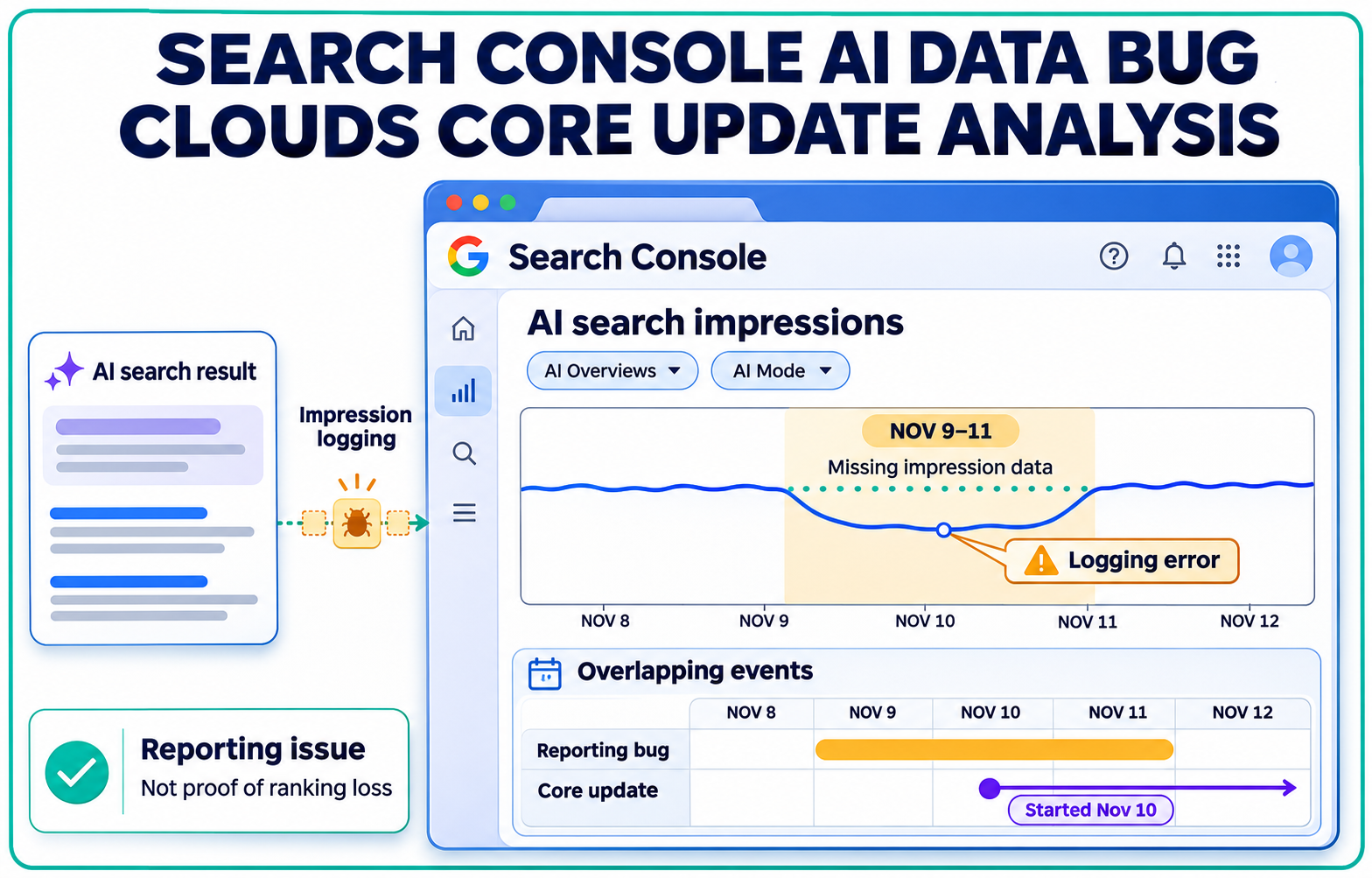
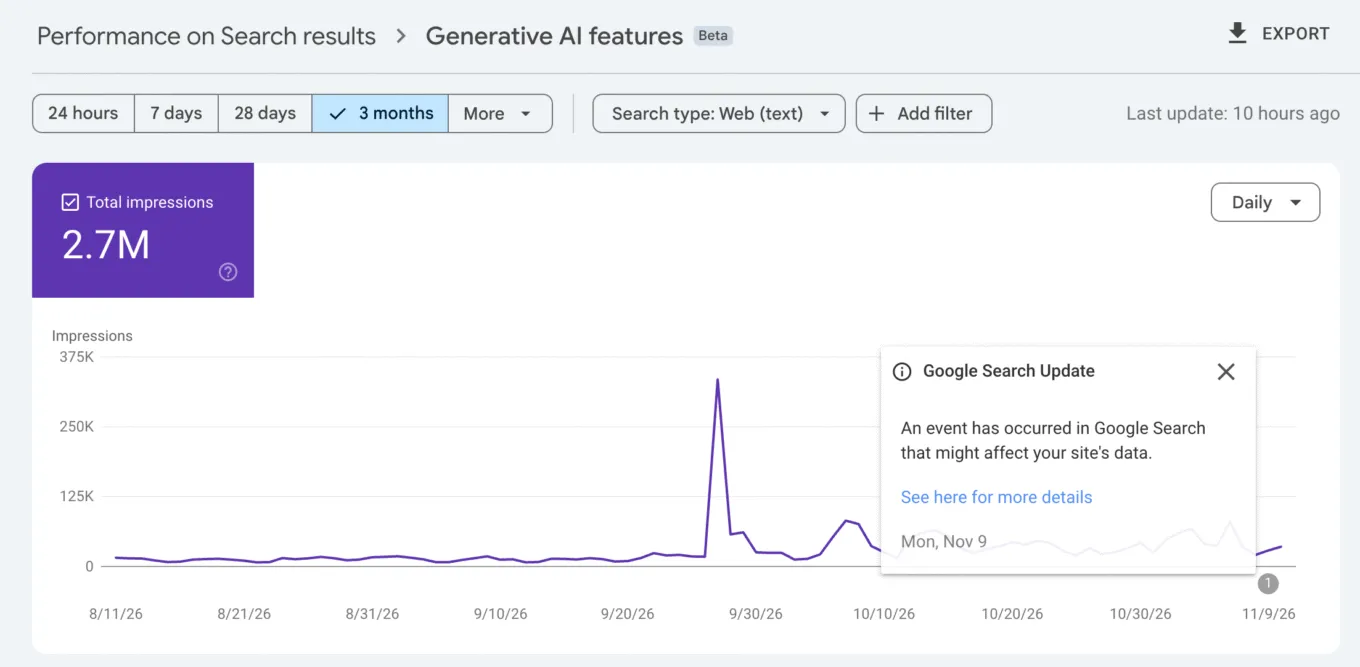
Google has confirmed a logging error in Search Console that caused impressions to be underreported in its Generative AI performance report between November 9 and November 11, 2026. The three-day reporting issue overlaps with the launch of Google's November core update, creating a potentially misleading picture for businesses tracking their visibility in AI-powered search results.
The company documented the issue on November 12, confirming that the affected figures reflect a problem with data collection rather than an actual decline in search performance. The error concerns reported impressions within Google's generative AI search features, including AI Overviews and AI Mode.
The timing is particularly awkward for SEO teams. With a major ranking update underway, unexpected movements in Search Console are likely to receive closer scrutiny. In this case, however, a sudden decline in AI impressions cannot automatically be attributed to changes in Google's ranking systems.
The November 9–11 Drop Was a Logging Error, Not a Ranking Penalty
Google acknowledged the problem in its official Search Console data anomalies documentation, identifying November 9 through November 11 as the affected period.
The company attributed the lower reported impressions to a logging error and explicitly stated that “This issue affects data logging only.”
That distinction rules out one explanation for the reported decline: the logging error itself did not cause websites to lose visibility in Google Search. Instead, Google's reporting systems failed to record the full volume of impressions appearing within the affected generative AI performance report.
An impression represents an instance in which a website's URL appears to a user within a supported generative AI search feature. Google uses these figures to help publishers understand how frequently their content appears in AI-generated search experiences.
When the logging process fails, those recorded totals can fall even if the underlying exposure remains unchanged. A website that appeared consistently in AI Overviews or AI Mode during the affected dates could therefore show fewer impressions than it actually received.
Google has not disclosed how many properties were affected, the total volume of missing impressions or the percentage by which the reported figures were understated.
The company's notice also does not establish that regular organic search rankings declined or that websites experienced corresponding traffic losses. The confirmed problem concerns impression logging within the Generative AI performance report in Search, rather than a broader failure across every Search Console reporting tool.
Google's Core Update Started Right in the Middle of the Reporting Gap
The reporting error would have been inconvenient at any time. Its overlap with a major Google ranking update makes interpreting the affected dates more complicated.
According to the Google Search Status Dashboard, the November 2026 core update began rolling out on November 10 at 10:06 a.m. Pacific Standard Time. That places the update's launch directly inside the three-day period affected by the Search Console logging error.
Core updates can change how Google evaluates and ranks content across its search results. Those changes may affect impressions, clicks and visibility for individual pages, although their impact varies considerably between websites.
A reporting failure introduces a separate variable.
Consider a publisher comparing AI search visibility before and after November 10. If the Generative AI performance report shows a sharp decline immediately after the update began, the publisher might reasonably investigate whether the ranking changes affected its content. But Google's confirmed logging error prevents that particular decline from serving as reliable evidence.
The situation is further complicated because the core update and the reporting error are not the same event. The logging problem does not establish that the November core update had no effect on rankings, nor does it explain every traffic movement a website might experience during the rollout.
TechWyse previously covered the November 2026 core update rollout, including Google's recommendation to avoid drawing conclusions from incomplete deployment data.
Google's standing core update assessment guidance recommends waiting until a rollout has finished and then allowing at least one full week before conducting a detailed performance comparison.
For affected properties, the November 9–11 reporting gap creates an additional limitation. Those dates cannot be treated as a complete record of generative AI impressions unless Google subsequently restores the missing data.
The Generative AI Performance Report Measures Visibility, Not Everything AI Search Delivers
The affected report is relatively new.
Google introduced dedicated generative AI performance reporting in June 2026, providing website owners with a separate view of how their content appears in AI-powered search experiences. The feature subsequently expanded worldwide, with Google confirming global availability on August 31.
Before the dedicated reports arrived, visibility within AI search features was included in broader Search Console performance data without the same standalone reporting view.
The Generative AI performance report for Search covers impressions from AI Overviews and AI Mode. It allows website owners to examine which pages appear in these experiences, where those impressions originate and how visibility changes over time.
Available reporting dimensions include pages, countries, devices and dates. Google also offers a separate generative AI report for Discover, which is not identified as part of the November 9–11 incident.
The dedicated Search report focuses on impressions rather than providing a complete breakdown of clicks and conversions attributable to AI-generated results. Traditional Search Console reporting continues to include activity from supported AI search features within its broader performance metrics.
That limitation matters when interpreting the current error.
A decline in recorded AI impressions does not establish a corresponding decline in website visits. Likewise, the reporting problem does not provide evidence that fewer users clicked links appearing in Google's AI-generated responses.
The distinction between visibility and traffic was already important before this incident. As TechWyse reported when Google expanded AI search reporting worldwide, the new reports made AI appearances easier to measure without fully separating every aspect of AI-driven website traffic.
The November logging error temporarily weakens one of those measurements: the recorded frequency with which a website appears in generative AI search results.
Search Console Has Already Experienced Similar AI Reporting Failures
This is not the first time Google's generative AI reporting system has recorded incomplete impression data.
In August 2026, Google documented another logging error affecting the Generative AI performance report in Search between August 13 and August 17. The company identified the problem as a reporting issue rather than a change in actual search visibility.
Google subsequently restored the missing August data. An update published on August 21 confirmed that the Performance report once again contained complete metrics for the affected period.
The earlier incident provides a useful precedent, although it does not guarantee the same outcome for November.
Google's current data anomalies notice confirms the November reporting error but does not specify whether historical impressions will be restored or provide a timetable for any correction.
Other Search Console reporting problems have affected different Google discovery surfaces throughout 2026. On August 13, for example, Google documented a separate error that reduced reported clicks and impressions in Discover and affected generative AI impression reporting within Discover.
A similar problem occurred in May, when a logging error caused Discover performance data to appear lower than expected. TechWyse covered that incident in its report on the Google Discover Search Console reporting bug.
These incidents differ in scope. Some affected clicks and impressions, while others concerned impressions alone. Their common feature is that the recorded metrics did not accurately reflect the activity being measured.
Google maintains its data anomalies page to document known reporting issues and distinguish them from changes in actual search performance.
SEO Teams Need to Separate Missing Impressions From Actual Traffic Changes
The immediate challenge for SEO teams is determining which performance signals remain useful while the November core update continues.
Search Console's affected Generative AI report should not be used on its own to establish whether a website gained or lost AI search visibility between November 9 and November 11. Comparisons involving those dates may understate impressions and distort short-term trend analysis.
Other information can still provide context. Conventional Search performance metrics, website analytics, page-level traffic patterns and conversion records can help establish whether changes in reported visibility correspond with changes in actual visits. None of those measurements should be assumed to independently reconstruct the missing generative AI impressions.
For agencies preparing client reports, the practical implication is straightforward: the affected dates need to be identified as a known data-quality limitation. A short-term decline in the AI performance chart should not be presented as evidence of a core update impact without supporting information from unaffected reporting sources.
The problem also complicates year-over-year and month-over-month comparisons involving the affected period. Even after the November core update finishes rolling out, the three-day impression gap could remain visible in historical reports unless Google restores the missing information.
As of November 13, Google's Search Status Dashboard continues to list the November 2026 core update as active. The company's Search Console data anomalies page separately records the November 9–11 generative AI impression logging error, with no confirmed restoration date for the affected figures.