
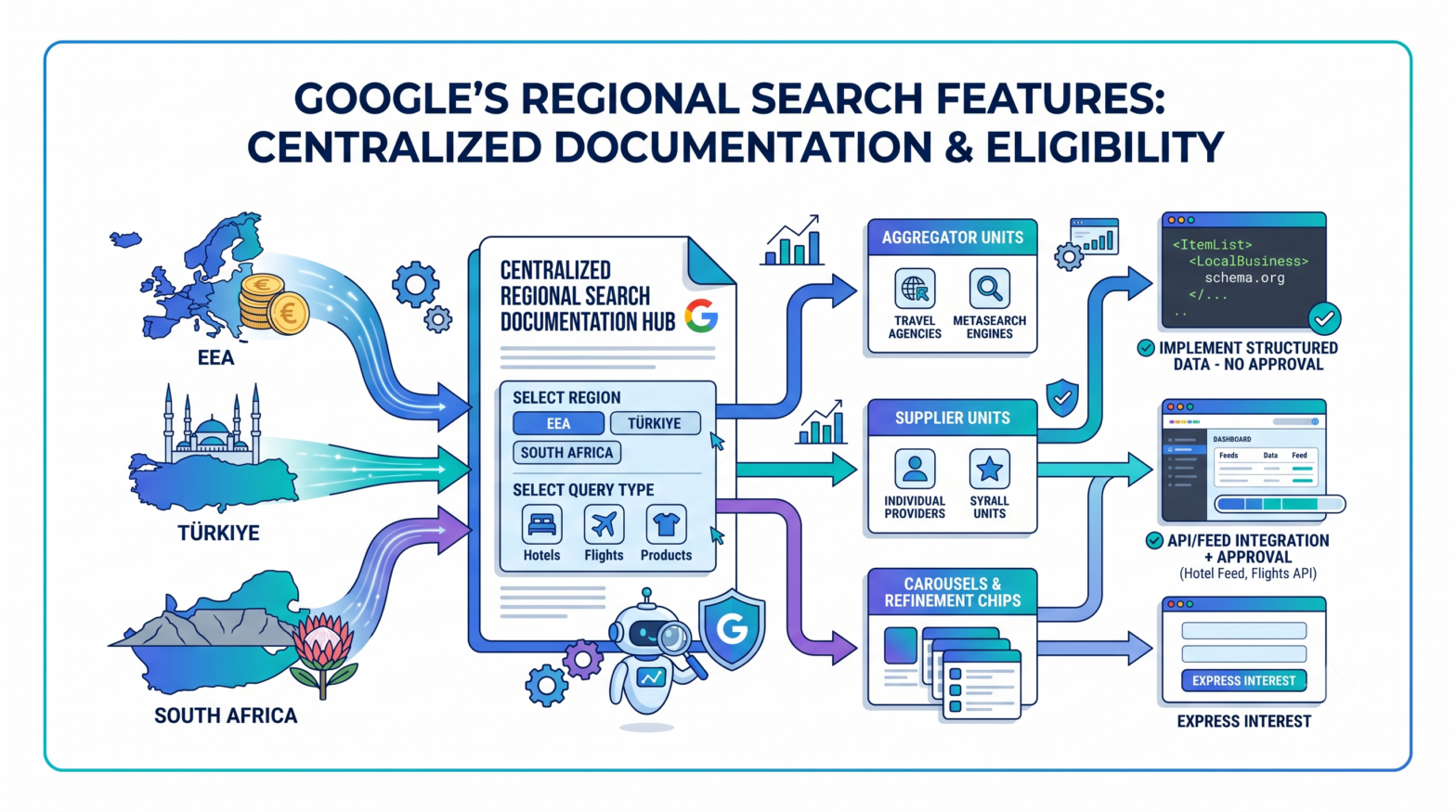
Site owners and aggregators operating in the European Economic Area, Türkiye, and South Africa now have a single reference point for regional Google Search features and how to access them. Google Search Central published a page titled "Regional differences in Search experience" on September 8, 2026, consolidating eligibility criteria and participation steps for seven region-specific features across the three markets.
What the New Documentation Covers
The Google Search Central changelog entry describes the addition as documentation covering regional Search experiences, including aggregator units, supplier units, and carousels, published to help publishers, businesses, and aggregators understand eligibility criteria and how to participate.
According to the hub page, Google states it is "evolving the search results page for certain types of queries to provide new opportunities for Vertical Search Services (VSS), Comparison Shopping Services (CSS), direct suppliers, and content providers," and directs site owners to filter by company location and query type to identify applicable features.
The EEA carries the largest set of features in the hub. The aggregator unit is designed for Vertical Search Services including online travel agencies, comparison shopping services, metasearch engines, and directories, and covers hotel, flight, long-distance train, and product queries. A supplier unit runs alongside it for direct providers such as individual hotels or airlines serving EEA users. The hub also documents structured data carousels for travel, local, and product queries, an ecosystem carousel covering weather, sports, finance, and translation, and a job sites carousel and refinement chip.
For Türkiye, Google's documentation covers a "Places sites" aggregator carousel and refinement chip available to users searching for queries related to local businesses and hotels. South Africa's documentation includes a regional badge and refinement chip covering travel, product, car hire, food delivery, and bus booking searches.
Participation Requirements by Feature
The participation path differs across the seven features. Structured data carousels are the one entry open to any site that implements the required markup, with no approval step attached. The markup requirement combines an `ItemList` schema with a supported `LocalBusiness`, `Product`, or `Event` type, with at least three entities on a summary or category page linking to detail pages.
Google's documentation states that a site does not need to provide additional data beyond what is accessible through web crawling to appear in the supplier unit, though supplier results can be enhanced with data feeds where available. The aggregator unit is the opposite case, requiring a direct feed integration or a real-time API depending on the vertical. Hotel aggregators supply a lodging feed, flight and ground transportation aggregators connect through real-time APIs, and product aggregators participate through the Comparison Shopping Services program. Aggregators must also receive approval as a Vertical Search Service.
Publishers do not need to add any markup to be eligible for the Places sites aggregator carousel or refinement chips. Most feature pages on the hub link to an interest form for site owners who want to express participation intent.
The ecosystem carousel, introduced as a new documentation page on September 8, introduces written eligibility criteria for that unit for the first time. Google's documentation states the unit may appear next to answers built on charts or live data such as stock prices or weather, and that a site must be "an authoritative source or a specialized provider" in its category to qualify, though the page gives no launch date.
Timeline of the Underlying Features
Not all features listed in the hub are new. Google announced the job sites unit, refinement chips, and carousel rich results for the EEA in February 2024 in connection with preparations for the Digital Markets Act. The South African badge dates to September 2024, and the Google Search Central changelog shows carousels reaching Türkiye in May 2025 and South Africa in August 2025.
The "Places sites" feature was an EEA aggregator unit in 2024 but is now listed in the hub for Türkiye alone, and the documentation does not state whether the EEA version was retired.
Practical Implications for Marketers and SEOs
For site owners with traffic in the covered markets, the hub provides a faster triage path than previously existed. Before this documentation, identifying which features applied to a given client required cross-referencing individual blog posts and changelog entries spanning more than two years. The two-filter interface, by region and query type, maps directly to one of three participation paths: structured data markup, feed integration plus Vertical Search Service approval, or an interest form submission. Sites operating as direct suppliers in the EEA face the lowest technical barrier to entry, while aggregator participation involves lead time for feed or API setup. The ecosystem carousel documentation is notable in that it is the first formal written statement from Google of qualification criteria for that unit.
The documentation arrived alongside DMA-related changes to the search results page, with Google writing that it "is evolving the search results page for certain types of queries to provide new opportunities for Vertical Search Services (VSS), Comparison Shopping Services (CSS), direct suppliers, and content providers."