
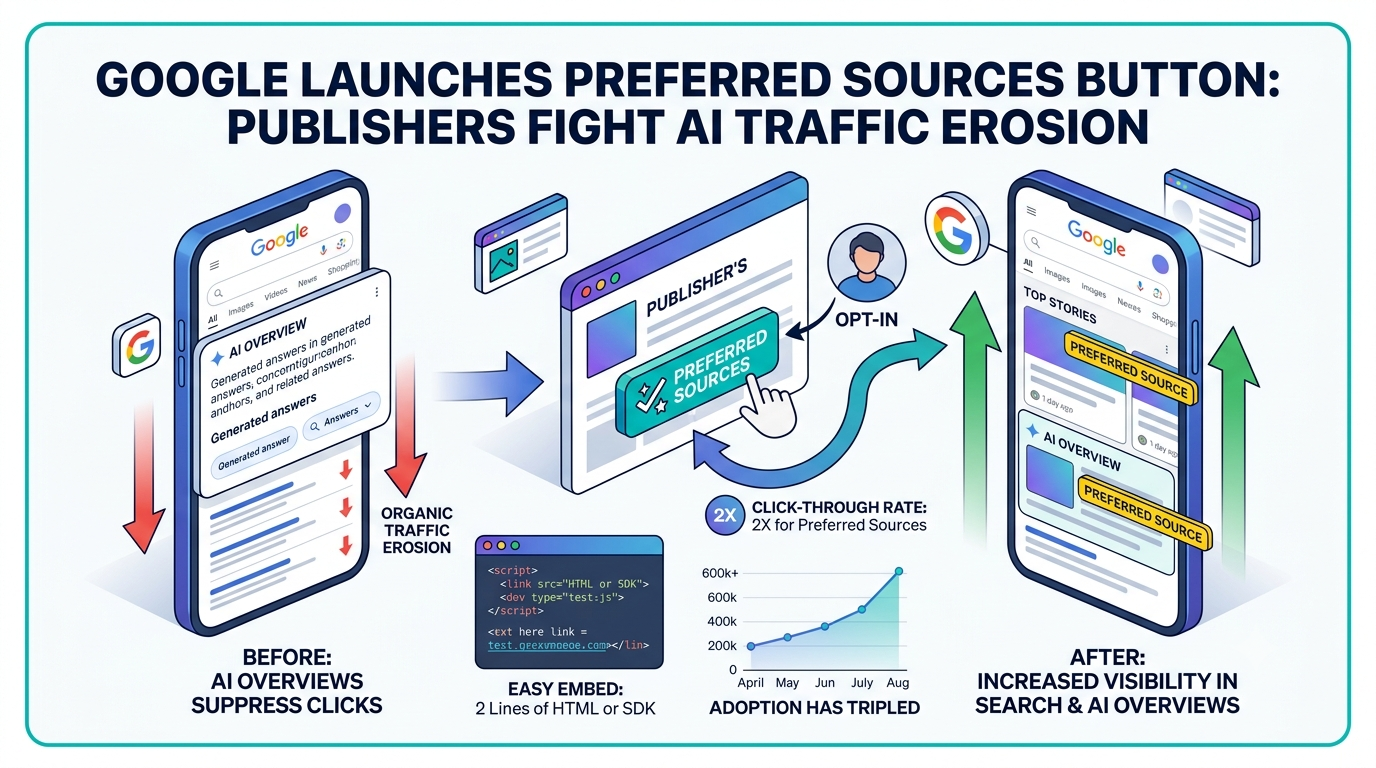
Publishers losing organic traffic to AI-generated search results now have a direct tool to protect visibility with their existing audiences. Google confirmed in an August 20, 2026 blog post authored by Mrinalini Loew, General Manager of the Google Search Ecosystem, that an embeddable "Preferred Sources" button is now available for websites to deploy, with implementation code published the same day in Google's Search Central documentation.
What the New Button Does
The button is an interactive element that publishers can embed directly on their pages. When a reader clicks it, the site is added as a Preferred Source on Google and the reader is immediately returned to where they left off on the publisher's page. The previous mechanism required readers to navigate away to a Google settings page to complete the same action, a friction point that limited adoption.
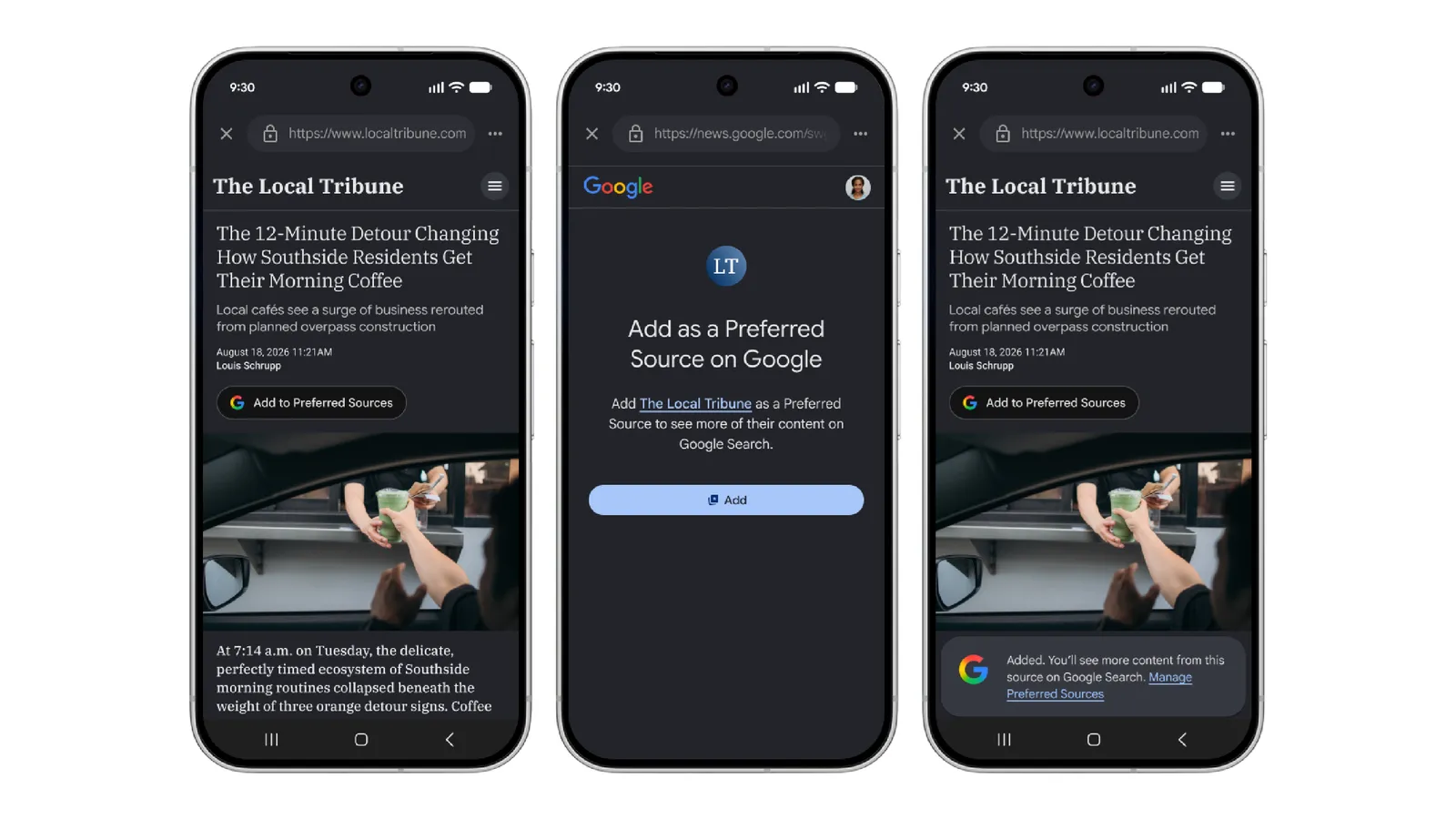
Once a site is added, readers more easily find that publication's content in Top Stories, AI Overviews, and AI Mode. As of May 27, 2026, Google began showing preferred sources not only in Top Stories, but also in AI Overviews and AI Mode, each clearly marked with a "preferred" label.
Implementation Options
Two lines of HTML are enough for the standard implementation; Google renders the rest in a localized format. Publishers can set the button to a light or dark theme and override the default display language. Google's Search Central documentation also provides an advanced JavaScript SDK path for publishers who want to trigger the Preferred Sources flow from their own custom UI elements, and a deeplink option for sites whose content management systems cannot support JavaScript. Google documents the deeplink as a text link or a clickable image and notes it can also be dropped into social posts, email newsletters, and promotions.
One eligibility boundary applies to all implementation methods. Google's own examples make the boundary explicit: a root domain and a subdomain both qualify, while a subdirectory path such as a blog folder does not.
Adoption Has Tripled Since May
Google disclosed that readers have now selected more than 600,000 unique sources, roughly 255,000 more than the figure the company reported at the end of May. In December 2025, Google reported around 90,000 unique sources selected. By April 2026, that had grown to 200,000. The figure now stands at over 600,000, tripling in just a few months.
Google says becoming a preferred source can drive more traffic to publishers, citing studies showing people are twice as likely to click through to a preferred source when available.
The Traffic Context Driving Publisher Interest
The button arrives as AI-generated search results continue to suppress organic click-through rates across the publishing industry. A field study published on SSRN found that AI Overviews reduce outbound organic clicks by 39.8% and increase zero-click searches by 34.5%, without affecting sponsored clicks or overall search frequency. For publishers, AI Overviews and AI Mode have been widely blamed for cutting referral traffic across the industry, with some sites reporting Discover clicks dropping by as much as 98% after Google's December 2025 core update.
By offering publishers these additional tools, Google is trying to assuage the damage that the rapid growth of AI-powered search features has had on traffic-dependent businesses.
How the Feature Has Evolved
Google launched Preferred Sources in August 2025 in the U.S. and India after a June 2025 Labs beta, letting users choose favourite outlets to prioritize in Top Stories. It expanded to English globally in December 2025, then to all supported languages on April 30, 2026. On May 27, 2026, Google extended the mechanic into AI Overviews and AI Mode, turning a Top Stories feature into a visibility channel that runs in parallel to the ranking algorithm. The embeddable button announced August 20 is the first time publishers can initiate that opt-in from their own pages.
What This Means for Publishers and Marketers
Preferred Sources is a personalized signal, not a universal ranking factor. It changes what an opted-in reader sees and does not raise rankings for everyone else. Google says it works alongside ranking systems and does not override content relevance. Publishers who embed the button and actively promote it to existing audiences stand to convert loyal readers into a persistent visibility advantage, particularly in AI Overviews and AI Mode, where the "preferred" badge distinguishes their links from untagged results. Publishers who previously added an older static badge or deeplink should verify in Search Central documentation whether their existing implementation needs to be replaced with the new interactive button to trigger the improved post-confirmation redirect.
One line in the documentation limits how much this should be read as a ranking instruction: the listed implementation methods are described as examples of audience building and are "not required to do them in order to appear as a preferred source."
Natural Language Discover Controls and Audio Briefings Also Announced
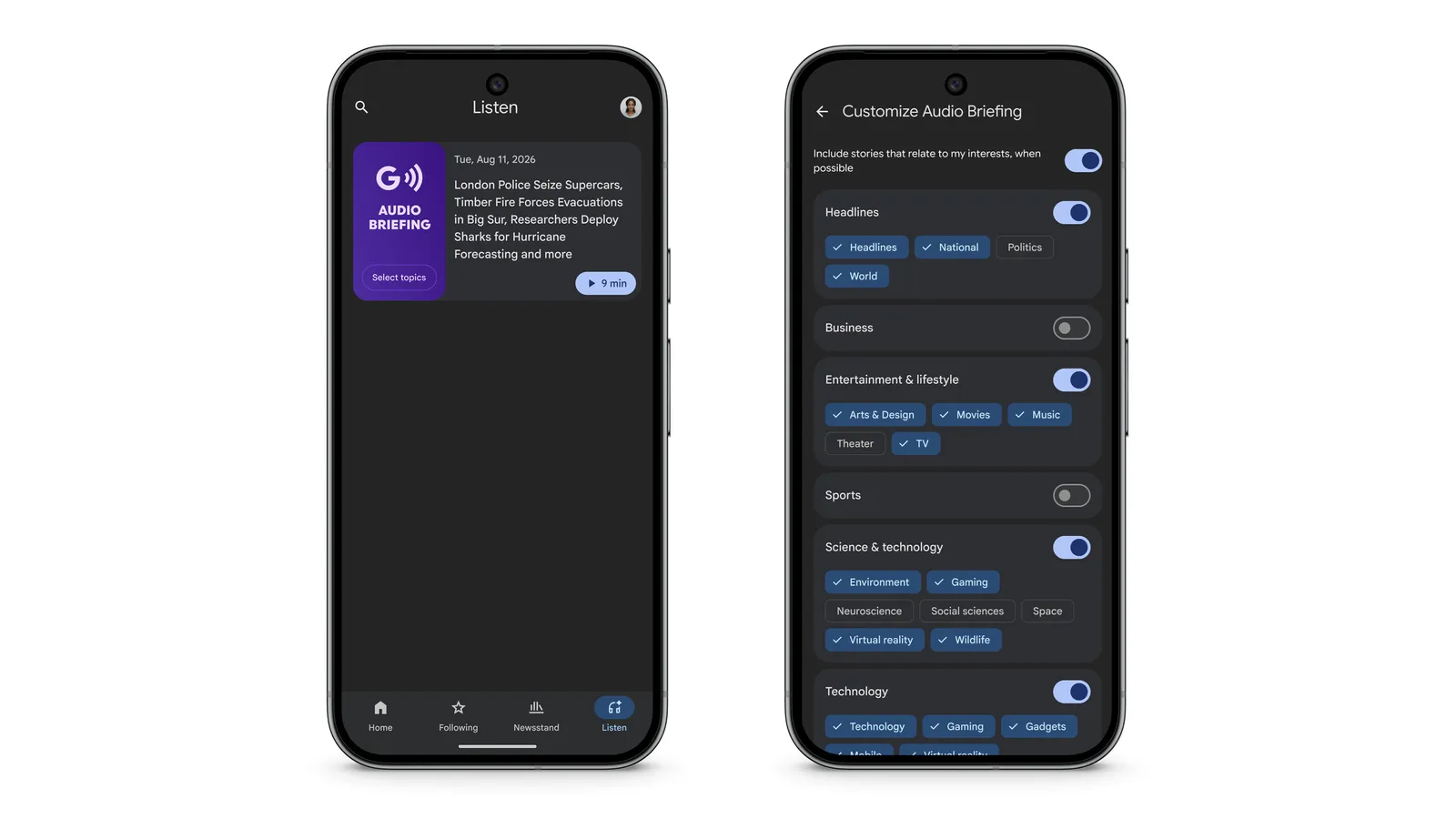
The August 20 announcement included two additional personalization features. Users will soon be able to refine their Discover feed by typing specific interests directly into the Google app. The feature will let users tap the three-dot menu on any Discover card and describe in plain text which topics or links they want to see more or less of, with the feed adjusting in real time and retaining those preferences. A third personalization feature makes it easier for users to customize their daily audio briefings in the Google News app on Android. Users can curate their briefings by choosing specific topics and can explore topics by clicking links to full articles. Google credited the range of publishers in its news AI pilot program, announced December 10, 2025, for enabling deeper coverage of key stories within those briefings.
The button code for the Preferred Sources embed is available now in Google's Search Central documentation. Discover's natural language controls do not yet have a confirmed launch date beyond Google's stated: "in the coming days."