
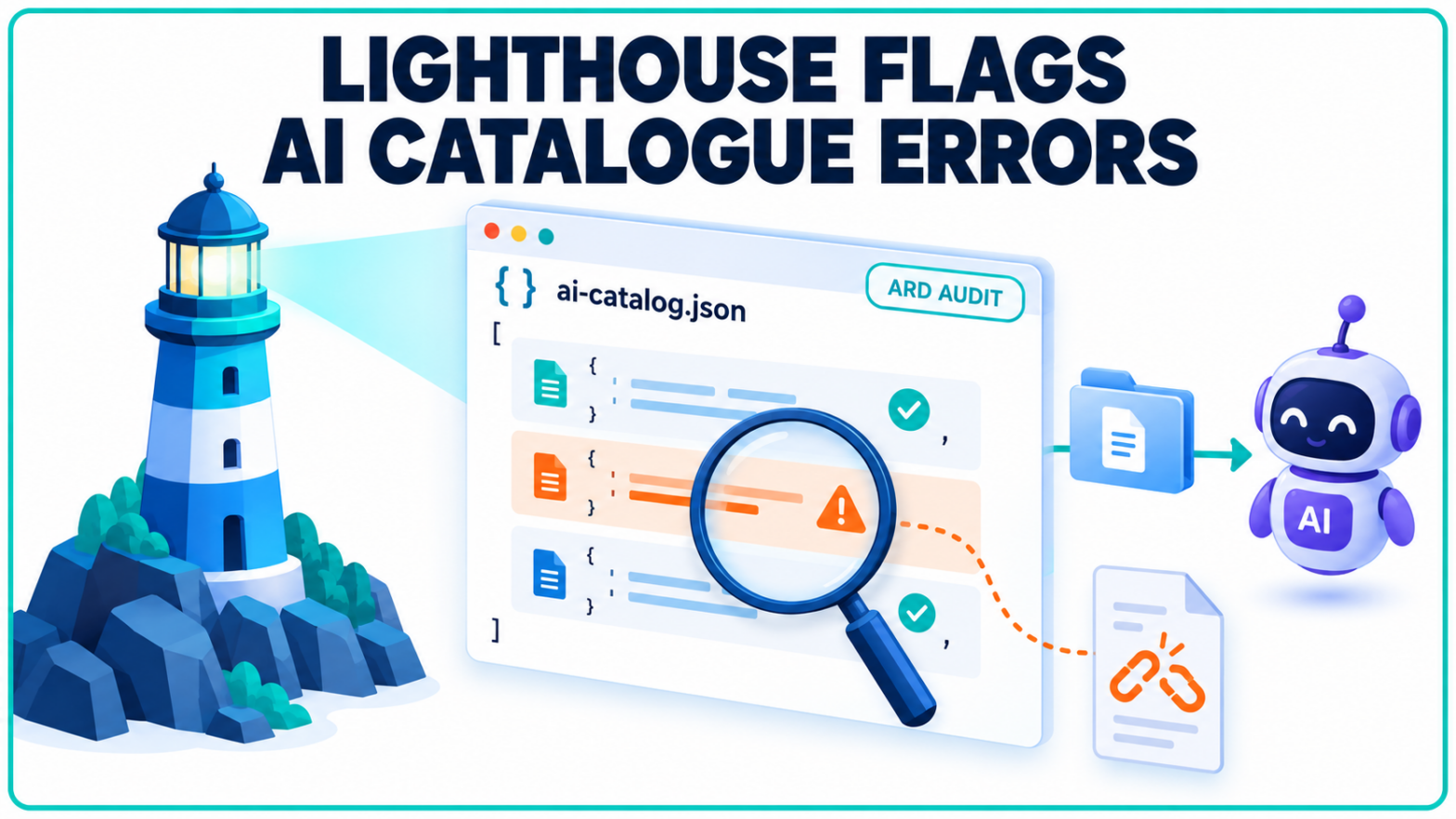
A website can advertise resources to AI agents and still send them to a broken catalogue. Google Lighthouse now includes a check that exposes that gap.
The Lighthouse 13.5.0 release, published September 18, adds an Agent Resource Discovery audit identified as ard-schema. It checks an ai-catalog.json manifest against the Agentic Resource Discovery specification, giving developers a diagnostic for the information they publish to help machines locate resources.
The scope is specific. This is catalogue validation, rather than a general measure of how easily search bots can read a webpage. Sites without a catalogue can receive a Not Applicable result.
Google Lighthouse Checks the Catalogue a Site Advertises
The distinction starts with what Agentic Resource Discovery, or ARD, describes.
The ARD specification covers resources that language models can use beyond their own capabilities, including tools, agents and callable services. It defines how those resources can be described and found across discovery systems. The published specification remains a proposal.
A catalogue provides structured information about those resources. It gives a compatible system something explicit to inspect instead of requiring it to infer every capability from the visible website.
Lighthouse’s implementation separates finding that catalogue from checking its contents. A gatherer locates and retrieves the file; the audit passes the returned content to a conformance tester.
The audit source code makes the result conditional. When no explicit catalogue signal exists and the default location does not return HTTP 200, the audit is marked Not Applicable. When a site explicitly advertises a catalogue, an unsuccessful response or empty content produces a failure.
For a retrieved manifest, validation errors fail the audit. Lower-severity warnings produce an internal result of 0.9, while a clean result receives 1. Those values describe this individual check, not a new search visibility score.
AI Agents Get Several Signposts, With a Defined Priority
The resource discovery gatherer shows where Lighthouse looks for the catalogue and which signal takes precedence.
Its selection order is:
- An Agentmap entry in robots.txt.
- An HTML link element using the ai-catalog relationship.
- An HTTP Link header using that relationship.
- The default /.well-known/ai-catalog.json location.
The gatherer selects the first available explicit location, or the default path when none is supplied, then fetches that URL. It does not cycle through every candidate until one passes validation. Its HTTP-header discovery runs in navigation mode.
That behaviour has a concrete consequence. A stale catalogue reference can direct the check to an unavailable file even when a working catalogue exists elsewhere. Publishing the document and keeping its discovery signals accurate are separate responsibilities.
For developers investigating a failure, the chosen catalogue URL is therefore part of the evidence. The gatherer records that address alongside the response status, content, headers and discovery signals.
ARD Joins llms.txt Under Agent Discoverability
The release also changes how related checks are organised. A merged Lighthouse configuration update groups the ARD audit and the existing llms.txt audit under Agent Discoverability, within Agentic Browsing.
Both concern information exposed to machines, but their checks differ.
The llms.txt convention provides a concise description of a site and links to useful content. Chrome’s documentation for that audit says a server error while retrieving the file triggers a flag. A 404 is treated as Not Applicable because providing the file is optional.
ARD adds validation of a structured resource manifest to that discovery group.
The surrounding category covers more than files. Google’s Agentic Browsing documentation describes checks involving tool registration, accessible names and roles, and layout stability. These are deterministic tests of technical conditions that can affect machine interaction.
Chrome still describes the category as experimental. It reports individual results and a pass ratio rather than the weighted 0–100 score used by other Lighthouse categories.
Finding Resources Does Not Prove an Agent Can Use Them
The new audit sits alongside work on how AI agents interact with websites once they arrive.
Google’s WebMCP documentation describes a proposed standard through which pages expose structured tools using JavaScript or annotated HTML forms. Its examples include completing support forms, handling booking inputs and invoking application functions.
ARD’s specification addresses discovery and descriptions across systems. WebMCP addresses functions exposed by a webpage to a compatible agent. The distinction separates locating a resource from performing an action with it.
A valid catalogue cannot, by itself, establish that a booking will complete or that an agent will choose the right business. The Lighthouse check inspects the manifest; it does not run every listed service through a customer journey.
For marketing and SEO teams, the practical use is implementation review. Businesses that publish agent resources can use the result to identify broken references and malformed catalogues, while assessing crawlability, content and conversion flows through their existing checks. An ARD result belongs with the technical evidence about an integration, rather than being presented as proof of improved rankings or AI citations.
Google Search Requirements Remain Separate
The expansion of Google Lighthouse into agent interaction does not establish a new requirement for Google Search.
Google’s guidance for AI features in Search says pages do not need new machine-readable files, AI text files or special markup to appear in AI Overviews or AI Mode. Eligibility still depends on indexing and the ability to appear in Search with a snippet, alongside the existing technical and content requirements.
An agent catalogue serves a different purpose from those eligibility rules. Its validation result should be read within the experimental browsing category where Lighthouse places it.
The Lighthouse team expects version 13.5.0 to ship in Chrome 156 DevTools, with PageSpeed Insights expected to receive the release within two weeks. That is the published rollout expectation; the release notes do not confirm that every interface already exposes the new audit.