
Matching a page to a query is one problem. Deciding exactly where that page belongs among dozens of plausible answers is another.
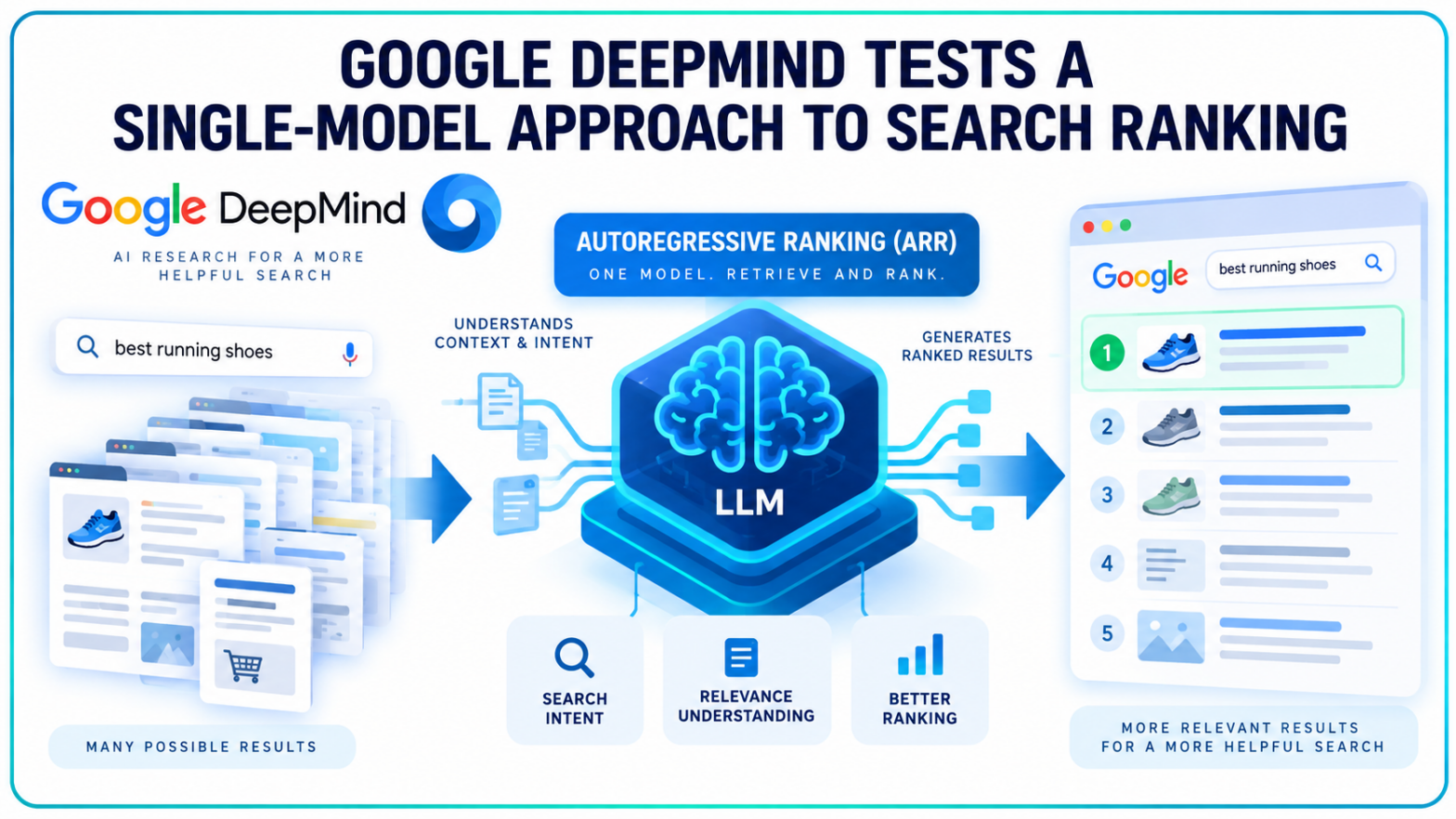
Google DeepMind researchers are testing an LLM-based ranking approach that tackles both parts differently. Called Autoregressive Ranking, or ARR, the method generates document identifiers based on their relevance to a query and could replace the familiar split between fast retrieval and more computationally expensive reranking.
There is an important boundary here.
The research paper does not say ARR is being used in Google Search, and Google has not announced a ranking update based on the work. What it does provide is a detailed look at how generative models could become better at ordering information when several results are relevant but not equally useful.
Search Ranking Normally Splits Speed From Precision
Large-scale information retrieval has a difficult engineering problem. A system needs to search an enormous collection quickly, but it also needs enough understanding of the query and documents to put the best result first.
One common solution uses two stages.
Dual encoders represent queries and documents separately as mathematical embeddings, allowing a system to retrieve plausible matches efficiently. The trade-off is that compressing each side into a vector limits how deeply the model can examine the relationship between the query and each document.
Cross encoders can make finer relevance judgements because they process the query and document together. They are also much more expensive when thousands or millions of documents need to be evaluated. The DeepMind paper describes this tension as a reason retrieval systems commonly retrieve candidates first and rerank them afterward.
Autoregressive Ranking takes another route.
Instead of using one model to find candidates and another to score them, an LLM generates document IDs token by token, conditioned on the query. Beam search can then be used to produce likely documents in ranked order. The researchers argue that the architecture offers greater expressive capacity than dual encoders without requiring a cross-encoder to score every candidate separately.
That matters to the broader development of AI search because ranking increasingly involves more than finding pages containing similar words. Google already documents systems such as BERT, RankBrain and neural matching that interpret meaning, concepts and intent rather than relying on exact-term correspondence alone.
SToICaL Trains the Model to Care About the Whole Ranking
Using an LLM for retrieval does not automatically make it a good ranking model.
That is one of the paper's central problems.
Language models are normally trained around next-token prediction. In a ranking task, however, correctly predicting the most relevant document does not necessarily teach the model how the second, fifth or twentieth result should be ordered.
The researchers developed a training method called Simple Token-Item Calibrated Loss, or SToICaL, to address that gap. It adjusts the training objective so relevance ordering contributes directly to how the model learns.
At the item level, higher-ranked documents can receive greater weight. At the token level, the model can distribute probability across valid document-ID paths according to relevance instead of treating one document identifier as the only acceptable target.
The distinction is technical, but the objective is straightforward: teach the model that ranking is not merely a search for one correct answer.
A query can have many relevant pages.
Their order is the problem.
That is particularly relevant when thinking about search intent. Someone searching for a product category, comparing alternatives or researching a complex subject may generate a large set of pages that are broadly relevant. Ranking quality depends on distinguishing which one most closely satisfies the particular need expressed by that query.
The Shopping Test Exposed Both Gains and a Trade-Off
The researchers tested their method using WordNet and the ESCI Shopping Queries dataset.
ESCI is especially interesting from a search perspective because the experiment involved queries and product titles rather than only an abstract ranking problem. The researchers created candidate sets using Google's Gecko embeddings, then trained the autoregressive model to order product identifiers according to relevance.
The results were not a clean win across every metric.
On the ESCI test, the standard next-token prediction baseline recorded an nDCG score of 95.23. Variants using the researchers' trie-based rank-aware method reached 97.21, while also improving recall at several depths beyond the first result.
Top-result performance moved in the opposite direction.
The baseline achieved 95.16 on Recall@1, while the tested rank-aware variants shown in the paper were around 67% to 70%. The researchers explicitly acknowledge that the ESCI method hurt Recall@1 while improving Recall@K for K greater than one and raising the aggregate nDCG score.
That trade-off prevents a simple conclusion that the new method is universally better.
On WordNet, the results were stronger. The researchers reported that rank-aware training sharply reduced cases where irrelevant documents outranked relevant ones. In a separate WordNet comparison, ARR performed comparably with the more expensive cross-encoder approach and substantially better than the dual encoders tested.
The paper's result is therefore about ranking architecture and training efficiency, not a claim that every query suddenly produces a better first result.
This Is DeepMind Research, Not a Confirmed Google Ranking Update
That distinction matters for SEO.
The paper was first submitted to arXiv in January 2026 and includes researchers affiliated with Google DeepMind, the University of Massachusetts Amherst and the University of Texas at Austin. The latest version of the paper carries a February 2026 date.
Nowhere in the paper does it state that Autoregressive Ranking or SToICaL has been deployed in Google Search.
Google's public guide to its notable Google Search ranking systems currently discusses technologies including BERT, RankBrain, neural matching and passage ranking. ARR and SToICaL are not listed. Google also says changes to Search go through testing and evaluation before proposed systems are implemented.
So there is no new ranking factor for SEOs to optimize around.
No SToICaL markup. No ARR content formula.
The research is more useful as evidence of where information-retrieval work is heading: toward models capable of making more nuanced relevance distinctions without requiring the traditional retrieval and reranking architecture.
Intent Audits Matter More Than Reverse-Engineering ARR
The practical SEO question is not how to optimize for this experimental model.
It is whether a page clearly satisfies the search task it claims to target.
Google already says its automated systems consider the words in a query alongside page relevance, quality, source expertise, language, location and other factors. RankBrain helps relate words to concepts, while neural matching compares conceptual representations between queries and pages.
For marketers, an intent audit can therefore stay grounded in established SEO practice. Review whether a ranking page actually answers the dominant need behind its target queries, whether important distinctions are buried beneath introductory copy, and whether separate intents have been forced onto one page simply because they share similar keywords.
That work also aligns with Google's existing guidance for AI search visibility, which continues to place conventional crawlability, usefulness and content quality ahead of AI-specific optimization tricks.
The DeepMind research gives that conversation a more technical backdrop. Its model is designed to learn how relevant documents should be ordered relative to one another, rather than treating retrieval as a hunt for only the first acceptable result.
Whether that architecture ever becomes part of Google Search remains unanswered.
The paper closes with further work still required around combining document-ID design with token-based ranking losses. On the shopping benchmark, the loss in top-one recall provides another unresolved problem.
For now, ARR belongs in the research pipeline, not the list of confirmed Google ranking systems.