
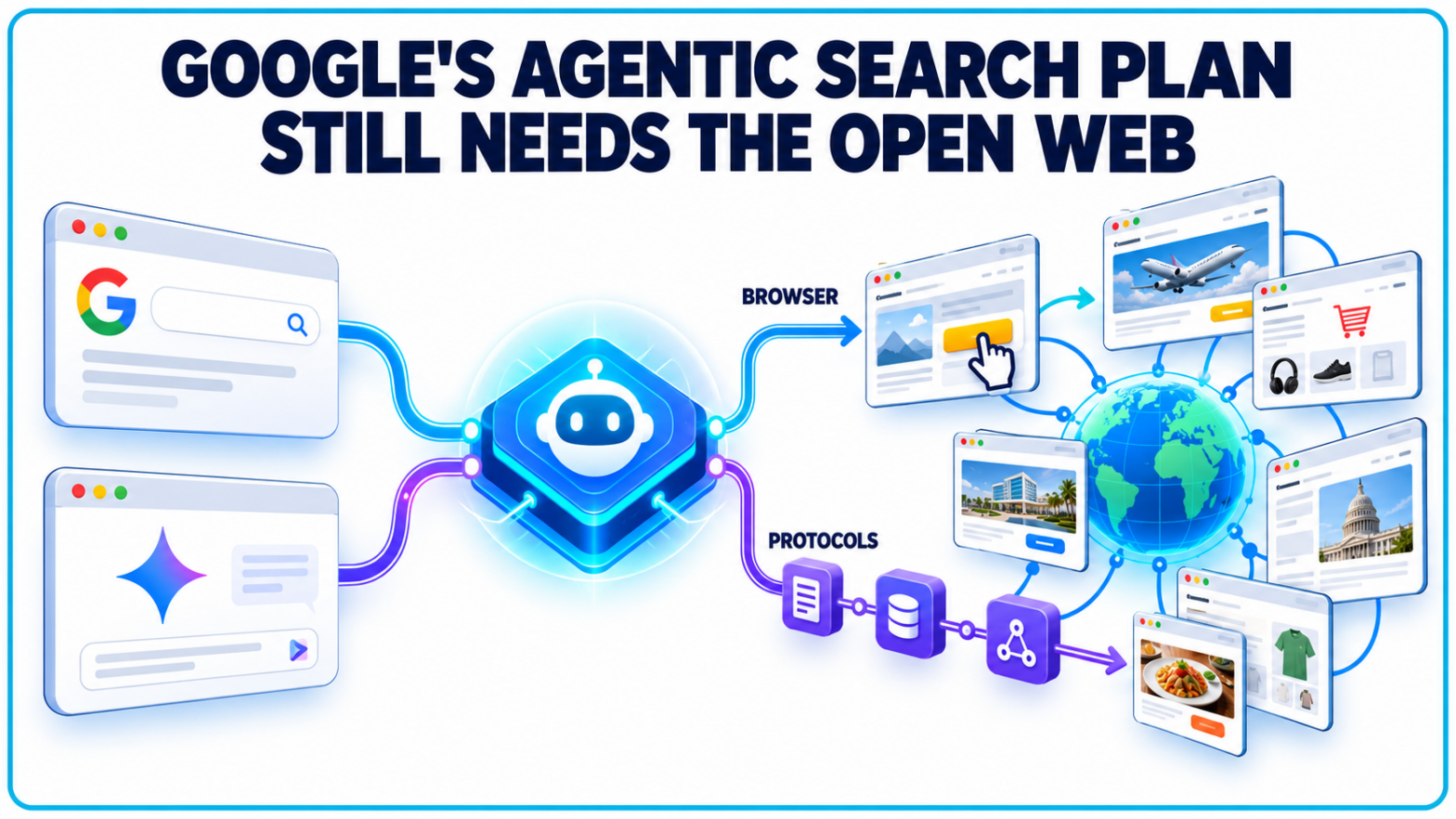
Google’s future Search experience may not wait for people to click, browse and complete tasks themselves. But the company is not planning to leave websites behind.
Alphabet CEO Sundar Pichai says Google’s agents will reach businesses in two ways: by navigating websites much like people do and by connecting through structured protocols built for machine-to-machine interactions.
Search and Gemini Do Not Have to Become One Product
Pichai outlined the strategy during an October 21 interview with Alex Heath, describing an agent that carries a user’s context and unfinished tasks across Google products.
His near-term vision is “one box.”
That does not necessarily mean collapsing Search, Gemini and other Google services into one interface. Pichai instead expects a persistent agentic layer to connect them.
“I expect our agents to provide that unifying experience across these products,” Pichai said.
An agent could begin a task in Search, continue it in Gemini and retain the context needed to resume later. The user would not have to reconstruct the request or begin a separate session every time the interface changed.
Pichai said the proportion of Gemini interactions that could be classified as agentic has been increasing. These are not conventional information requests that end with an answer. They require the system to conduct research, monitor changes or complete an action for the user.
That direction follows Google’s earlier description of agentic search as a system that coordinates tasks rather than simply returning results.
The Agent Becomes the Persistent Search Interface
Google began making that model more concrete at I/O 2026.
The company introduced information agents designed to operate continuously in the background, monitoring websites, news sources, social posts and live data. Google also announced expanded booking tools, automated calls to certain local businesses and custom trackers that users can revisit over time.
In its official Search announcement, Google said information agents would be able to synthesize updates and take action when relevant conditions are met. An apartment-search agent, for example, could repeatedly scan listings and notify the user only when a property matches the requested criteria.
That changes the unit of search.
A traditional query begins when someone enters keywords and ends when that person leaves the results page. A persistent agent may continue working after the initial interaction, revisit sources and act when new information becomes available.
Pichai expects this layer to carry personal context as well. An agent running in the cloud could remember where a user stopped, what criteria mattered and which actions had already been completed.
Google Search would still retrieve and evaluate information, but the visible search session would become one part of a longer workflow. The agent, rather than the results page, becomes the continuous point of contact.
Websites Face Two Types of Machine Visitor
Agents still need a way to reach the services and information available outside Google.
Pichai described two routes. The first is browser-based computer use, in which an agent opens pages, interprets their contents and interacts with buttons or forms. The second uses protocols that expose structured capabilities directly to the agent.
Browser automation resembles what a person already does. It can work with websites that were never specifically built for AI agents, making it useful while dedicated standards remain fragmented.
Google has already documented a user agent called Google-Agent. The company says agents hosted on Google infrastructure use it to navigate the web and perform actions requested by users.
Google-Agent is classified as a user-triggered fetcher rather than a conventional search crawler. Google says these fetchers generally ignore robots.txt rules because the request originates with a user. The company publishes associated IP ranges and warns that user-agent strings can be spoofed.
Google is separately testing Web Bot Auth, a cryptographic authentication protocol intended to help websites determine whether traffic claiming to come from a particular agent is genuine. TechWyse previously examined how Web Bot Auth could distinguish legitimate AI agents from impersonators and automated scrapers.
The second route avoids much of the uncertainty of visual browser interaction. A website or service can expose defined actions that an agent calls directly, without searching for the right button or attempting to interpret a changing page layout.
Protocols Offer Scale, but the Standards Are Still Forming
Pichai called browser-based computer use an elegant approach because it mirrors human behaviour and can preserve checkpoints where the user remains in control.
Protocols are the longer-term scaling play.
He cited growing activity around Model Context Protocol, agent communication standards and payment protocols. The ecosystem is still unsettled, however, and Pichai predicted a period of competing implementations before more interoperable standards emerge.
He described protocols as “a far more scalable approach.”
Google’s clearest working example is the Universal Commerce Protocol, an open standard intended to connect agents, merchants and payment providers. UCP supports agentic actions in AI Mode and Gemini, beginning with direct purchasing.
Instead of opening a retailer’s website, locating a product, building a cart and completing each checkout field through browser automation, an agent can use standardized commerce functions supplied by an integrated merchant.
Google says retailers remain the merchant of record and retain their customer relationships and transaction data. UCP also supports connections with other emerging standards, including Agent Payments Protocol, Agent2Agent and Model Context Protocol.
The technology is expanding beyond its initial checkout function. Multi-item carts, catalogue access, account linking, loyalty support and post-purchase functions are part of the protocol’s roadmap. TechWyse has tracked those additions through its coverage of Universal Commerce Protocol.
Browser agents and structured protocols therefore solve different timing problems. Browser access allows agents to use much of the existing web now. Protocols can make those interactions more dependable and efficient, but only after businesses, platforms and software providers agree on how the systems should communicate.
Agentic Search Leaves the Traffic Model Unsettled
For marketers and website operators, the immediate shift is from optimizing only for discovery to supporting machine-executable actions.
Pages still need clear information, accessible controls and dependable technical performance when an agent browses them. Businesses adopting protocols face a different requirement: maintaining accurate product, availability, pricing and transaction data that software can access without relying on the visual website.
Neither route guarantees a human visit.
An agent may retrieve information, compare options and complete a transaction while the user remains inside Search or Gemini. The originating website can still supply the information or fulfil the service, but its role may be less visible in analytics built around page views, sessions and referral clicks.
The advertising model is also unresolved. When asked how agent browsing would affect businesses whose interfaces depend on engagement, Pichai said the longer-term approach should begin with what users want and also work for the companies providing value. He did not describe how ads would be selected, displayed or measured when an agent completes the browsing.
Google’s current infrastructure reflects that unfinished transition. Google-Agent can already navigate ordinary pages on a user’s behalf, while UCP integrations are still being expanded through merchant onboarding and waitlists. One route uses the web as it exists; the other is rebuilding parts of it for agents.