
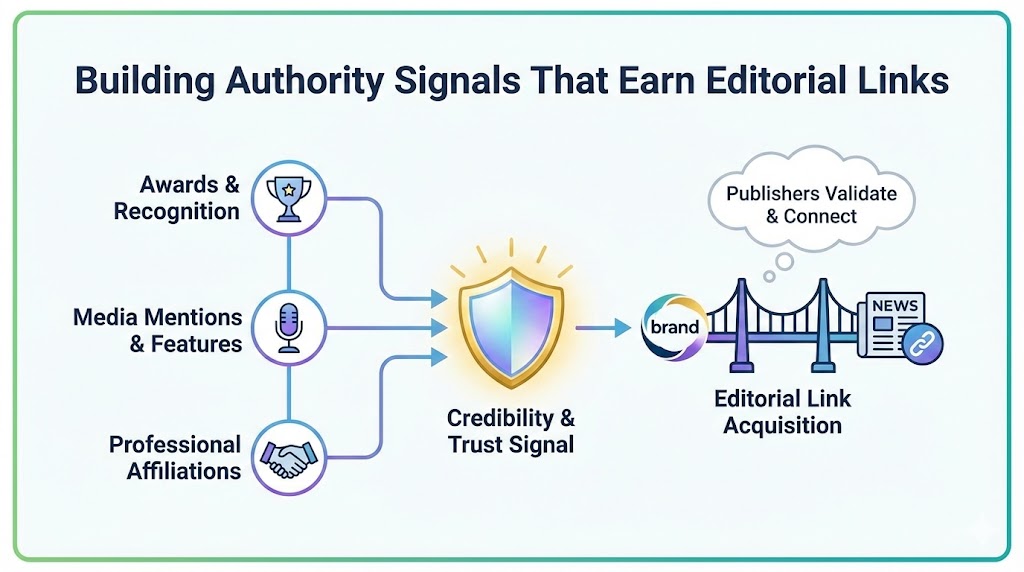
Businesses competing for editorial links are facing a familiar challenge: publishers are inundated with outreach requests and increasingly selective about who they engage. As a result, link acquisition is less about volume tactics and more about how clearly a brand can establish legitimacy at first contact.
Across digital marketing and PR teams, there is growing emphasis on front-loading credibility signals—concise proof points that communicate authority before a pitch is fully considered. When done well, these signals can materially increase response rates without repeated follow-ups or aggressive outreach.
Authority as a filtering mechanism
Publishers, editors, and site owners routinely make rapid judgments about inbound requests. Signals that demonstrate professional standing help differentiate serious organizations from low-quality or automated pitches. In many cases, a brief reference to external validation is enough to establish trust and justify continued engagement.
These signals are not interchangeable with traditional ranking factors. They operate at the human decision-making level, shaping whether an email is opened, read, or ignored entirely.
Recognition and external validation
Formal recognition remains one of the most straightforward ways to demonstrate credibility. Industry awards, local business recognitions, and acknowledgments for community or charitable work all contribute to a perception of legitimacy. While not every business operates in an award-driven sector, even modest forms of recognition can signal stability and professionalism.
Media visibility plays a similar role. Being cited, interviewed, or featured in established publications—whether online or broadcast—creates transferable trust. These mentions act as shorthand for editorial vetting, indicating that a third party has already assessed the brand as credible.
Institutional relationships and professional affiliations
Partnerships with associations, trade groups, and professional organizations can be particularly influential in outreach contexts. Many of these institutions maintain newsletters, journals, or member publications and actively seek expert contributions.
Contributing to these outlets—especially print or offline publications—often yields indirect benefits rather than direct links. However, the reputational value of being published by a respected organization can significantly improve link acquisition elsewhere. Editors are more receptive when a brand can be credibly associated with institutions they recognize or belong to themselves.
Peer publishing and professional overlap
Another indicator of authority is the presence of work published by comparable organizations or respected peers. When a brand’s content appears alongside established voices in its field, it signals relevance and acceptance within the professional community.
This form of validation often builds organically over time, particularly for companies that invest consistently in high-quality contributions rather than one-off placements.
The role of author credibility
Author identity also influences outreach outcomes. Editors are more inclined to engage when content is attributed to individuals with recognizable credentials or practical experience in the subject matter. Clear professional backgrounds—such as educators writing on education or practitioners writing within their industry—help reduce perceived risk for publishers.
For many organizations, strengthening author profiles and making those credentials visible on corporate websites has become a prerequisite for sustained link acquisition efforts.
Preparing before outreach
The common thread across these approaches is preparation. Authority signals cannot be fabricated at scale or assembled overnight. They require deliberate investment in visibility, professional participation, and credible authorship.
As publishers continue to raise standards, marketers who prioritize demonstrable expertise and third-party validation are more likely to earn editorial links without relying on volume-based outreach tactics.