
Robots.txt is often treated like a locked gate. Google’s latest clarification shows it can behave more like a routing table, and one misplaced Googlebot section can leave unwanted URLs exposed in search.
The Risk Is Not That Google Ignores Valid Rules At Random
The issue surfaced after a Shopify site owner reported spam search-result URLs appearing in Google despite a Disallow: /search rule in robots.txt. The case was first reported by Search Engine Journal, after Google Search Advocate John Mueller responded directly in a Reddit thread.
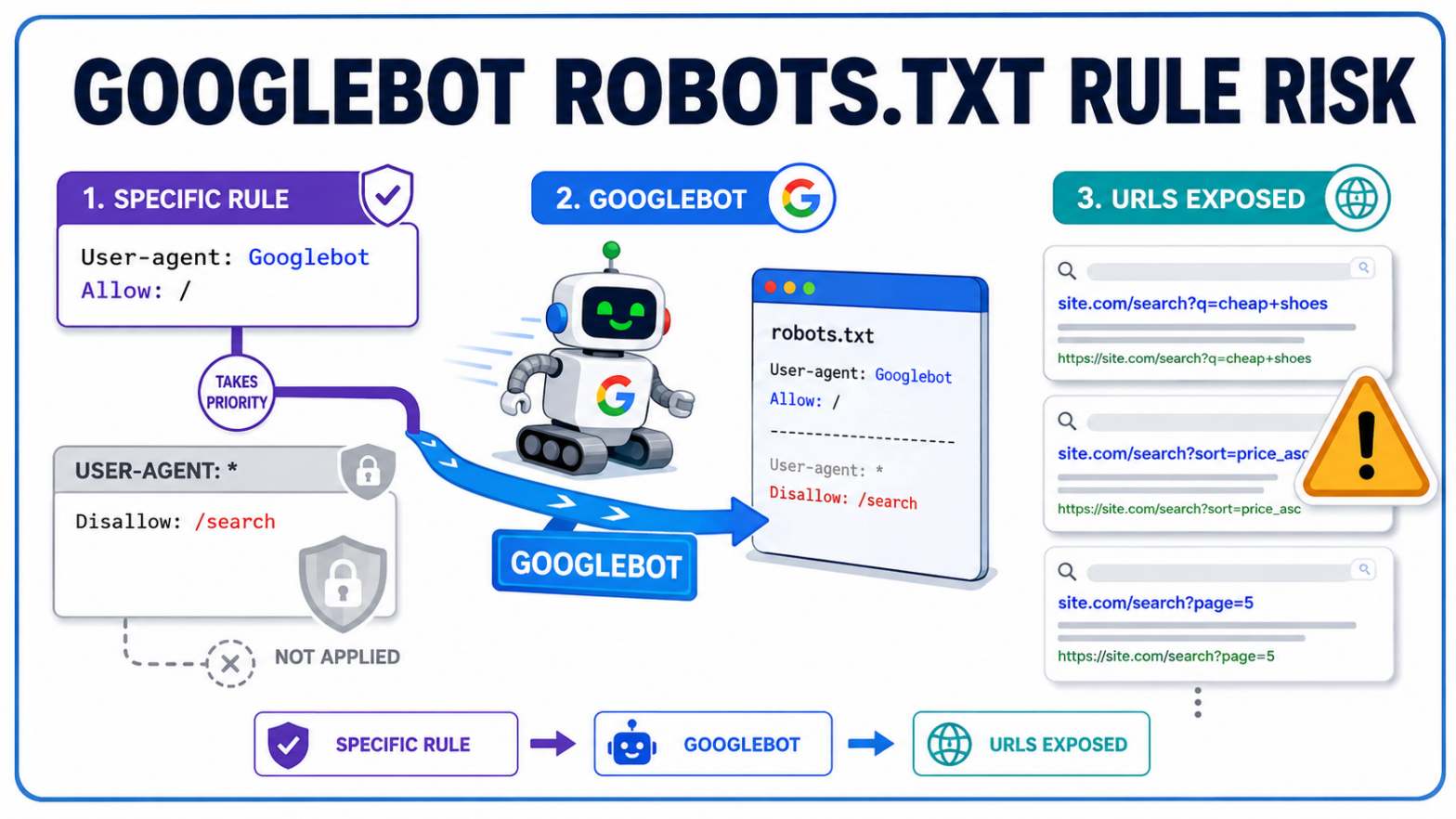
Mueller pointed to a common but dangerous robots.txt setup: one block written specifically for Googlebot, followed later by a broader User-agent: * block containing additional rules.
His explanation was direct:
“With robots.txt, the more specific rules win, so if you have a user-agent: Googlebot section, it will only use that section.”
That is the technical vulnerability. Googlebot is not combining the specific Googlebot rules with the global rules. It is selecting the most specific matching group and ignoring the broader group for that crawler.
Google’s own robots.txt documentation confirms the behaviour. Google says only one group is valid for a crawler, and that user-agent-specific groups and global * groups are not combined.
A Global Block Can Disappear For Googlebot
For enterprise websites, ecommerce platforms, multilingual sites, and CMS environments with generated robots.txt files, this can become a serious crawl-control failure.
A file may appear safe during a quick human review because the global section contains blocks for internal search, faceted navigation, admin-adjacent paths, staging-like folders, or other low-value URL patterns. But if a separate User-agent: Googlebot block exists above or below it, Googlebot may never apply those global rules.
That can allow crawlable URL sets to expand quietly.
In the Shopify case, the affected URLs were internal search-result pages created through spam queries. These pages can multiply quickly because each spam phrase generates a separate URL. If Google discovers them through links, logs, spam campaigns, or other signals, the site can end up with indexed search pages that were never meant to represent the brand.
For SEOs, this is not just a housekeeping issue. It can dilute index quality, inflate crawl waste, and create messy reporting in Google Search Console. For larger sites, it can also make technical SEO audits harder because the robots.txt file may look correct until user-agent precedence is tested.
Robots.txt Still Does Not Hide Sensitive Pages
The security angle is sharper for organizations that use robots.txt as a privacy barrier.
Google’s documentation is clear that robots.txt is mainly used to manage crawler access and server load. It is not a reliable method for keeping a page out of Google Search. If a blocked page is linked elsewhere, Google may still index the URL without crawling its contents.
For private admin pages, staging environments, client portals, or sensitive operational paths, robots.txt should not be treated as access control. Google recommends stronger methods such as password protection or noindex, depending on the goal.
That distinction matters. Robots.txt can tell compliant crawlers not to fetch a URL. It does not authenticate users, remove public links, stop every crawler, or guarantee that a URL will never appear in search results.
In high-security environments, the urgent technical vulnerability is not Googlebot “breaking in.” It is teams mistaking crawl directives for security controls, then compounding the mistake with user-agent blocks that do not behave as expected.
Noindex Only Works If Google Can See It
The fix is not always to add more robots.txt rules.
Google’s noindex documentation says the page must be accessible to Googlebot for the directive to work. If robots.txt blocks the URL, Googlebot cannot crawl the page and cannot see a meta robots tag or X-Robots-Tag header.
That creates a familiar SEO trap: teams block a URL in robots.txt because they do not want it indexed, then add noindex and expect Google to remove it. If Google cannot crawl the page, it cannot process the noindex instruction.
Shopify’s own help documentation recommends adding a meta robots noindex tag to hide search-result templates from search engines. That approach can be useful for internal search pages, but only if the page is not simultaneously blocked from Googlebot in robots.txt.
For marketers and SEOs, the practical implication is straightforward: crawl control and index control need separate QA. Robots.txt should be audited for user-agent grouping, path matching, and platform-generated changes. Indexation controls should be tested through rendered HTML, HTTP headers, and Google Search Console inspection rather than assumed from the presence of a rule.
Enterprise SEO Teams Need Robots.txt Change Control
The vulnerable pattern is easy to introduce.
A developer adds a custom Googlebot block. A CMS app injects platform defaults. An ecommerce team adds disallow rules for internal search. A migration team adds staging restrictions. Months later, the file contains rules that look comprehensive but do not apply to the crawler everyone cares about most.
Google’s parser also supports only specific robots.txt fields, including user-agent, allow, disallow, and sitemap. Unsupported fields such as crawl-delay do not become enforceable because they appear in the file.
That makes robots.txt a governance issue, not just an SEO file.
Large websites should treat robots.txt changes like production configuration changes: reviewed, tested, logged, and validated against Google’s parser behaviour. The same applies to AI crawler directives, where TechWyse has previously examined how bot-blocking policies are becoming part of broader digital asset control in the age of generative search.
The robots.txt file still matters. It can protect crawl budget, keep low-value patterns out of crawling paths, and guide search engines away from areas that do not deserve attention. But the current Googlebot case shows how fragile that control becomes when teams assume the global rule applies everywhere.
One specific user-agent block can change the entire outcome.