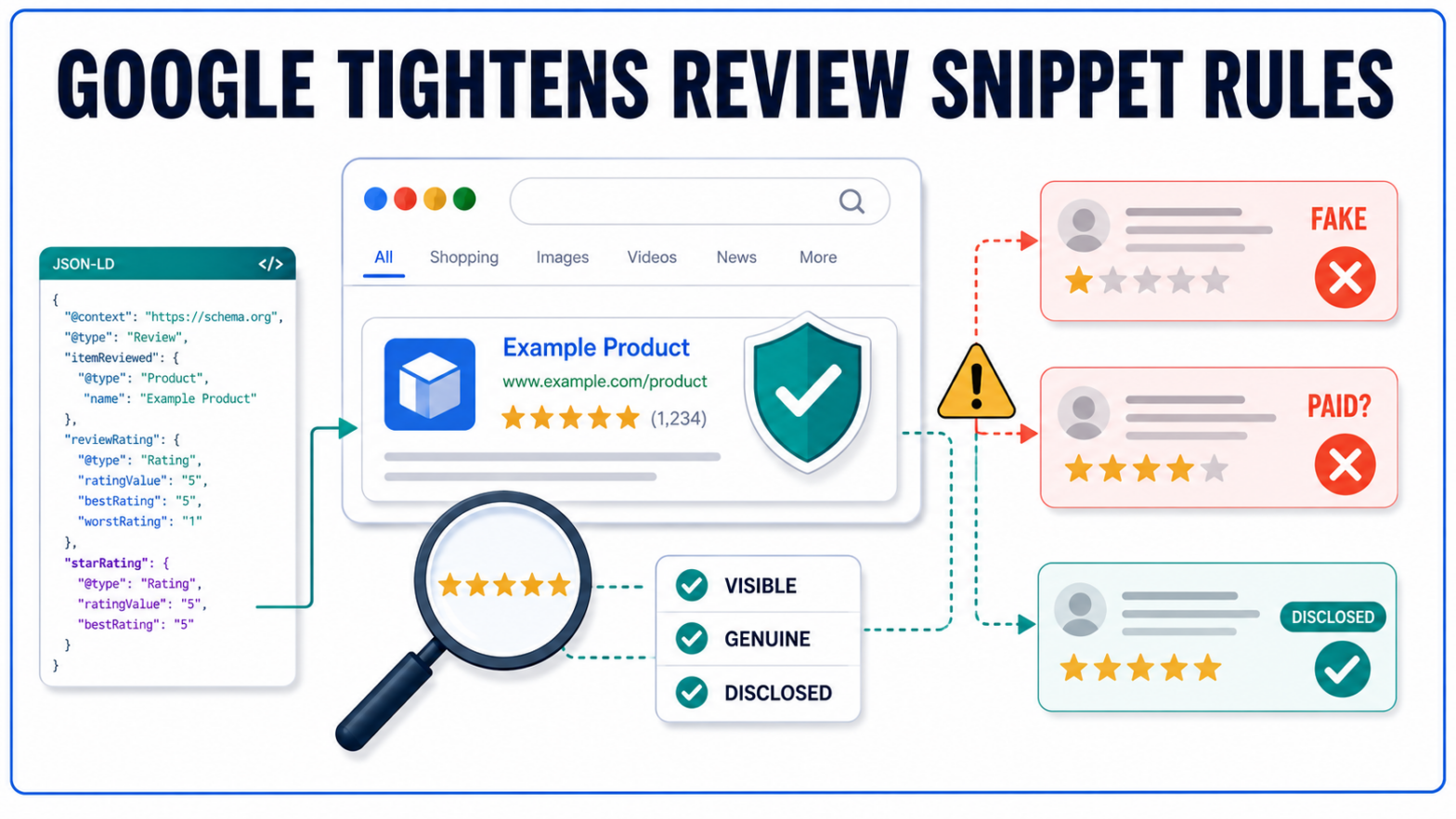
Star ratings in Google Search now come with a clearer trust condition: reviews cannot be fake, and paid or benefit-driven reviews cannot be hidden from users.
Google updated its review snippet structured data documentation on July 24, 2026, adding explicit language that sites should not include fake or undisclosed incentivized reviews on the page or inside structured data markup.
Review Markup Now Has A Clearer Trust Test
Google’s review snippet guidelines already required review content to be visible to users, tied to a specific item, and eligible under the supported schema types. The latest wording sharpens the quality side of that policy.
The new guidance says: “Don't include fake or undisclosed incentivized reviews” in page content or structured data markup.
Google lists two examples: reviews that are not based on a genuine product or service experience, and reviews written in exchange for money, discounts, vouchers, free products, or similar benefits when that incentive is not clearly and prominently disclosed.
That distinction matters.
Google is not saying all incentivized reviews are automatically barred from review snippet eligibility. The issue is undisclosed incentivization. If a review was influenced by compensation or a benefit, the incentive must be visible enough for users to understand the context behind the rating.
For brands, publishers, affiliates, ecommerce sites, and product review platforms, the update brings review markup closer to the broader direction of Google Search: structured data is not just a technical enhancement. It is a representation of content Google expects users to be able to verify on the page.
Structured Data Cannot Clean Up Weak Review Practices
Review snippet structured data can help Google understand ratings and display rich results, including star ratings and review summaries. But the markup does not create eligibility on its own.
Google’s documentation says the marked-up review content must be readily available to users on the same page. If a page uses AggregateRating, users should be able to see that aggregate rating. If it marks up individual reviews, users should be able to see the review text and rating.
That principle now extends more plainly to authenticity.
A five-star rating generated by a review campaign, seeded through a discount offer, or collected through a free-product program may create a compliance issue if the page presents it like an ordinary customer review. The same applies when structured data includes ratings that are not visible, not connected to real user experiences, or pulled from sources Google does not allow.
Google also repeats an older restriction: sites should not aggregate reviews or ratings from other websites. For local businesses and organizations, the rules are narrower still. If the business being reviewed controls reviews about itself, pages using LocalBusiness or Organization structured data are ineligible for the star review feature.
That keeps review snippets from becoming a self-published trust badge.
TechWyse has covered related structured data changes before, including Google’s removal of FAQ rich results and updates to merchant listing structured data. The pattern is consistent: Google continues to narrow rich result eligibility around content it can interpret with confidence.
Manual Actions Remain Part Of The Risk
The update is not only a best-practice note. Google’s review snippet page warns that sites violating structured data guidelines may face a manual action.
If that happens, the structured data on the affected page can be ignored, while the page itself may still appear in Google Search. Site owners can fix the issue and submit the site for reconsideration through Google’s manual action process.
That makes this update operationally important for SEO teams.
The Rich Results Test can confirm whether markup is technically valid, but Google notes that some structured data problems are not syntax issues. Fake reviews, undisclosed incentives, and spammy markup can pass a code validation check while still violating content guidelines.
For marketers and SEOs, the practical impact is straightforward: review snippet structured data now needs a content audit, not only a schema audit. Teams should check whether marked-up reviews are visible, specific, sourced from real users, and properly labelled when incentives were involved. Review collection workflows, ecommerce templates, affiliate review pages, product pages, and local business pages all need the same level of scrutiny.
Review Snippet Eligibility Still Depends On Specific Markup Rules
Google continues to support review snippets for several content types, including books, course lists, events, movies, products, recipes, software apps, and certain local business use cases. It also supports reviews for several Schema.org creative work types.
The review must still refer to a specific item, not a category or list of items. If multiple individual reviews are included, Google says the page should also include an aggregate rating of those reviews.
There are also field-level requirements. Review markup needs valid author information, and the reviewer name must be a real name rather than promotional text. Google gives “50% off until Saturday” as an example of a name that would not qualify.
Aggregate ratings also need to be handled carefully. If a site marks up an aggregate evaluation, it should use AggregateRating, and the rating value should follow Google’s expected numerical format. Decimal ratings should use a dot instead of a comma in structured data, even if the visible page uses another local display format.
These are technical details, but they sit inside a larger trust framework. Structured data markup is most useful when it accurately reflects what users can already see and understand on the page.
Google Is Drawing A Brighter Line Around Review Signals
The timing is notable because review signals remain valuable across ecommerce, local SEO, software, travel, and comparison content. Star ratings can influence attention in search results, even when rankings do not change.
Google’s update does not remove review snippets. It narrows the acceptable inputs behind them.
That puts more pressure on review systems that blend organic customer feedback with campaign-generated ratings. Incentivized reviews may still be usable when properly disclosed, but burying that disclosure in terms and conditions, email fine print, or off-page policy language is unlikely to satisfy the standard Google describes.
The documentation was last updated on July 24, 2026. Google has not attached a separate blog announcement to the change, but the revised guideline now sits inside the official Search Central requirements for review snippets and rich result eligibility.